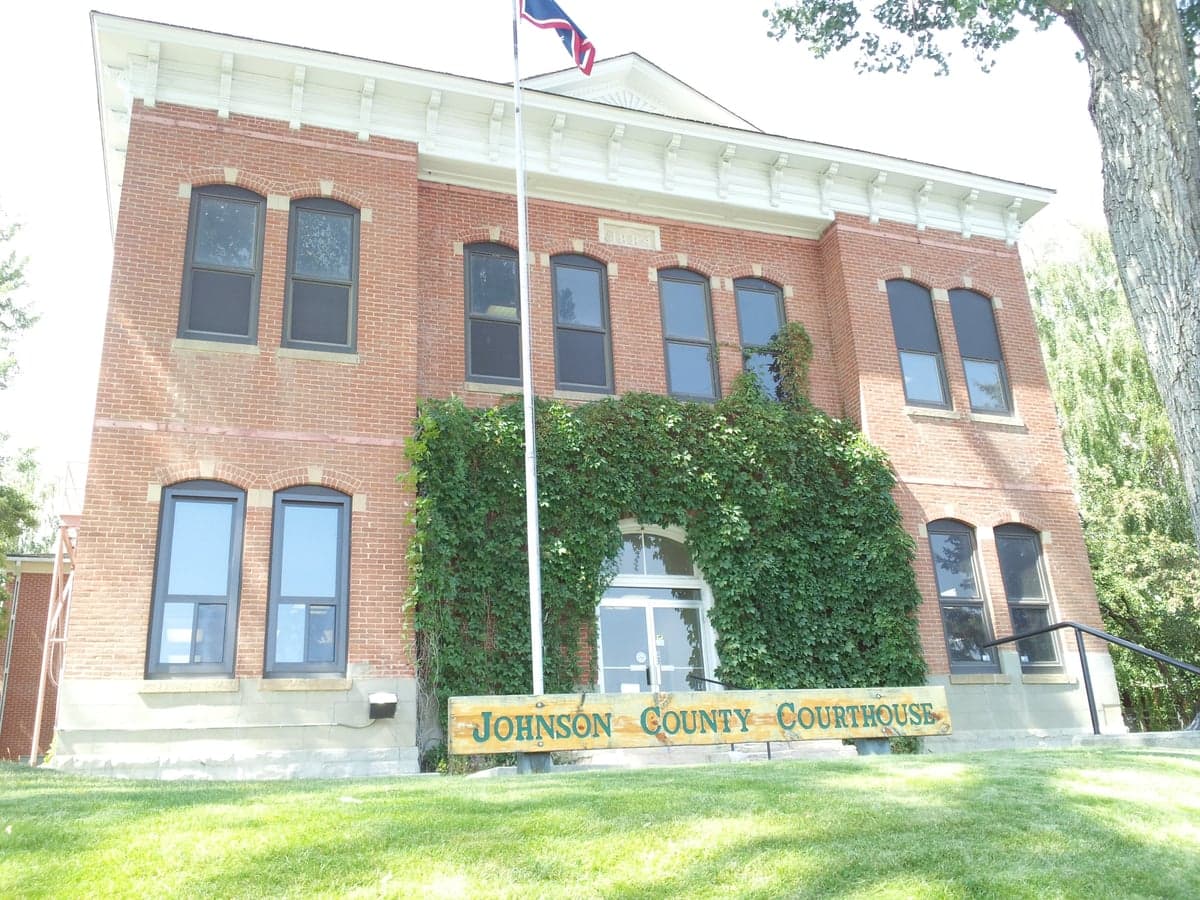
Photo: Wikipedia
Political ClimatePolitical Climate in Johnson County
Showing state-level results — no local-only data available.
Local Political AnalysisPolitical Analysis of Johnson County
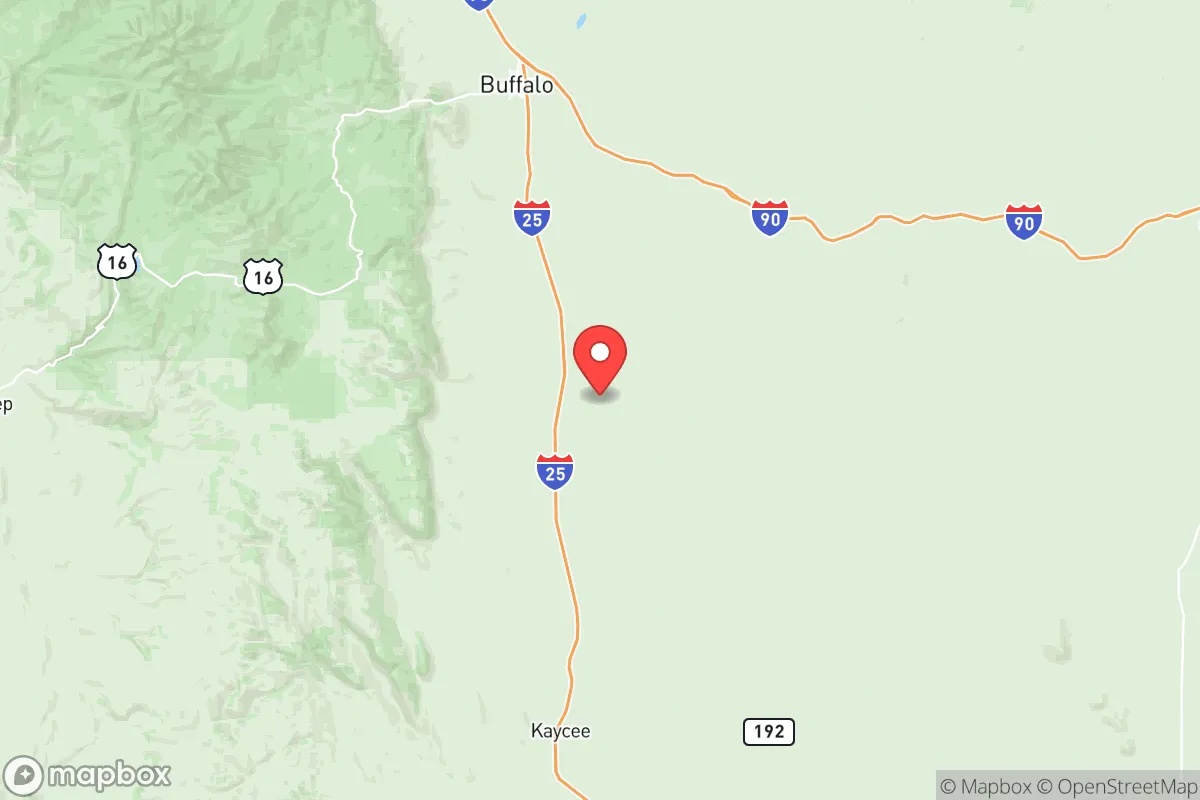
Johnson County, Wyoming, is one of the most reliably Republican counties in the state, with a Cook Partisan Voting Index (PVI) of R+23, meaning it votes about 23 points more Republican than the national average. This isn't a recent shift—the county has been a GOP stronghold for decades, with registered Republicans outnumbering Democrats by roughly 5 to 1. The county seat, Buffalo, anchors the conservative vote, while the smaller town of Kaycee leans even further right. There are no towns in Johnson County that lean blue; the closest thing to a swing precinct is the area around the town of Story, where a handful of independent and Democratic-leaning voters occasionally tip a local race, but even there, Republicans hold a comfortable majority. The trajectory is steady: the county's political lean has deepened slightly over the past decade, mirroring the broader trend in rural Wyoming, but without the dramatic swings seen in some suburban counties.
How it compares
Comparing Johnson County to the rest of Wyoming is a bit like comparing a conservative to a more conservative version of itself. The state of Wyoming as a whole is also deeply red—its Cook PVI is unknown, but it's widely considered one of the most Republican states in the nation, with a PVI likely around R+25 to R+30. Johnson County's R+23 is actually slightly less Republican than the state average, which might surprise people. That's because the state's PVI is pulled rightward by even more conservative counties like Sublette (R+35) and Lincoln (R+32). In practice, this means Johnson County is a solid Republican stronghold, but it's not the most conservative county in Wyoming. The difference is subtle: in Johnson County, you'll find a mix of ranching families, energy workers, and retirees, while in the state's most conservative counties, the economy is more heavily dominated by oil and gas extraction. Politically, Johnson County's representatives in the state legislature are reliably conservative, but they tend to be more focused on local issues like land use and water rights than on national culture wars.
What this means for residents
For conservative residents, Johnson County is a comfortable place to live. Local elections are almost always decided in the Republican primary, and the general election is a formality. The county commission, school board, and city councils in Buffalo and Kaycee are all dominated by Republicans. For liberal residents, the reality is different. They are a small minority, and their political views are rarely represented in local government. However, the political climate is not hostile in a personal sense—most people are neighborly, and political disagreements are usually handled with a "live and let live" attitude. The biggest practical impact is on policy: the county has low taxes, minimal regulation, and a strong emphasis on property rights and gun ownership. Social services are limited, and there is little public transportation. The local school system is well-funded by state standards, but curriculum decisions are made with a conservative bent.
Culturally, Johnson County is distinct from the rest of Wyoming in a few ways. The county has a strong ranching and Western heritage, and the annual Johnson County Fair and Rodeo in Buffalo is a major event. There's also a notable libertarian streak—residents tend to be skeptical of both federal and state government overreach, whether it's about land management or COVID-19 restrictions. This makes the county a bit more independent-minded than some of the more uniformly conservative counties in the state. In the long term, the political climate is likely to remain stable. The county's population is aging and slowly declining, which tends to reinforce existing political patterns. New residents are often retirees from other conservative states, so the political balance is unlikely to shift significantly in the next decade. For anyone moving to Johnson County, the key takeaway is that the politics are deeply conservative, but the culture is more about self-reliance than partisan conflict.

State Political ClimatePolitical Climate in Wyoming
State Political AnalysisPolitical Environment in the State
Wyoming is one of the most reliably Republican states in the nation, with a partisan lean that has only deepened over the past two decades. In the 2024 presidential election, Donald Trump carried the state by roughly 46 points, a margin that has grown from about 39 points in 2016 and 43 points in 2020. The dominant coalition is a mix of rural ranchers, energy-sector workers, and a growing number of conservative transplants from blue states, all united by a strong libertarian streak and deep skepticism of federal authority. While Democrats hold a small foothold in Teton County (home to Jackson) and parts of Laramie (home to the University of Wyoming), the state’s overall trajectory is solidly red, with no signs of a purple shift on the horizon.
Urban vs. rural divide
The political map of Wyoming is defined by a stark urban-rural split, but even the "urban" areas are small by national standards. The two largest cities, Cheyenne (Laramie County) and Casper (Natrona County), vote reliably Republican, though Cheyenne’s proximity to the state government and military bases gives it a slightly more moderate, establishment-Republican flavor. Laramie (Albany County) is the state’s most liberal enclave, driven by the university population, and has voted Democratic in recent presidential cycles. Jackson (Teton County) is the wealthiest and most left-leaning area, with a mix of second-home owners and service workers that has turned it into a Democratic stronghold. In contrast, the vast rural counties—like Sublette, Carbon, and Fremont—routinely deliver 80%+ Republican margins. The divide is less about culture war and more about economics: rural areas depend on extractive industries (oil, gas, coal, and ranching), while the urban pockets rely on tourism, education, and government services.
Policy environment
Wyoming’s policy environment is built on a foundation of low taxes, minimal regulation, and a hands-off approach to personal liberties. There is no state income tax, and the sales tax is capped at 4% (with local options adding up to 2%). Property taxes are among the lowest in the nation, with no tax on retirement income. The regulatory posture is aggressively pro-business, especially for energy and agriculture. Education policy is locally controlled, with school choice limited to charter schools and homeschooling; there is no voucher program, though a 2023 bill to create education savings accounts failed. Healthcare is a mixed bag: the state did not expand Medicaid under the ACA, leaving a coverage gap for low-income adults, but it has a robust network of rural health clinics. Election laws are straightforward: voter ID is required, same-day registration is not allowed, and mail-in voting is available with an excuse. The state has a closed primary system, meaning only registered Republicans can vote in the dominant GOP primary, which effectively decides most general elections.
Recent policy direction
Over the past five years, Wyoming has moved decisively toward a more assertive conservative agenda, particularly on cultural and liberty issues. In 2022, the legislature passed a near-total abortion ban (the "Life is a Human Right Act"), with exceptions only for rape, incest, and medical emergency. Gun laws are among the most permissive in the country: permitless carry was enacted in 2021, and the state has a strong "stand your ground" law. Parental rights in education were strengthened with a 2023 law requiring schools to notify parents of any curriculum involving sexuality or gender identity, and a 2024 law banned transgender athletes from female sports. On privacy and surveillance, Wyoming passed a data privacy law in 2023 that gives residents control over how companies use their personal data, but it has no statewide ban on facial recognition by law enforcement. Property rights are robust, with a 2022 law limiting the use of eminent domain for carbon pipelines. Voting access has tightened slightly: a 2021 law shortened the absentee ballot request window and required a notarized signature for mail ballots. The overall direction is toward maximizing individual freedom in the traditional sense—guns, property, and speech—while restricting it on social issues like abortion and transgender rights.
Civil unrest & political movements
Wyoming is not a hotbed of civil unrest, but it has a long history of organized political movements, particularly around land use and federal overreach. The "Sagebrush Rebellion" of the 1970s and 80s, which sought to transfer federal lands to state control, still echoes in local politics. In 2023, a group of activists in Fremont County (home to the Wind River Indian Reservation) staged a protest against a proposed wind farm, citing cultural and environmental concerns. Immigration politics are relatively quiet, as the state has a small foreign-born population (about 3%), but there have been symbolic resolutions opposing sanctuary cities. Election integrity controversies flared briefly after 2020, with a few county-level audits, but no major fraud was found. The most visible flashpoint for newcomers is the tension between long-time residents and wealthy out-of-state buyers, particularly in Teton County, where housing prices have skyrocketed. This has fueled a populist, anti-growth sentiment that crosses party lines, with both left-leaning housing advocates and right-leaning property rights groups opposing new development.
Projection
Over the next 5-10 years, Wyoming’s political trajectory is likely to remain deeply conservative, but with a growing libertarian-populist strain. In-migration from blue states, particularly to Jackson and Laramie, will continue to push those areas leftward, but the overall state population is aging and shrinking in rural counties, which reinforces the Republican base. The energy transition away from coal will be a major flashpoint: as coal jobs decline, expect more pressure on the state to diversify its economy, which could lead to a split between pro-fossil fuel traditionalists and a new wave of tech and tourism entrepreneurs. The legislature will likely continue to pass culture-war bills on education and transgender rights, but the real action will be on tax policy—specifically, whether the state can maintain its no-income-tax model as revenues from energy royalties decline. A new resident moving in now should expect a state that is politically stable but economically restless, where the biggest fights will be over land use, energy, and how to attract new residents without losing the character that drew them here.
For a new resident, the bottom line is this: Wyoming offers a political environment that is reliably conservative, with low taxes, strong gun rights, and a hands-off government on most personal matters. If you’re a conservative, you’ll find a welcoming community and a government that largely shares your values. If you’re a liberal, you’ll find small but vibrant enclaves in Laramie and Jackson, but you’ll need to accept that your vote will rarely matter in statewide elections. The practical takeaway is that Wyoming is a place where politics is less about daily life than in many states—people here are more concerned with the weather, the cost of living, and the next hunting season than with the latest legislative session. That’s the real draw for many: a state that mostly leaves you alone, for better or worse.
* Values derived from national, state, county, city and local statistics and may differ in a specific area. Last updated: 2026-07-12T21:35:52.000Z
Narrative content on this page is AI-generated and may contain mistakes. Verify any details that matter before acting on them.
ReloMaps may earn a commission from affiliate links at no extra cost to you.

