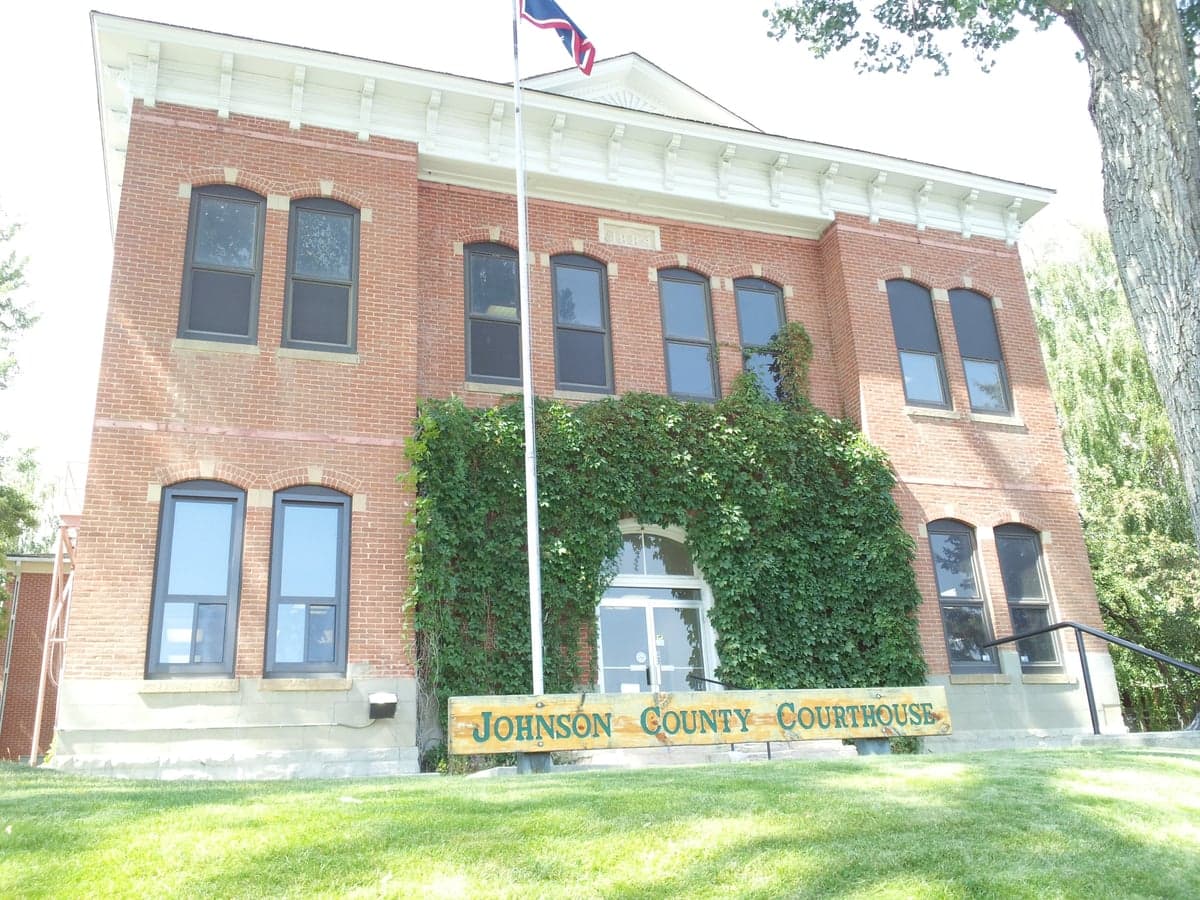
Photo: Wikipedia
Demographics of Johnson County
Affluence Level in Johnson County
A middle-class area roughly in line with national averages across income, home values, education, and employment.
People of Johnson County
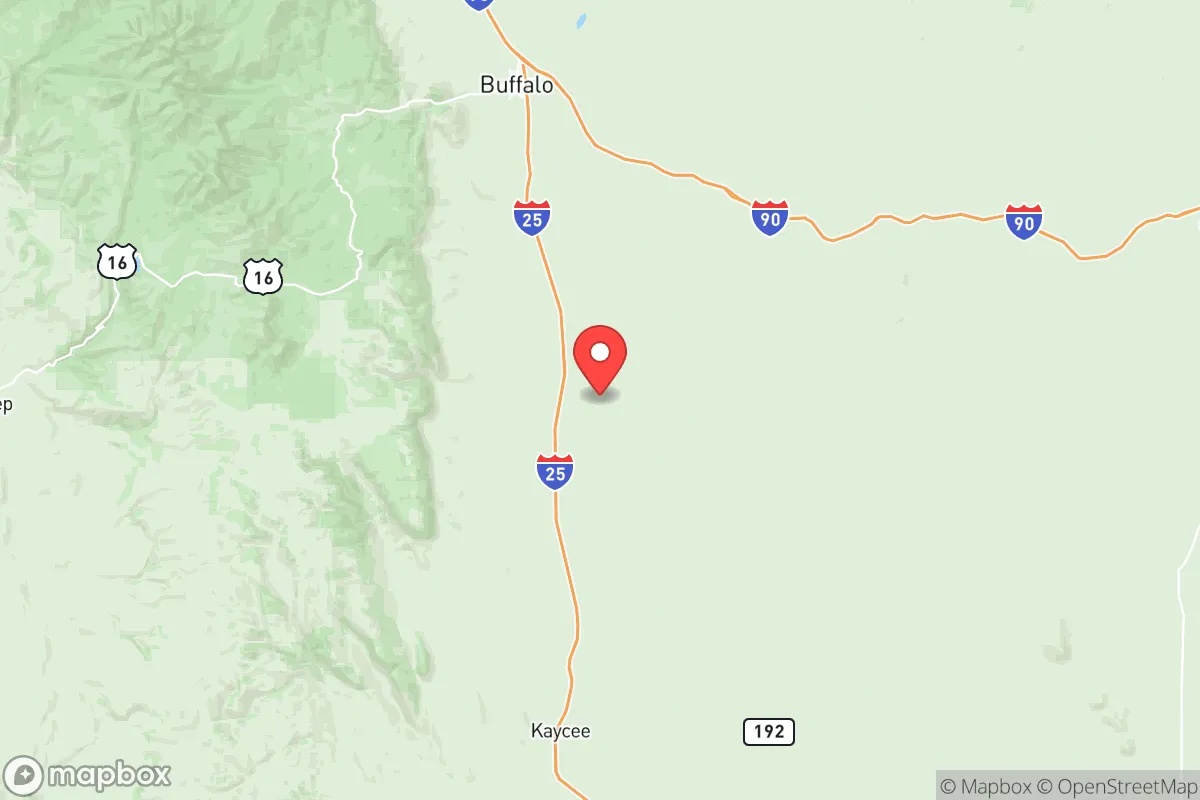
Johnson County, Wyoming, is home to roughly 8,600 residents, making it one of the state’s more sparsely populated areas, with a character defined by its deep ranching roots and a strong sense of frontier independence. The population is overwhelmingly White (90.2%) and native-born (only 1.1% foreign-born), with a small Hispanic community (4.2%) and a tiny Indian-subcontinent presence (0.5%). The county seat, Buffalo, serves as the cultural and economic hub, while the smaller town of Kaycee anchors the southern end of the county, both places where the legacy of the open range and the Johnson County War still shapes local identity.
Settlement & growth (pre-1960)
Long before European settlement, the area that is now Johnson County was part of the traditional territory of several Plains Indian nations, including the Crow, Cheyenne, and Lakota Sioux. These groups followed the vast bison herds across the Powder River Basin, and the region’s rivers—the Powder, the Clear Creek, and the Crazy Woman Creek—provided vital water sources. The first non-Native presence came with fur trappers and traders in the early 1800s, but permanent settlement did not begin until after the Bozeman Trail was established in the 1860s, which cut directly through the area and sparked conflict with the Lakota.
The real wave of American settlement arrived in the 1870s and 1880s, driven by the cattle boom. Ranchers from Texas and the Midwest drove herds north to graze on the open range, founding the town of Buffalo in 1879 as a supply point along the trail. The town of Kaycee followed in the 1890s, named after the KC Ranch, a major cattle operation. These early settlers were overwhelmingly of Anglo-American stock—primarily from the Midwest and the South—and they brought with them a culture of ranching, individualism, and suspicion of federal authority. This ethos exploded into the infamous Johnson County War of 1892, a range war between large cattle barons and smaller homesteaders that ended with the intervention of the U.S. Cavalry. The conflict cemented the county’s reputation as a place where local autonomy was fiercely defended.
Homesteading continued into the early 1900s, with the Enlarged Homestead Act of 1909 drawing a modest number of settlers to dryland farming, though the arid climate limited widespread agriculture. The railroad reached Buffalo in 1914, connecting the county to national markets and spurring modest growth. Unlike many parts of the West, Johnson County did not see large-scale immigration from European groups such as Germans, Scandinavians, or Italians; the population remained almost entirely native-born White, with a small number of Chinese laborers who worked on the railroad but did not form a lasting community. By 1960, the county’s population was just over 5,000, and its economy was almost entirely dependent on cattle ranching and some coal mining near the town of Monarch.
Modern era (post-1965)
The post-1965 era brought little demographic change to Johnson County, in stark contrast to the rest of the United States. The Hart-Cellar Act of 1965, which dramatically increased immigration from Asia and Latin America, had almost no effect here. The foreign-born population remains at just 1.1%, and the county’s racial composition has shifted only slightly. The Hispanic share grew from negligible levels in 1970 to 4.2% today, largely driven by a small number of families working in the ranching and oil-and-gas sectors. These Hispanic residents are dispersed throughout the county, with a slight concentration in Buffalo, where they work in construction, hospitality, and agricultural support.
The most significant domestic migration trend has been the arrival of retirees and second-home owners from Colorado and the Front Range, drawn by the county’s lower cost of living, wide-open spaces, and access to the Bighorn Mountains. This has led to modest suburban-style development around Buffalo, particularly along the Clear Creek corridor and near the base of the mountains. The town of Story, a small unincorporated community west of Buffalo, has seen a small influx of people seeking a rural lifestyle within commuting distance of Sheridan. The county’s population has grown slowly but steadily, from about 7,000 in 1990 to 8,602 today, with growth concentrated in Buffalo and its immediate outskirts.
The Indian-subcontinent community, while tiny at 0.5%, is a very recent arrival, consisting of a handful of professionals working in healthcare at the Johnson County Healthcare Center in Buffalo or in the energy sector. There is no established enclave; these residents are fully integrated into the broader community. The East/Southeast Asian population is effectively zero, and the Black population is statistically nonexistent. The county remains one of the least diverse in Wyoming, a fact that reflects both its remote location and its economic base in ranching and resource extraction, which have not attracted the immigrant labor pools seen in other parts of the country.
The future
Johnson County’s population is projected to continue its slow, steady growth, likely reaching around 9,500 to 10,000 by 2040. The primary drivers will be domestic migration from more expensive Western states—particularly Colorado, California, and the Pacific Northwest—as remote work and the desire for a slower pace of life bring new residents to the area. This influx will likely concentrate in and around Buffalo, where housing construction is already expanding, and along the Highway 16 corridor leading into the Bighorn Mountains. The town of Kaycee is less likely to see significant growth due to its distance from major amenities.
The county will remain overwhelmingly White and native-born for the foreseeable future. The Hispanic share may grow slowly, perhaps reaching 6-7% by 2040, as families continue to arrive for work in the energy and service sectors. The Indian-subcontinent community may grow slightly as healthcare and technical jobs expand, but it will remain a very small fraction of the population. The county is not becoming more diverse in any meaningful sense; rather, it is becoming slightly more populated by people who share the same cultural and political values as the existing residents. The cultural identity of the county—rooted in ranching, hunting, and self-reliance—is likely to persist, though tensions may emerge between long-time residents and newcomers who bring different expectations about land use and development.
For someone moving to Johnson County today, the area offers a stable, culturally homogeneous community with a strong sense of place and a low-crime, family-oriented environment. The population is not changing rapidly, and the county’s identity as a ranching and outdoor-recreation destination is likely to endure. New residents should expect to integrate into a community that values tradition, local knowledge, and a hands-on approach to life, rather than a place undergoing rapid demographic transformation.

* Values derived from national, state, county, city and local statistics and may differ in a specific area. Last updated: 2026-07-12T21:35:52.000Z
Narrative content on this page is AI-generated and may contain mistakes. Verify any details that matter before acting on them.
ReloMaps may earn a commission from affiliate links at no extra cost to you.

