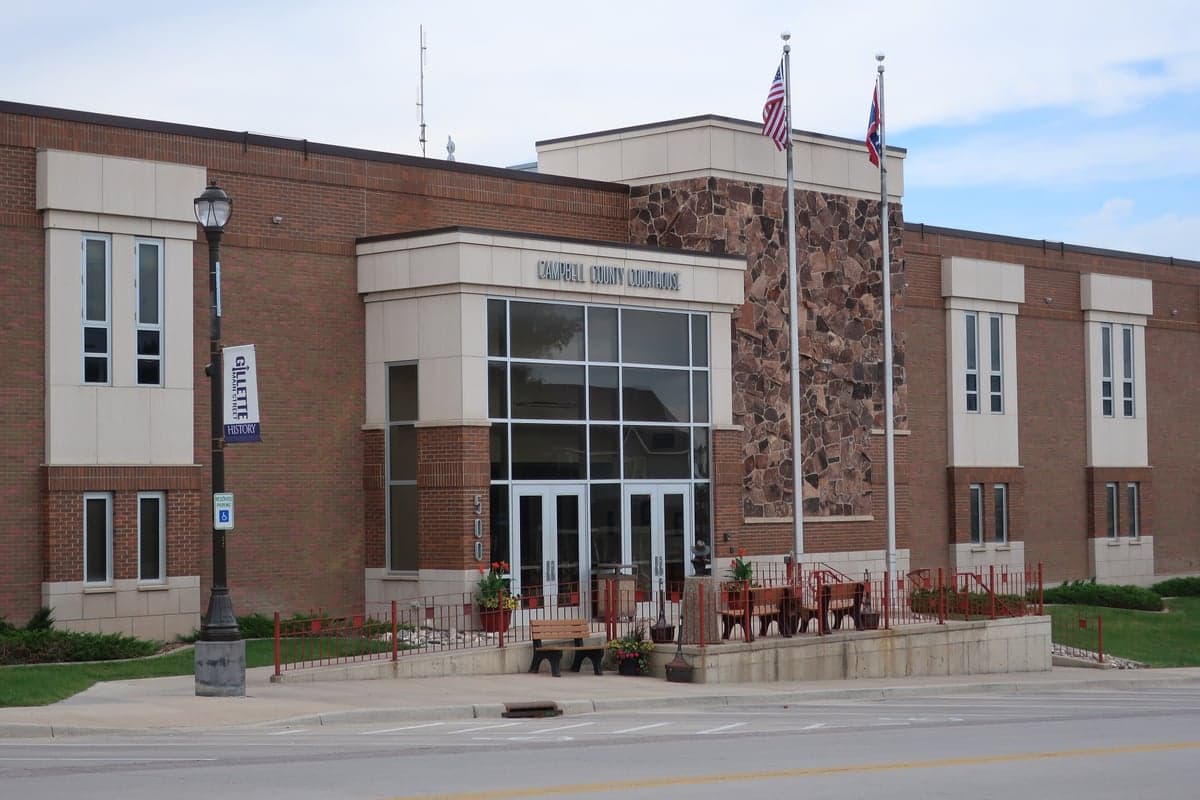
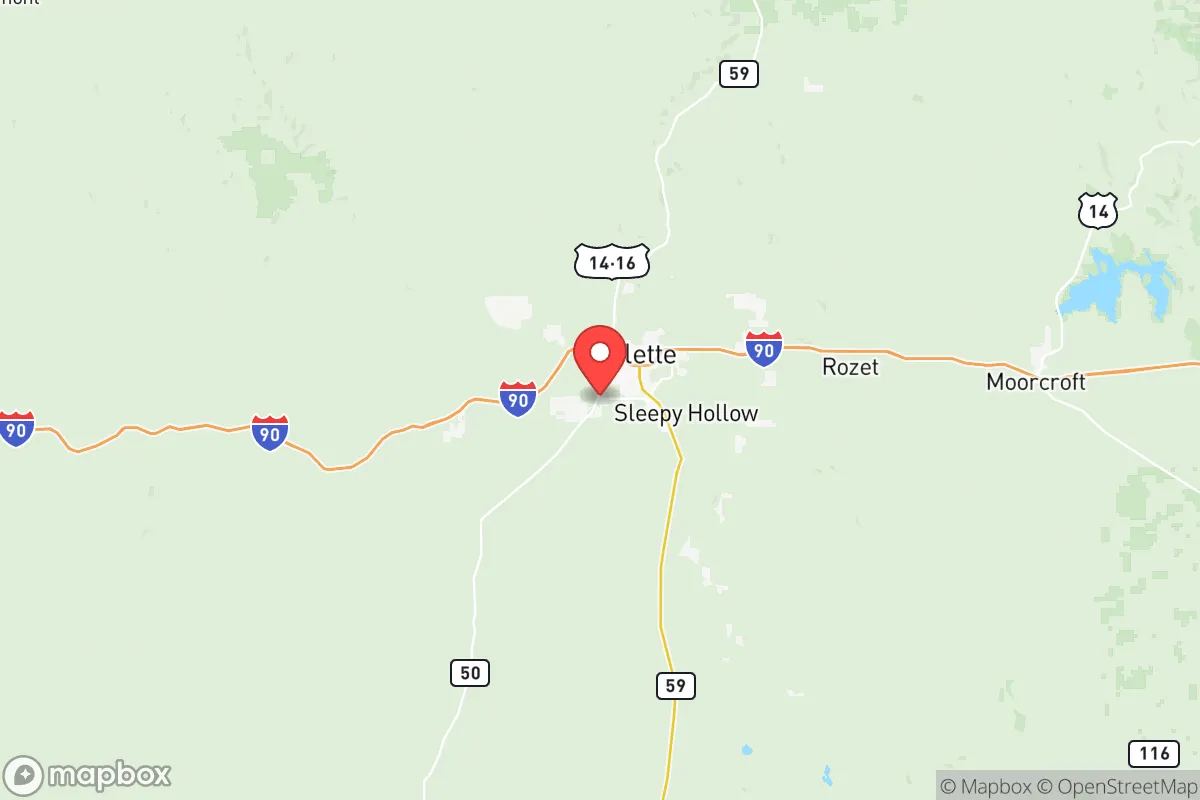
Photo: Wikipedia
Political ClimatePolitical Climate in Campbell County
Showing state-level results — no local-only data available.
Local Political AnalysisPolitical Analysis of Campbell County
Campbell County, Wyoming, is one of the most reliably Republican jurisdictions in the nation, carrying a Cook Partisan Voting Index (PVI) of R+23 — a score that places it among the top 5% of reddest counties in the United States. This isn't a recent shift; the county has voted for the GOP presidential candidate by margins exceeding 40 points in every election since 2000, with Donald Trump pulling over 80% of the vote in both 2020 and 2024. The political DNA here is deeply tied to the energy industry — coal, oil, and natural gas extraction dominate the local economy, and policy debates around federal land use, environmental regulation, and mineral rights are not abstract issues but daily realities. While the county seat, Gillette, is the only incorporated city and contains the bulk of the population, the political temperature varies noticeably between its neighborhoods and the surrounding unincorporated communities.
How it compares to Wyoming, WY
At first glance, Campbell County and the state of Wyoming appear politically identical — both carry a Cook PVI of R+23. But that surface-level match masks real differences in intensity and internal variation. Wyoming's R+23 is an average across 23 counties, some of which (like Teton County, home to Jackson Hole) lean Democratic, pulling the statewide number leftward. Campbell County, by contrast, has no such counterweight. In the 2024 primary, the county's Republican turnout was nearly 10 times higher than Democratic turnout, a ratio far more lopsided than the state as a whole. Within the county, the town of Wright — a small coal-mining community 40 miles south of Gillette — consistently votes 10-15 points more Republican than Gillette's more moderate west side precincts near the college and hospital. Meanwhile, the rural areas around Sleepy Hollow and the Powder River Basin are among the most conservative in the state, with precinct-level GOP vote shares regularly exceeding 90%. So while the PVI numbers match, Campbell County is a purer, more concentrated version of Wyoming's conservatism — less influenced by the tourist-driven liberalism of the state's western edge.
What this means for residents
For conservative residents, Campbell County offers a political environment where their values are the default — local school board meetings, county commission decisions, and even zoning debates tend to reflect a pro-business, limited-government ethos. The county commission has been entirely Republican for decades, and the Gillette City Council rarely sees a contested non-Republican race. For liberal or moderate residents, the reality is more isolating. There is no organized Democratic party presence in the county; the local party headquarters in Gillette operates on a shoestring budget and often struggles to field candidates for local office. Socially liberal residents — particularly younger professionals working in healthcare or education — often describe feeling politically invisible, though the growing presence of remote workers and renewable energy projects (like the nearby Carbon Creek wind farm) is slowly diversifying the political conversation. The practical effect is that policy debates here are less about left vs. right and more about which flavor of conservatism wins out — libertarian-leaning ranchers versus industry-aligned developers, for instance.
Culturally, Campbell County stands apart from the rest of Wyoming in its unapologetic embrace of extractive industry. While the state as a whole has a cowboy-and-open-range identity, Campbell County's identity is explicitly industrial — you see it in the constant truck traffic on Highway 59, the coal trains running through Gillette, and the fact that the county produces more energy than 40 individual states. This creates a distinct policy culture: the county's legislative delegation in Cheyenne is among the most aggressive in pushing back against federal environmental regulations, and local ordinances tend to favor mineral rights holders over surface landowners. For newcomers, the biggest adjustment isn't the politics themselves — it's how openly and consistently those politics shape every aspect of daily life, from the price of a gallon of gas to the topics discussed at a neighborhood barbecue.

State Political ClimatePolitical Climate in Wyoming
State Political AnalysisPolitical Environment in the State
Wyoming is the most reliably Republican state in the nation, with a Cook Partisan Voting Index of R+23, meaning it votes about 23 points more Republican than the country as a whole. The dominant coalition is a blend of rural ranchers, energy-sector workers, and libertarian-leaning conservatives who prize low taxes and minimal government interference. Over the past 10-20 years, the state has only grown more Republican, with Democrats virtually extinct at the state legislative level and no Democratic presidential candidate winning the state since Lyndon B. Johnson in 1964. However, this solid red veneer hides real internal tensions between the traditional extractive-industry base and a newer wave of remote workers and retirees drawn by the state’s wide-open spaces and lack of income tax.
Urban vs. rural divide
The political map of Wyoming is less about urban versus rural and more about energy versus tourism. The two largest population centers, Cheyenne (Laramie County) and Casper (Natrona County), are reliably Republican but slightly more moderate than the rest of the state. Cheyenne, as the state capital and home to F.E. Warren Air Force Base, has a significant government and military presence that tilts it toward establishment Republicans. Casper, historically an oil and gas hub, has seen its politics harden as the energy industry has come under federal pressure. The real deep-red strongholds are the rural counties like Sublette and Campbell (Gillette), where mining and drilling dominate the economy and voters routinely deliver 80%+ margins for GOP candidates. The one notable blue dot is Teton County (Jackson Hole), which is an outlier: a wealthy, tourist-driven enclave that votes Democratic in presidential elections by double digits. This creates a fascinating dynamic where the state’s most expensive real estate and most famous natural attractions are in a liberal pocket, while the rest of the state views Jackson Hole with a mix of economic envy and cultural suspicion. Laramie (Albany County), home to the University of Wyoming, is another small liberal-leaning area, though it’s far less wealthy and influential than Teton County.
Policy environment
Wyoming’s policy environment is defined by no state income tax, a low 4% state sales tax (with local options that can push it to 6%), and some of the lowest property tax rates in the country. The state’s revenue is heavily dependent on mineral extraction—coal, oil, natural gas, and trona—which makes the budget volatile and deeply tied to commodity prices. Education policy is locally controlled, with school districts given wide latitude, though the state has seen ongoing debates over school choice and funding for rural districts. Healthcare is a persistent challenge: Wyoming is one of the few states that has not expanded Medicaid under the Affordable Care Act, leaving a coverage gap for low-income adults. Election laws are relatively straightforward: voter ID is required, same-day registration is not available, and mail-in voting is allowed but not universal. The state has a strong tradition of ballot initiatives, including a recent successful measure to create a $10 million fund for election security audits. Gun laws are among the most permissive in the country: no permit is needed to carry a concealed firearm, and the state has a “stand your ground” law. There is no red flag law, and the state has passed a Second Amendment Preservation Act that purports to nullify federal gun restrictions.
Recent policy direction
Over the last five years, Wyoming has moved aggressively to assert state sovereignty and push back against federal authority. In 2021, the legislature passed a law creating a “Second Amendment Sanctuary State” designation, and in 2023 it enacted a near-total ban on abortion, with exceptions only for rape, incest, and medical emergencies. The state has also passed laws restricting transgender athletes from competing in school sports consistent with their gender identity and banning gender-affirming care for minors. On the education front, Wyoming has embraced school choice, including a 2024 law that expanded charter school access and created education savings accounts for families. Property rights have been strengthened with a 2022 law limiting the ability of local governments to regulate short-term rentals like Airbnb, a move that has reshaped housing markets in tourist towns like Jackson and Cody. On taxation, the state has resisted any move toward an income tax, instead relying on a mix of mineral royalties and sales taxes. Privacy and surveillance are areas where Wyoming is notably libertarian: the state has a law prohibiting warrantless drone surveillance and has rejected any form of vaccine passport or digital ID mandate. Voting access remains stable, with no major changes to early voting or mail-in ballot rules, though the state did tighten voter ID requirements in 2022.
Civil unrest & political movements
Wyoming is not a state known for large-scale protests, but it has a strong tradition of anti-federal activism. The Sagebrush Rebellion of the 1970s and 1980s, which demanded the transfer of federal lands to state control, remains a powerful undercurrent. In recent years, the most visible political movements have been around energy policy: in 2020, there were significant protests in Gillette against the Biden administration’s moratorium on new oil and gas leases on federal land. The “Yellow Vest” movement, which originated in Canada but found a foothold in Wyoming, has organized rallies in support of the energy industry. On the left, the most organized activism is in Jackson Hole, where environmental groups like the Sierra Club and local chapters of the Sunrise Movement have held protests against new development and fossil fuel extraction. Immigration politics are relatively quiet in Wyoming, as the state has a very small foreign-born population (around 3%), and there are no sanctuary city policies. Election integrity has been a flashpoint: after the 2020 election, the Wyoming Freedom Caucus pushed for a forensic audit of the state’s voting machines, which was ultimately conducted and found no irregularities, but the controversy deepened distrust among some conservative voters. There is a small but vocal secessionist movement, mostly online, that talks about Wyoming joining Idaho or forming a new “Greater Idaho” state, but it has no serious political traction.
Projection
Over the next 5-10 years, Wyoming will likely become even more Republican in terms of voting patterns, but the nature of that Republicanism is shifting. The old guard—moderate, pro-business, focused on energy extraction—is being challenged by a more populist, anti-establishment wing that is skeptical of corporate influence and more focused on cultural issues. The in-migration of remote workers, particularly to Teton County and the Laramie area, is slowly diversifying the economy and the electorate, but these new arrivals tend to be either wealthy conservatives who want lower taxes or wealthy liberals who want access to nature—neither group is likely to flip the state blue. The biggest wildcard is the energy transition: if coal continues to decline and oil and gas face long-term headwinds, the state’s budget will come under severe pressure, potentially forcing a conversation about a state income tax or major cuts to services. That could realign the political coalitions in ways that are hard to predict. For now, a new resident should expect a state that is deeply conservative, fiercely independent, and increasingly polarized between the libertarian-leaning rural majority and the small but vocal liberal minority in the tourist towns.
For someone moving to Wyoming, the bottom line is this: if you are conservative, you will find a state that largely aligns with your values on taxes, guns, and limited government, but you should be prepared for a political culture that is more libertarian than evangelical, with a strong streak of “leave me alone” individualism. If you are liberal, you will find small but active communities in Jackson and Laramie, but you should expect to be in the political minority in most of the state, with limited access to the policy outcomes you might prefer. The practical takeaway is that Wyoming’s politics are stable, predictable, and unlikely to surprise you—what you see is what you get, and what you get is a state that has been red for generations and intends to stay that way.
* Values derived from national, state, county, city and local statistics and may differ in a specific area. Last updated: 2026-06-28T11:44:25.000Z
Narrative content on this page is AI-generated and may contain mistakes. Verify any details that matter before acting on them.
ReloMaps may earn a commission from affiliate links at no extra cost to you.

