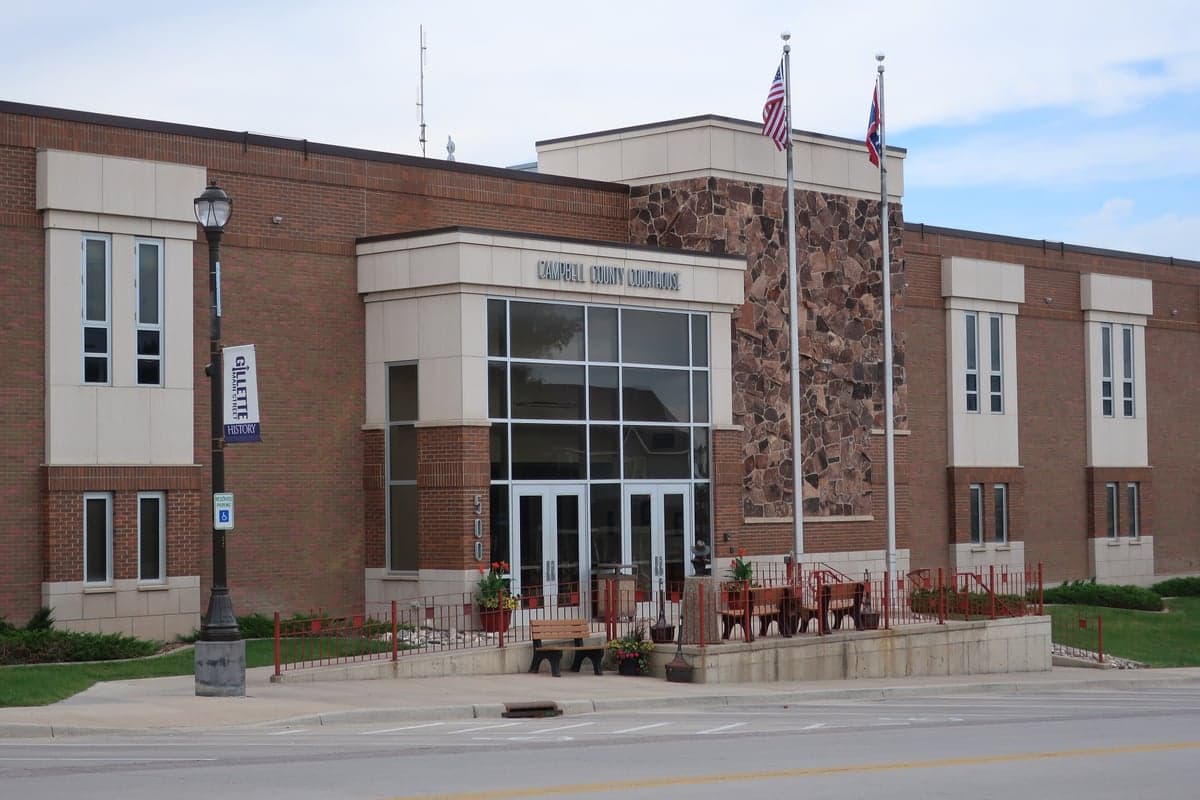
Photo: Wikipedia
Personal Sovereignty in Campbell County
Viable for self-reliance. Generally workable, though some barriers may limit total independence.
What does Personal Sovereignty tell us?
Personal Sovereignty measures your capacity for self-reliance and independence with minimal government friction. Higher scores mean fewer barriers between you and the way you want to live... but it assumes you have the space you need and good neighbors.
What does this tell us?
Personal Sovereignty measures your capacity for self-reliance and independence with minimal government friction. Higher scores mean fewer barriers between you and the way you want to live... but it assumes you have the space you need and good neighbors.
State Policy
Energy independence: Net exporter (800% of energy produced in-state)
Personal Liberty
Homesteading

Personal Liberty Analysis
Campbell County, Wyoming, offers one of the strongest personal sovereignty environments in the Rocky Mountain region, anchored by Wyoming’s low-tax, limited-government ethos and a deeply ingrained culture of self-reliance. The county’s regulatory posture is light-touch across the board, with no state income tax, minimal property tax burdens, and a legal framework that prioritizes individual autonomy over collective mandates. For a relocation audience valuing personal freedom, the area presents a compelling mix of constitutional protections, practical self-defense laws, and viable off-grid living options, though the degree of autonomy varies between the county’s urban hub of Gillette and its more rural outposts like Wright, Rozet, and the unincorporated communities along the Powder River Basin.
Tax burden and regulatory posture: how Campbell County compares to surrounding areas
Wyoming’s tax structure is among the most favorable in the nation for individuals and families seeking to keep more of their earnings. Campbell County residents pay no state personal income tax, no corporate income tax, and no inventory tax on business assets. Property taxes are assessed at a low effective rate—roughly 0.6% of market value on residential property—and the county’s mill levy is among the lowest in the state. Sales tax in Campbell County is 5.5% (4% state, 1% county, 0.5% optional), which is moderate but still below the national average. Regulatory oversight is minimal: there are no county-level building codes in unincorporated areas, no zoning in most rural sections, and no state-mandated energy codes for single-family homes. The city of Gillette does enforce a basic building permit system for new construction and major renovations, but the process is streamlined compared to jurisdictions in Colorado or Montana. In contrast, the town of Wright (population ~1,800) operates with even lighter regulation, often allowing owner-built structures with minimal inspection. The county’s regulatory posture is best described as "permissive but not lawless"—environmental and land-use rules exist but are rarely enforced against individual property owners.
Self-defense and gun law specifics: what the Second Sanctuary status means for residents
Campbell County is a designated Second Amendment Sanctuary, and Wyoming as a whole is a constitutional carry state. No permit is required to carry a concealed firearm for any law-abiding adult 21 or older (18 for open carry). The state preempts all local firearm ordinances, meaning Gillette, Wright, and the unincorporated areas like Rozet and Sleepy Hollow cannot enact their own gun restrictions. Stand-your-ground and castle doctrine laws are fully codified in Wyoming statutes (W.S. 6-2-602), with no duty to retreat in any place where a person is lawfully present. Use of deadly force is presumed reasonable if an intruder has unlawfully entered a dwelling or occupied vehicle. The county sheriff’s office in Gillette is known for a pro-Second Amendment stance, and concealed carry permits (optional for reciprocity with other states) are issued on a shall-issue basis with a turnaround time of 30–45 days. For residents who travel frequently, the Wyoming permit is recognized in 37 states. The practical effect for Campbell County residents is that self-defense planning is straightforward: legal carry is unrestricted, and defensive use of force is protected by clear, predictable statutes.
Self-reliance and homesteading viability: lot sizes, zoning, and off-grid feasibility
Campbell County is one of the most homestead-friendly areas in the West for those seeking self-reliance. Outside of Gillette’s city limits, there is no county-wide zoning in unincorporated areas, and minimum lot sizes for rural parcels are typically 35 acres in agricultural zones, though smaller parcels (5–10 acres) are common in subdivisions like Rozet Ranchettes and Sleepy Hollow Estates. Off-grid living is fully legal: Wyoming has no state law requiring connection to a municipal power grid or water system. Residents in areas like Wright, Reno Junction, and the Powder River Basin routinely use solar panels, wind turbines, propane generators, and rainwater catchment systems. Well drilling is permitted with a simple state permit (around $200), and septic systems require a county health department inspection but no onerous engineering review. The county’s arid climate (12–14 inches of annual precipitation) makes rainwater harvesting practical for supplemental use, though full self-sufficiency requires a reliable well. Zoning in Gillette itself is more structured—minimum lot sizes of 6,000–8,000 square feet in residential zones, with building permits required—but the city’s code explicitly allows backyard chickens, small-scale gardening, and limited livestock on larger lots. For serious homesteaders, the unincorporated areas around Rozet and the Belle Fourche River valley offer the most freedom, with no HOA restrictions and minimal county oversight.
Personal liberties: parental rights, medical autonomy, speech, and property protections
Wyoming law provides strong protections for parental rights, including a statutory presumption that parents have the fundamental right to direct their children’s upbringing, education, and healthcare. Campbell County School District (covering Gillette, Wright, and rural schools) does not mandate COVID-19 vaccines or masks for students, and parental opt-out provisions for sex education and health screenings are clearly defined. Medical autonomy is similarly robust: Wyoming has no state-level vaccine mandate for adults, and the state’s 2023 "Right to Try" law allows terminally ill patients access to experimental treatments without FDA approval. Speech protections are reinforced by Wyoming’s lack of a state-level hate speech law, and the county’s conservative culture generally supports unfettered political expression. Property rights are among the strongest in the nation, with Wyoming’s "Private Property Rights Protection Act" requiring government agencies to conduct a takings analysis before any regulation that could diminish property value. In practice, this means Campbell County residents face little risk of eminent domain abuse or regulatory overreach on land use. The county’s planning department in Gillette is known for a "yes, if" rather than "no, because" approach to development permits, and property owners in areas like Antelope Valley and the Little Powder River corridor routinely build without interference.
Overall, Campbell County ranks among the top 10% of U.S. counties for personal sovereignty, combining Wyoming’s constitutional protections with a local culture that actively resists federal and state overreach. The tax burden is negligible, self-defense laws are unambiguous, and off-grid living is not just tolerated but normalized. Compared to neighboring states—Montana’s recent property tax increases, Colorado’s gun restrictions, or South Dakota’s sales tax creep—Campbell County offers a more consistent, low-friction environment for those who prioritize autonomy. The only trade-off is the county’s reliance on energy extraction (coal, oil, gas), which creates economic cycles that some may find constraining, but for the sovereignty-minded individual or family, the regulatory and legal landscape is as free as it gets in the continental United States.

* Values derived from national, state, county, city and local statistics and may differ in a specific area. Last updated: 2026-06-28T11:44:25.000Z
Narrative content on this page is AI-generated and may contain mistakes. Verify any details that matter before acting on them.
ReloMaps may earn a commission from affiliate links at no extra cost to you.

