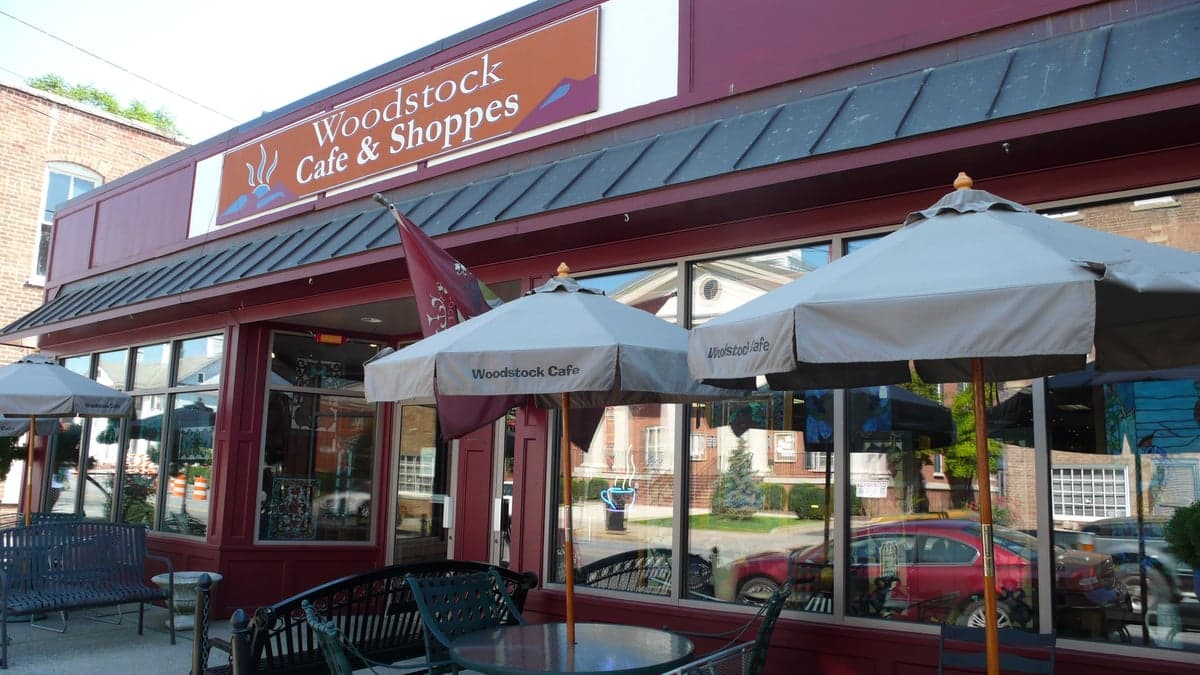
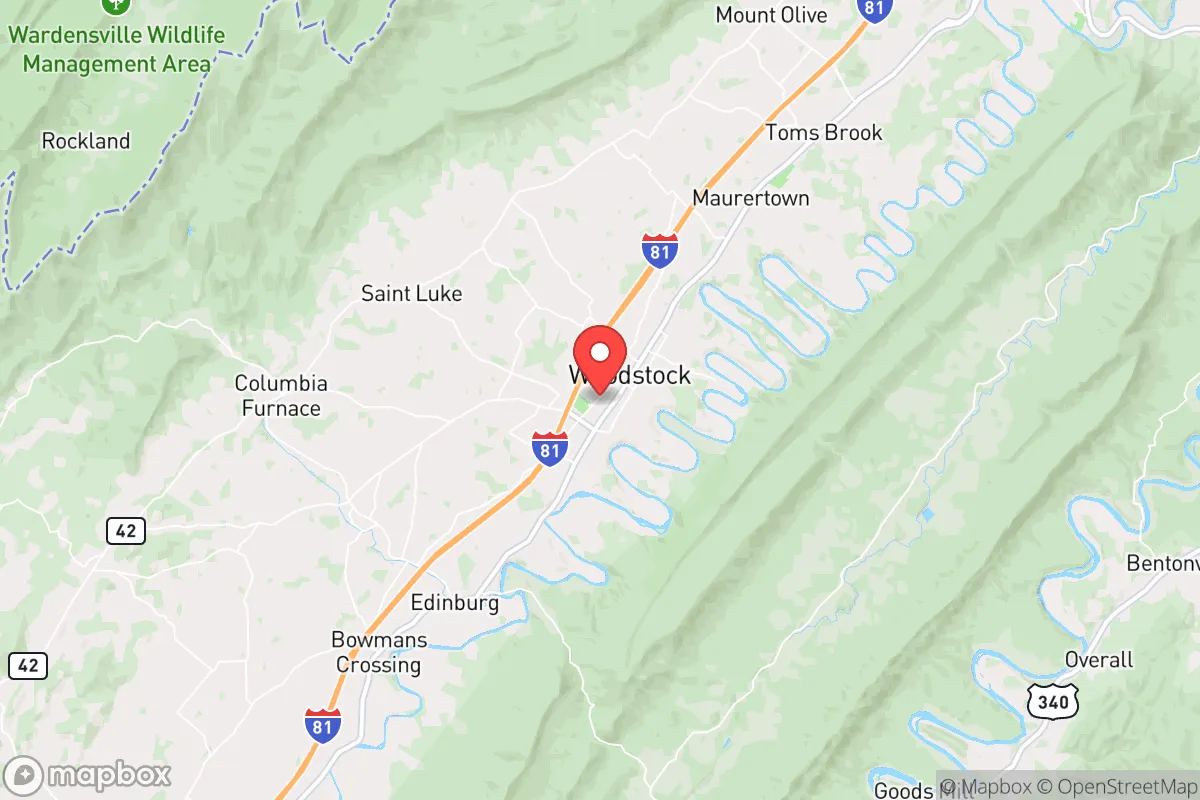

Photo: Wikipedia
Political ClimatePolitical Climate in Woodstock, VA
District shown is the primary district for this city’s centroid. Cities may span multiple districts.
Inherited from parent state — no local data available.
Local Political AnalysisPolitical Analysis of Woodstock, VA
Woodstock, Virginia, sits in a reliably conservative corner of the Shenandoah Valley, carrying a Cook PVI of R+12. That’s a solidly Republican district, and it’s been that way for as long as most folks around here can remember, though the flavor of that conservatism has shifted some over the years. The broader state of Virginia, by contrast, is now a D+4 lean, which tells you just how much the political gravity has moved toward the urban crescent in Northern Virginia and Richmond since the early 2000s.
How it compares
The gap between Woodstock and the rest of Virginia isn’t just a number—it’s a lived reality. When you drive 90 minutes east to places like Fairfax or Arlington, you’re in a completely different political universe, one where Democrats routinely win 70% of the vote. Even closer to home, the contrast is stark: Harrisonburg, about 30 minutes south, has trended blue in recent cycles thanks to James Madison University’s student population, while Winchester to the north has become a genuine swing city. Woodstock, though, has stayed true to its rural, agricultural roots. Shenandoah County as a whole hasn’t voted for a Democratic presidential candidate since Lyndon Johnson in 1964, and that streak shows no sign of ending. The 2024 results were typical—Republicans carried the county by a comfortable double-digit margin, mirroring the R+12 PVI almost exactly.
What this means for residents
For conservative residents, living in Woodstock means your vote carries real weight in local elections. The Board of Supervisors, the school board, and the circuit court judgeships are all reliably Republican, so the primary election in June is often the real contest. You’ll see more Trump and Youngkin signs than anything else on the lawns along Main Street, and the local GOP committee is active and organized. For liberal residents, it’s a different story. You’re likely in the minority, and you’ll know it—but it’s not hostile. There’s a quiet tolerance here, a “live and let live” attitude that’s part of the Valley’s character. Democrats do hold some seats on the school board, and the county’s small but vocal Democratic committee keeps showing up to meetings, even when they lose 6-1 votes. The practical effect is that policy here skews conservative: low taxes, a strong sheriff’s office presence, and a school system that’s cautious about curriculum changes. But it’s not a place where political differences end friendships.
What daily life is like for families
Day-to-day, politics doesn’t dominate the way it does in the suburbs. People are more likely to talk about the apple harvest, the high school football team, or the new brewery on the edge of town. The biggest local controversies in recent years have been about data centers and solar farms—development issues that cut across party lines. Some conservatives oppose them for environmental reasons, while some liberals support them for economic growth. That’s the kind of nuance you get in a small town. The trajectory, though, is worth watching. Shenandoah County is growing slowly, and as more remote workers and retirees move in from Northern Virginia, the political math could shift a point or two. But don’t expect Woodstock to turn blue anytime soon. The R+12 lean is baked into the culture here—it’s about hunting, church, and family, not just party affiliation. For now, it remains one of the most reliably conservative small towns in a state that’s increasingly purple.

State Political ClimatePolitical Climate in Virginia
State Political AnalysisPolitical Environment in the State
Virginia has drifted from a reliably competitive swing state to a solidly Democratic-leaning one, carrying a Cook PVI of D+4 after a decade of demographic and geographic sorting. The state’s politics are now defined by a stark urban-rural chasm, with the sprawling D.C. suburbs of Northern Virginia and the revitalized cities of Richmond and Hampton Roads overpowering the conservative strongholds of the Shenandoah Valley and Southside. For a relocator, this means you are moving into a state where state government is firmly in Democratic hands, but where local control and a strong libertarian streak still offer breathing room for conservatives in the right county.
Urban vs. rural divide
The political map of Virginia is essentially a tale of two commonwealths. The engine of Democratic dominance is Northern Virginia, anchored by Fairfax County, Loudoun County, and Prince William County. These jurisdictions, once suburban Republican bastions, have transformed into dense, diverse, and highly educated communities that now deliver margins of 30 to 40 points for Democrats. Loudoun County, in particular, flipped hard after 2016, driven by an influx of federal contractors and tech workers who prioritize education funding and transit. The cities of Richmond and Norfolk, along with college towns like Charlottesville and Blacksburg, add to the urban coalition, while the Hampton Roads region’s military-heavy population remains more competitive but leans blue in presidential years.
Conversely, the rural west and south are deeply Republican. The Shenandoah Valley, anchored by Harrisonburg and Staunton, votes red by wide margins, as do the Southside counties along the North Carolina border, including Danville and Martinsville. These areas are culturally and economically distinct from the D.C. orbit, relying on agriculture, manufacturing, and timber. The 2021 gubernatorial race showed this divide clearly: Republican Glenn Youngkin won by sweeping the rural crescent and the outer suburbs, but he lost the populous inner suburbs and cities. A new resident should understand that a 45-minute drive from Richmond to the west can feel like a different political universe, with local sheriffs, school boards, and zoning boards often controlled by conservatives even in blue-leaning regions.
Policy environment
Virginia’s policy environment is a mixed bag that reflects its purple-to-blue trajectory. The state income tax is a flat 5.75%, which is moderate by national standards, and the sales tax is 5.3% (higher in some localities). Property taxes are set locally, leading to wide variation: Loudoun County rates are relatively low, while Richmond city rates are higher to fund urban services. The regulatory posture is business-friendly in the tech and data-center sectors — Northern Virginia is the data center capital of the world — but stricter on energy and environmental permitting than neighboring North Carolina or West Virginia.
Education policy is a flashpoint. Virginia’s public schools are funded through the Standards of Quality formula, but the state has seen fierce battles over curriculum and parental rights. The state does not have a robust school choice program; charter schools are limited, and there is no universal voucher system, though a small pilot program exists. Healthcare is a bright spot for liberals: Virginia expanded Medicaid under the Affordable Care Act in 2019, and the state has strong protections for pre-existing conditions. Election laws are moderate — no-excuse absentee voting and same-day registration are available, but voter ID is required, and the state does not have automatic voter registration.
Recent policy direction
The last five years have seen whiplash-inducing shifts. Under Governor Glenn Youngkin (2022-2026), the state moved right on several fronts: he signed a bill eliminating the state’s grocery tax, pushed for a 1% income tax rate cut, and championed a "Parents Matter" agenda that led to new model policies on transgender student participation in sports and parental notification for curriculum changes. However, the Democratic-controlled legislature blocked his proposed 15-week abortion ban, and the state remains a relative safe haven for abortion access in the South, with the procedure legal up to 26 weeks.
On guns, Virginia is a study in contrasts. It is a shall-issue state for concealed carry permits, and permitless carry was signed into law by Youngkin in 2024, making Virginia one of the more permissive states in the mid-Atlantic. Yet, the state also has a "red flag" law, passed in 2020, that allows courts to temporarily seize firearms from individuals deemed a threat. Property rights are generally strong, with no statewide rent control, but localities in Northern Virginia have imposed inclusionary zoning mandates. On privacy, the Virginia Consumer Data Protection Act (2021) gives residents control over their personal data, a rarity in the South. Ballot access is straightforward, but the state has no independent redistricting commission — a bipartisan commission was created in 2020 but failed to agree, leaving map-drawing to the courts.
Civil unrest & political movements
Virginia has been a flashpoint for national political movements. The 2017 "Unite the Right" rally in Charlottesville, which turned violent, left a lasting scar and made the city a symbol of racial tension. Since then, the state has seen organized progressive activism around racial justice and abortion rights, particularly in Richmond, where a large statue of Robert E. Lee on Monument Avenue was removed in 2021 after years of legal battles. On the right, the "Parents Matter" movement, fueled by school board controversies in Loudoun County, has been the most visible organizing force, leading to the 2021 Republican sweep of statewide offices.
Immigration politics are relatively quiet compared to border states, but Northern Virginia has several sanctuary-adjacent policies — Fairfax County and Alexandria limit cooperation with federal immigration enforcement. The state’s election integrity has been a subject of debate; the 2020 election saw no widespread fraud, but Republican activists have pushed for stricter voter roll maintenance, leading to a 2024 lawsuit over the removal of non-citizens from voter lists. A new resident will notice the political energy is less about street protests and more about school board meetings and county supervisor races, which are genuinely competitive in the outer suburbs.
Projection
Over the next decade, Virginia’s Democratic lean is likely to solidify, but not uniformly. The in-migration pattern is telling: the state gains residents from the Northeast and California, who settle overwhelmingly in Northern Virginia and Richmond, while domestic out-migration to the Carolinas and Florida is dominated by conservatives from the rural south. This sorting will push the PVI further left, possibly to D+6 or D+7 by 2032. However, the state’s political culture is not California-style progressivism. The Democratic coalition here is moderate, fiscally cautious, and heavily influenced by federal employees who favor competent governance over radical change.
For conservatives, the realistic future is one of permanent minority status at the statewide level, but with continued strength in local government and the ability to win statewide races in off-years when turnout drops, as Youngkin proved. The rural-urban divide will widen, and the state will likely see continued fights over school funding formulas and land use, with the growing urban population demanding more density and transit while rural areas resist. A relocator moving in now should expect a state that is politically competitive only in the margins — the real action will be in primaries and local races, not general elections.
For a new resident, the bottom line is that Virginia offers a politically bifurcated experience. If you are conservative, you can find a welcoming, affordable community in the Shenandoah Valley or Southside, where your vote matters locally and your values are reflected in county policy, even if the statehouse ignores you. If you are liberal, the urban crescent offers a progressive environment with strong public services and a dynamic economy. The state’s tax burden is moderate, its schools are above average, and its job market is robust, especially in tech and defense. Just know that your political experience will be shaped less by the state flag and more by the zip code you choose — and that the two Virginias are not likely to reconcile anytime soon.
* Values derived from national, state, county, city and local statistics and may differ in a specific area. Last updated: 2026-10-26T03:41:00.000Z
Narrative content on this page is AI-generated and may contain mistakes. Verify any details that matter before acting on them.
ReloMaps may earn a commission from affiliate links at no extra cost to you.

