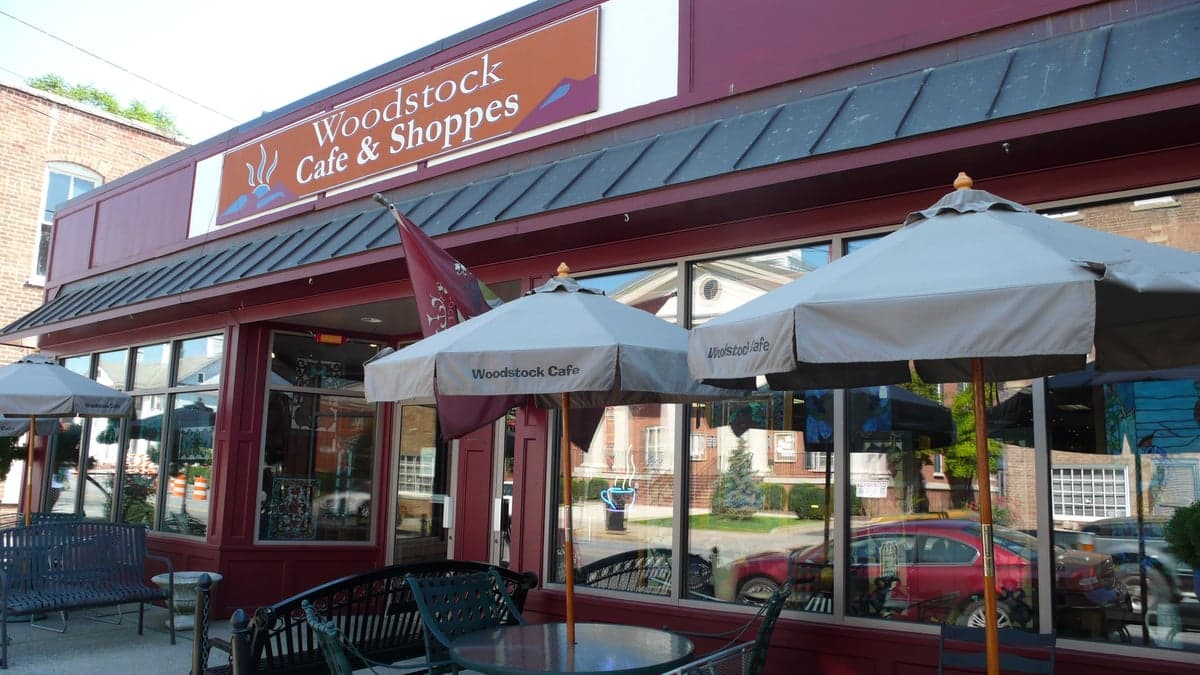
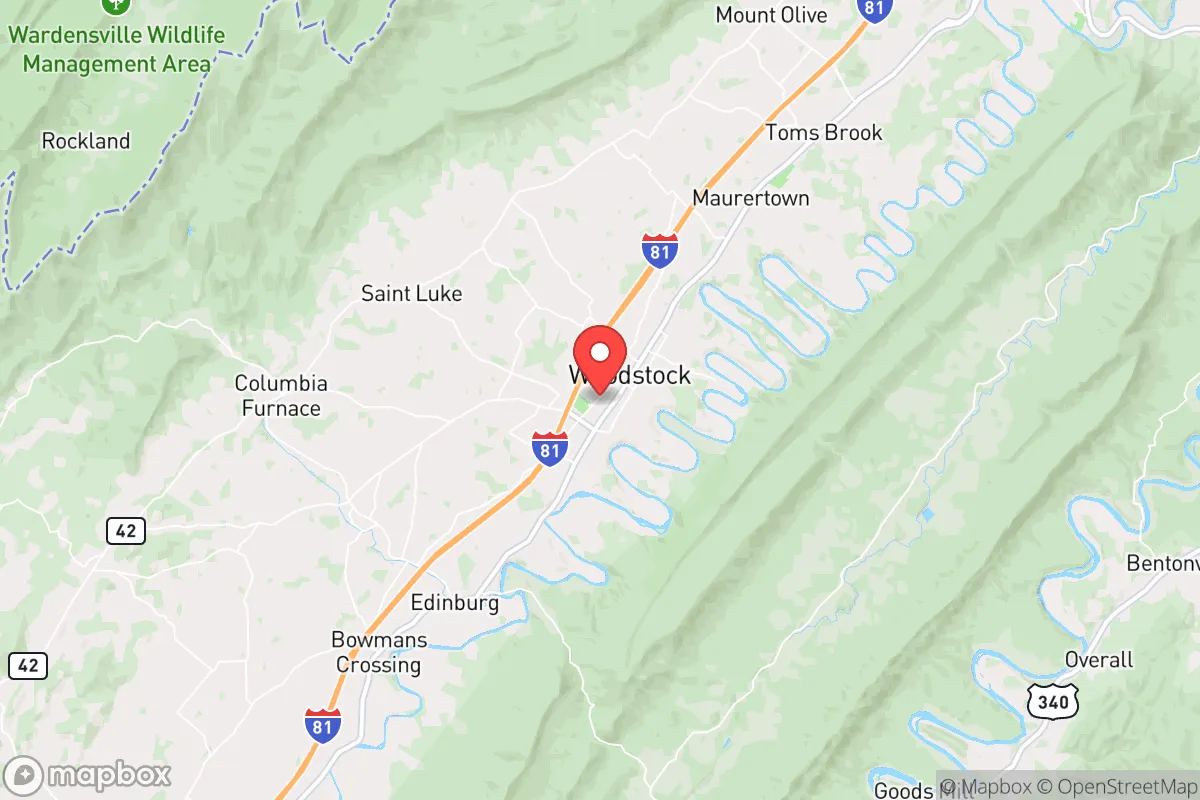
Photo: Wikipedia
Demographics of Woodstock, VA
Affluence Level in Woodstock, VA
A below-average socioeconomic profile. Incomes, home values, and educational attainment trail the U.S., with higher poverty and unemployment.
People of Woodstock, VA
Woodstock, Virginia, is a small Shenandoah Valley town of 5,851 residents with a distinctly working-class and increasingly diverse character. The population is roughly 68.8% White, 19.7% Hispanic, 6.8% Black, and 4.6% East/Southeast Asian, with 7.3% of residents foreign-born. A modest 24.4% of adults hold a college degree, reflecting a community rooted in trades, agriculture, and local services rather than white-collar industries. The town's identity is a blend of deep German-Swiss heritage, a growing Latino workforce, and a quiet Appalachian independence that still shapes daily life.
How the city was settled and grew
Woodstock was founded in 1761 by German and Swiss immigrants who pushed south from Pennsylvania along the Great Wagon Road, drawn by fertile limestone soils and the promise of cheap land. The original settlers were largely Lutheran and Reformed farmers, and they established the town's oldest residential core around Court Street and Main Street, where the 1796 courthouse still anchors the historic district. The early economy revolved around grain milling, livestock, and the Shenandoah River's water power, and the town served as the Shenandoah County seat from its founding. A second wave of Scots-Irish settlers arrived in the early 1800s, filling the North Main and Spring Street neighborhoods with modest frame houses and establishing the Presbyterian and Methodist congregations that still operate today. The arrival of the railroad in the 1870s brought a small but steady stream of Irish and German laborers, who settled in the East Court Street area near the depot, working as railroad hands, tanners, and mill workers.
Modern era (post-1965)
The post-1965 period brought the most significant demographic change in Woodstock's history. The 1965 Hart-Cellar Act opened immigration channels that, combined with the growth of the region's poultry and apple industries, drew a substantial Hispanic workforce — primarily of Mexican and Central American origin — to the Shenandoah Valley. These families concentrated in the Southwoode and Valley Vista neighborhoods, where affordable housing stock and proximity to the poultry plants in nearby Timberville and Harrisonburg made settlement practical. By 2026, Hispanic residents make up nearly one in five Woodstock residents, a share that has roughly doubled since 2000. The same period saw a smaller but notable influx of East/Southeast Asian families — Vietnamese and Filipino primarily — who arrived in the 1980s and 1990s, many connected to the region's healthcare and hospitality sectors; they settled largely in the Westwood subdivision and along the Route 42 corridor. The Black population, historically small in this part of the Valley, has grown modestly to 6.8%, with families dispersed across the town rather than concentrated in a single district. The Indian-subcontinent population is effectively zero, and there is no meaningful Arab community in Woodstock.
The future
Woodstock's population is becoming more diverse, but the pace is gradual and the pattern is one of dispersion rather than enclave formation. The Hispanic share is projected to continue climbing toward 25% by 2040, driven by both continued immigration and higher birth rates among established families, and these households are spreading beyond the original Southwoode and Valley Vista clusters into the newer developments off Reservoir Road. The East/Southeast Asian population is expected to remain stable at roughly 4-5%, as the town lacks the professional job base that attracts larger Asian communities to Northern Virginia. The White population, while still the majority, is aging — the median age for White residents is roughly 10 years higher than for Hispanic residents — and the town's public schools are already majority-minority. The college-educated share is creeping upward as remote workers and retirees from the Washington, D.C. metro area discover the Valley's lower housing costs, but Woodstock is unlikely to see the rapid gentrification that has reshaped nearby towns like Front Royal or Staunton.
For someone moving to Woodstock now, the town offers a stable, family-oriented environment where the old German-Swiss work ethic still sets the tone, but where Spanish is increasingly heard in the grocery aisles and the schools are more diverse than the older generation expected. The population is not shrinking, not booming, and not polarizing — it is slowly, steadily becoming a more layered community. The practical takeaway is that Woodstock rewards newcomers who value neighborly familiarity, low cost of living, and a place where the past is still visible on every corner, but who are comfortable with a town that is quietly, inexorably changing.

* Values derived from national, state, county, city and local statistics and may differ in a specific area. Last updated: 2026-10-26T03:41:00.000Z
Narrative content on this page is AI-generated and may contain mistakes. Verify any details that matter before acting on them.
ReloMaps may earn a commission from affiliate links at no extra cost to you.

