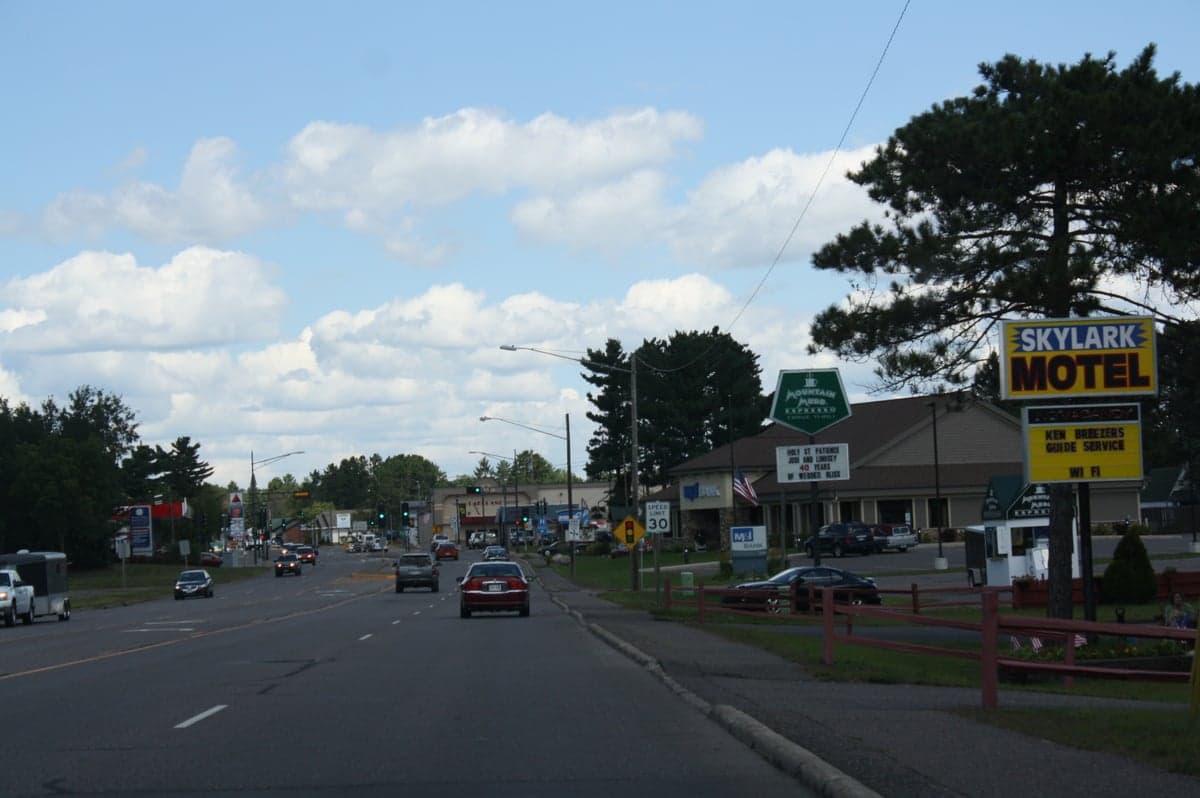
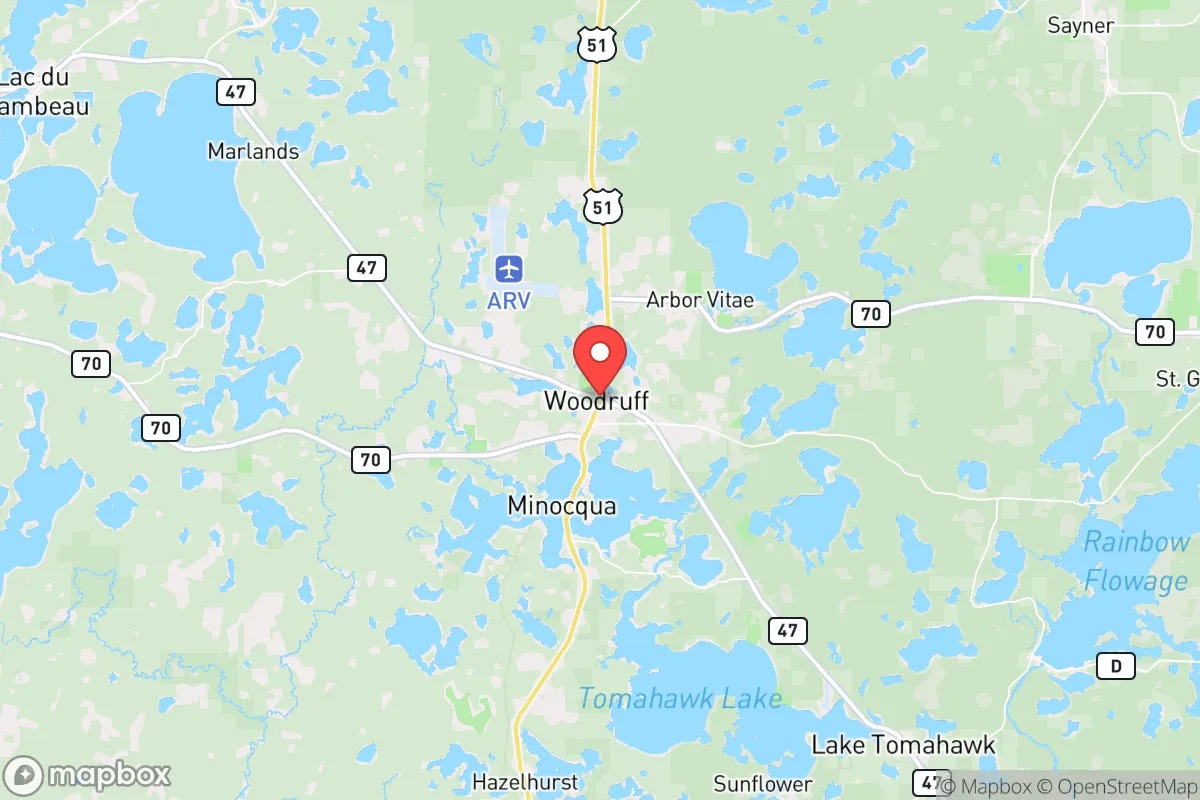
Photo: Wikipedia
Political ClimatePolitical Climate in Woodruff, WI
District shown is the primary district for this city’s centroid. Cities may span multiple districts.
Inherited from parent county — no local data available.
* Lean and PVI are calculated from the surrounding county’s 2020 and 2024 presidential results, Cook-style — a finer measure here than its congressional district (WI-7).
Political rankings in Wisconsin
- Most Conservative Cities in Wisconsin
- Most Liberal Cities in Wisconsin
- Best Liberal-Leaning Towns in the Midwest
- Safest Liberal-Leaning Towns in the Midwest
- Safest Conservative-Leaning Towns in the Midwest
- Affordable Small Towns for Conservatives
- Most Affordable Liberal-Leaning Small Towns in the U.S.
- Safest Conservative-Leaning Cities in the U.S.
- Most Conservative Counties in Wisconsin
- Most Liberal Counties in Wisconsin
Local Political AnalysisPolitical Analysis of Woodruff, WI
Woodruff, Wisconsin, sits in a reliably conservative pocket of the Northwoods, with a Cook Partisan Voting Index (PVI) of R+9, meaning the area votes about nine points more Republican than the national average. That’s a solid red lean, and it’s been that way for a while—though the margin has tightened a bit in recent presidential cycles as the state overall has swung closer to even. The surrounding state of Wisconsin carries a Cook PVI of EVEN, reflecting its status as a true battleground, but Woodruff and its neighbors in Oneida County have stayed consistently to the right of the state as a whole. If you’re looking at the trajectory, it’s less about a dramatic shift in ideology and more about a slow, steady alignment with the broader rural-urban divide that defines Wisconsin politics today.
How it compares
Woodruff’s R+9 puts it in a different political universe from the state’s EVEN rating. To get a sense of the contrast, drive 45 minutes south to Wausau, which leans Republican but is more moderate, or head an hour east to Rhinelander, which is even redder than Woodruff. The real split is with the state’s Democratic strongholds—Madison and Milwaukee—where the PVI can swing D+20 or more. In Woodruff, you’ll see Trump signs on lawns and “Let’s Go Brandon” flags on boats, while in Dane County, you’d find Harris-Walz yard signs and “In This House We Believe” placards. The difference isn’t just in voting patterns; it’s in daily conversation. In Woodruff, talk at the gas station or the bait shop tends to center on taxes, hunting regulations, and school funding, while in Madison, it’s more likely to be about public transit and climate policy. That said, Woodruff isn’t a monolith—there’s a small but visible liberal minority, often tied to seasonal residents from Chicago or the Twin Cities, who keep the local Democratic Party active, even if they rarely win countywide races.
What this means for residents
For conservative residents, Woodruff’s lean means their values are reflected in local governance—the county board, school board, and town councils tend to be Republican-leaning, which translates to lower property tax increases, fewer zoning restrictions, and a general skepticism of state-level mandates from Madison. For liberal residents, it means feeling like a minority voice, but not an isolated one. You’ll find like-minded folks at the library’s book club or the farmers market, and the local Democratic Party chapter is small but scrappy, hosting candidate meet-and-greets that draw 20-30 people. The practical impact is that policy debates here are less about big ideological battles and more about nuts-and-bolts issues: road maintenance, lake access, and the local school district’s budget. The area’s trajectory suggests this dynamic will persist, with Woodruff staying red as the state as a whole remains a toss-up. The biggest wild card is in-migration from more liberal parts of the Midwest, which could nudge the PVI toward R+7 or R+8 over the next decade, but that’s a slow burn.
One cultural distinction worth noting: Woodruff’s politics are intertwined with its identity as a vacation and retirement destination. The “up north” ethos—self-reliance, outdoor recreation, and a wariness of government overreach—shapes how people talk about everything from snowmobile trail funding to COVID-19 restrictions. Unlike in Milwaukee or Madison, where political affiliation often dictates social circles, here it’s more common to have a neighbor with a different sign in their yard and still share a beer on the dock. That’s not to say it’s all harmony—the 2020 election aftermath saw some heated town hall meetings—but the general vibe is that politics is a topic, not the topic. For anyone moving to Woodruff, the takeaway is simple: you’ll find a community that leans right, but with enough room for dissent that you won’t feel like an outsider, as long as you’re willing to talk about fishing first.

State Political ClimatePolitical Climate in Wisconsin
State Political AnalysisPolitical Environment in the State
Wisconsin is the quintessential swing state, with a Cook PVI of EVEN that perfectly captures its 50/50 split. Over the past 20 years, it has lurched from reliably blue in presidential elections (voting Democratic from 1988 to 2012) to a dead-even battleground, decided by margins under 1% in 2016 and 2020. The dominant coalitions are a shrinking but still potent union-and-college-town Democratic base in the southeast and Dane County, squared off against a growing, energized conservative coalition in the suburban WOW counties (Waukesha, Ozaukee, Washington) and the vast, rural northern and western reaches. The trajectory is a slow, grinding polarization: the rural areas are getting redder, the cities bluer, and the suburbs are the decisive battlefield.
Urban vs. rural divide
The political map of Wisconsin is a story of two worlds. Milwaukee and Madison are the Democratic strongholds, with Madison (Dane County) delivering margins of 75%+ for Democrats. Milwaukee’s core is similarly dominant, though its inner-ring suburbs like Wauwatosa and Shorewood have shifted leftward in recent cycles. The Republican base is anchored by the WOW counties—Waukesha, Ozaukee, and Washington—which routinely give GOP candidates 60-65% of the vote. These are the classic "SUV suburbs" of Milwaukee: affluent, family-oriented, and increasingly conservative as the city itself diversifies. The rural northwoods counties—like Vilas, Oneida, and Lincoln—have trended sharply red since 2010, driven by a mix of second-home owners, retirees, and a declining manufacturing base. The Fox Valley (Appleton, Green Bay, Oshkosh) is the true bellwether: these working-class, Catholic, historically union-heavy areas swung hard for Trump in 2016 and 2020, and they remain the most contested ground in the state. The Driftless Region in the southwest (around La Crosse and Platteville) is a microcosm—rural areas are deep red, but the college towns and river cities are blue islands.
Policy environment
Wisconsin’s policy environment is a patchwork reflecting its divided government. The state has a flat income tax of 4.4% (down from 7.75% in 2011), with a sales tax of 5% (local counties can add up to 0.5%). Property taxes are above the national median but capped by state law. The regulatory posture is generally business-friendly, with a right-to-work law passed in 2015 and a tort reform system that limits lawsuit damages. Education policy is a major flashpoint: the state has a robust school choice program (vouchers for private schools, especially in Milwaukee and Racine) and a charter school sector, but public school funding has been a perennial battle. Healthcare is mixed—the state expanded Medicaid under the Affordable Care Act in 2014, but private insurance markets are competitive. Election laws are moderately restrictive: voter ID is required, absentee voting is available without excuse, and drop boxes were banned by the state Supreme Court in 2022. The state has no sanctuary city laws; in fact, a 2019 law prohibits local governments from adopting sanctuary policies.
Recent policy direction
The last five years have seen a sharp rightward shift on several fronts. On gun and self-defense law, Wisconsin became a constitutional carry state in 2023 (Act 12), eliminating the permit requirement for concealed carry. The state also has a "stand your ground" law (2011) and preempts local gun ordinances. On parental and education rights, the 2023-24 session saw a ban on teaching gender identity and sexual orientation in grades K-3 (Act 20), and a requirement that schools notify parents if a child requests a name or pronoun change. Speech and privacy are generally protected, though the state has no broad data privacy law. On medical and bodily autonomy, the 1849 abortion ban was effectively reinstated after Dobbs, but a 2023 lawsuit (Planned Parenthood v. Kaul) has left the law in limbo—abortion remains legal up to 20 weeks pending a state Supreme Court decision expected in 2025. Property rights are strong, with no statewide rent control and limited eminent domain abuse. Taxation has been trending downward: the 2023-25 budget cut income taxes by 3.25% across the board and expanded the child tax credit. Voting and ballot access tightened: the 2022 Supreme Court ruling (Teigen v. Wisconsin Elections Commission) banned ballot drop boxes, and a 2024 law (Act 100) requires absentee ballots to be received by Election Day (no postmark grace period).
Civil unrest & political movements
Wisconsin has a history of intense political activism. The 2011 Act 10 protests against collective bargaining limits drew 100,000 people to the Madison Capitol, and the 2020 Kenosha unrest (after the Jacob Blake shooting) saw two people killed and the National Guard deployed. The state has a strong grassroots conservative movement, particularly in the WOW counties and the Fox Valley, where groups like the Wisconsin Family Action and the Republican Party of Waukesha County are highly organized. Immigration politics are relatively low-key compared to border states, but the 2023 "Operation Freedom" initiative (a state-level border security task force) reflects growing concern. Election integrity controversies have been a defining issue since 2020: the state legislature conducted a $676,000 investigation (the "Michael Gableman probe") that found no evidence of widespread fraud but fueled ongoing distrust. The 2023 election of liberal Justice Janet Protasiewicz to the state Supreme Court (by an 11-point margin) flipped the court from 4-3 conservative to 4-3 liberal, a seismic shift that will shape redistricting, abortion law, and election rules for the next decade. Secession or nullification rhetoric is rare, though some rural counties have passed "Second Amendment sanctuary" resolutions.
Projection
Over the next 5-10 years, Wisconsin will remain a toss-up, but the demographic trends favor a slight rightward tilt. The in-migration pattern is key: the state is gaining population from Illinois (especially Chicago suburbs), and these newcomers tend to be moderate-to-conservative, settling in the WOW counties and the Fox Valley. The Milwaukee metro is losing population, while the Madison metro is growing fast—but Madison’s growth is overwhelmingly young and liberal, which will keep Dane County a blue fortress. The rural areas will continue to bleed population and get redder, but their electoral weight is shrinking. The wild card is the state Supreme Court: the new liberal majority will likely strike down the current Republican-drawn legislative maps (which give the GOP a near-supermajority despite 50/50 statewide votes), leading to fairer maps by 2026. This could flip the state Assembly and Senate to Democratic control, creating a more balanced policy environment. Abortion law will likely be settled by the court by 2025, probably restoring legal abortion up to 20 weeks. The gun law trajectory is unlikely to reverse—constitutional carry is here to stay. A relocator moving in now should expect a state that remains deeply divided but where the policy pendulum will swing more moderately as the court and redistricting shift the balance of power.
Bottom line for a new resident: If you’re a conservative, you’ll find a welcoming environment in the WOW counties, the Fox Valley, or the northwoods—low taxes, strong gun rights, school choice, and a community that shares your values. If you’re a liberal, you’ll be comfortable in Madison, Milwaukee, or La Crosse—but you’ll need to accept that state-level policy will often be at odds with your preferences, at least until the new court maps take effect. For everyone, the practical takeaway is that Wisconsin is a state where your vote truly matters—and where your neighbors will let you know if they disagree. The politics are intense, but the people are generally friendly, and the state’s natural beauty and strong economy make it a solid choice for families who can handle a little heat in the kitchen.
* Values derived from national, state, county, city and local statistics and may differ in a specific area. Last updated: 2026-11-22T19:03:53.000Z
Narrative content on this page is AI-generated and may contain mistakes. Verify any details that matter before acting on them.
ReloMaps may earn a commission from affiliate links at no extra cost to you.

