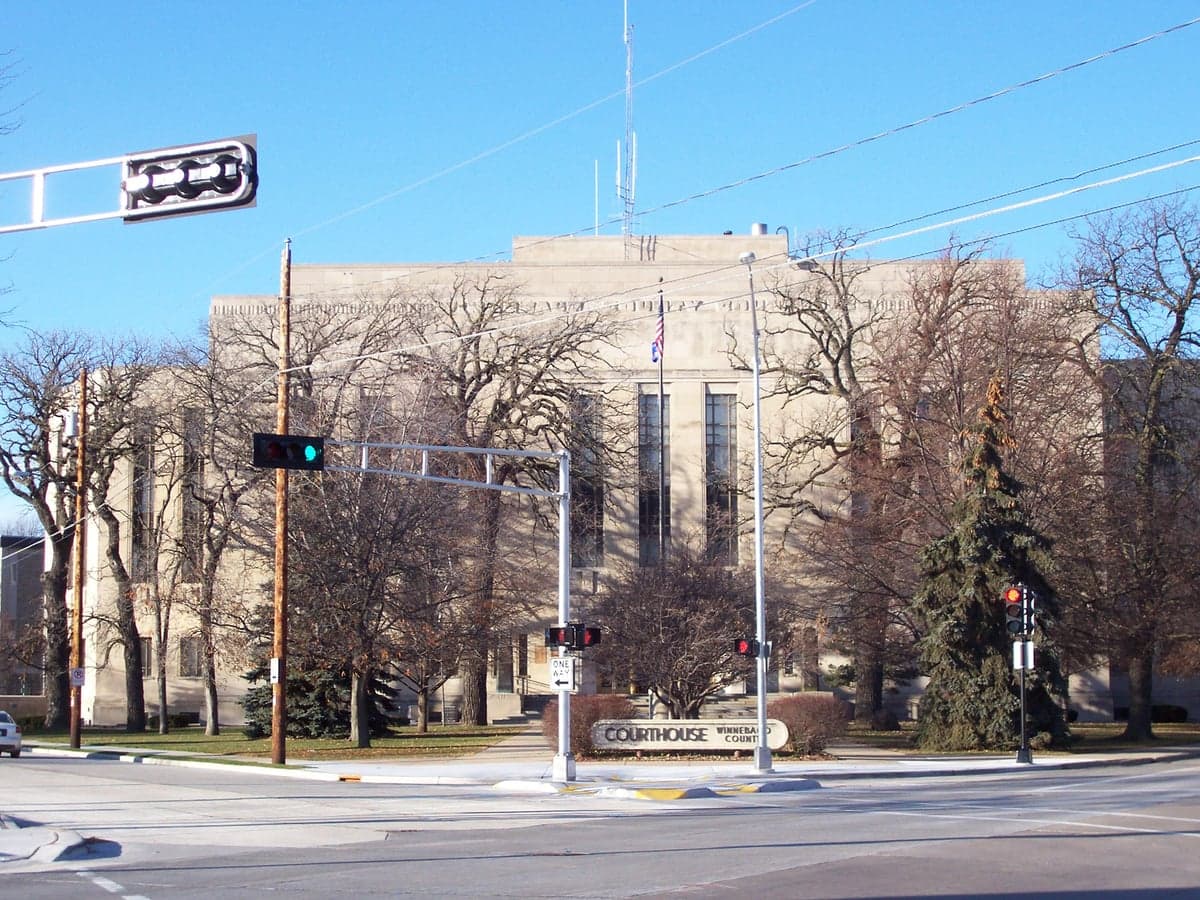
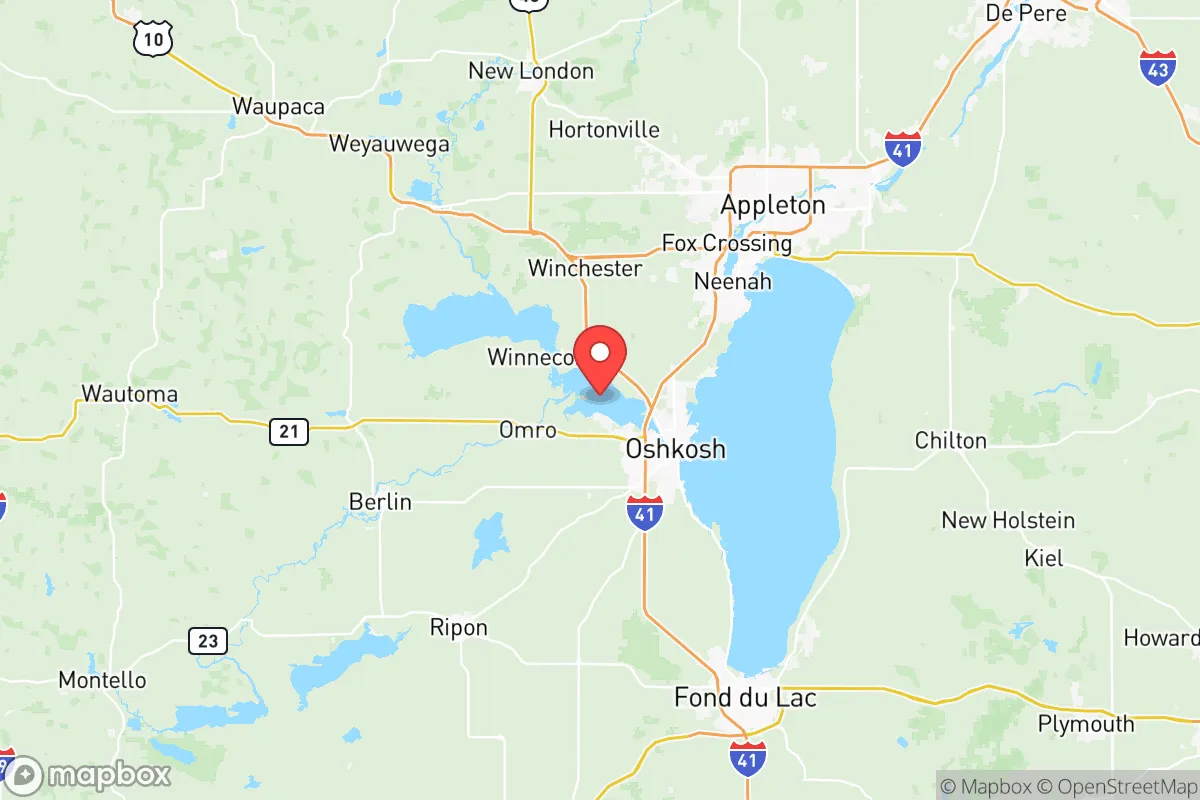
Photo: Wikipedia
Political ClimatePolitical Climate in Winnebago County
Showing district-level results — no local-only data available.
Local Political AnalysisPolitical Analysis of Winnebago County
Winnebago County, Wisconsin, leans reliably Republican with a Cook PVI of R+8, meaning it votes about eight points more conservative than the national average. This is a significant shift from the state as a whole, which sits at EVEN, and it reflects a county that has moved rightward over the past decade, particularly in its rural and suburban precincts. The county's political center of gravity is in Oshkosh and Neenah, but the real story is the growing red dominance in the townships and smaller communities that surround them.
How it compares
Compared to Wisconsin's statewide EVEN rating, Winnebago County is a solidly conservative outlier. The county's R+8 PVI means it's roughly eight points more Republican than the national average, while the state as a whole is perfectly balanced. This gap is driven by the county's rural and exurban areas: towns like Algoma, Black Wolf, and Nekimi routinely deliver margins of 60-70% for Republican candidates. In contrast, the city of Oshkosh itself is more competitive, with its downtown and university-area precincts leaning blue, while the west side and south side lean red. Neenah and Menasha also show a split, with Neenah's lakefront and older neighborhoods trending more moderate, while Menasha's industrial base has shifted rightward in recent cycles. The swing precincts are in the suburban fringe of Oshkosh and along the Highway 41 corridor, where growth is fastest and voters are less entrenched. This internal variation means that while the county is solidly red overall, it's not a monolith—there are real pockets of blue, especially in the college and downtown areas of Oshkosh.
What this means for residents
For conservative residents, Winnebago County feels like a comfortable place to live politically. Local offices—county board, sheriff, district attorney—are reliably held by Republicans, and the county's delegation to the state legislature is overwhelmingly conservative. This means conservative priorities like lower taxes, Second Amendment rights, and local control are generally reflected in county policy. For liberal residents, the experience is more mixed. While Oshkosh and Neenah have active Democratic organizations and progressive community groups, they are often outvoted at the county level. This can feel frustrating on issues like environmental regulation or social services, where county-level decisions may not align with their values. However, the presence of the University of Wisconsin-Oshkosh and a growing number of young professionals in the Fox Cities region means that liberal voices are not absent—they just don't carry the day in countywide elections. The practical effect is that both sides need to engage in coalition-building and compromise, especially on non-partisan issues like economic development and infrastructure.
Culturally, Winnebago County's political lean shows up in its policy priorities. The county has been a stronghold for the state's conservative movement, with local leaders often championing tax cuts and limited government. This has kept property taxes relatively low compared to neighboring counties like Outagamie or Brown, but it also means that public services like transit and social safety nets are more constrained. The county's relationship with the state government is generally cooperative, as both are controlled by Republicans, but there are occasional tensions over state mandates that the county must fund. For newcomers, the political climate is noticeable in everyday life—conversations about politics are common at local diners and community events, and the local newspaper, the Oshkosh Northwestern, covers both sides but with a clear conservative editorial bent. Overall, the county's R+8 lean is a stable feature of its identity, and while it may shift slightly in future cycles, it's unlikely to flip anytime soon.

State Political ClimatePolitical Climate in Wisconsin
State Political AnalysisPolitical Environment in the State
Wisconsin is the quintessential swing state, with a Cook PVI of EVEN that perfectly captures its knife-edge balance. Over the past 20 years, the state has shifted from a reliably blue-leaning battleground to a pure toss-up, driven by a stark urban-rural realignment. The Democratic coalition is anchored in Milwaukee and Madison, while the rest of the state has swung hard toward the GOP, creating a political environment where statewide races are routinely decided by less than a percentage point. For a relocator, this means your vote genuinely counts, but it also means you’re moving into a state where political tension is baked into the culture.
Urban vs. rural divide
The political map of Wisconsin is a tale of two landscapes. Milwaukee County, home to the state’s largest city, delivers massive Democratic margins — Joe Biden won it by over 200,000 votes in 2020. Dane County, anchored by Madison and the University of Wisconsin, is even more lopsided, with Democrats routinely pulling 75% or more of the vote. These two counties alone are enough to offset Republican gains everywhere else. Meanwhile, the WOW counties — Waukesha, Ozaukee, and Washington — form the suburban Republican stronghold west and north of Milwaukee, consistently delivering 60-65% GOP margins. The real story, though, is the rural and exurban shift. Counties like Door, Brown (Green Bay), and Outagamie (Appleton) have moved rightward over the past decade, with the Fox Valley region becoming increasingly Republican. The northern tier, from Ashland to Vilas, has also trended red, driven by opposition to environmental regulations and cultural conservatism. The result is a state where the political geography is simple: two blue islands in a sea of red, with the margins in the suburbs and small cities deciding everything.
Policy environment
Wisconsin’s policy environment reflects its divided government. The state has a flat income tax rate of 4.4% (as of 2025, with a scheduled reduction to 3.5% by 2026), and property taxes are moderate compared to neighboring Illinois and Minnesota. The state is a right-to-work state, meaning no one can be forced to join a union as a condition of employment — a legacy of 2015’s Act 1. Education policy is a flashpoint: the state has a robust school choice program, including the Milwaukee Parental Choice Program (the oldest in the nation) and a statewide voucher system, but public school funding remains a perennial fight. Healthcare is mixed — Wisconsin expanded Medicaid under the Affordable Care Act, but the state legislature has resisted full expansion of BadgerCare. Election laws are moderately restrictive: voters must show a photo ID at the polls, absentee voting is available without an excuse, but drop boxes were effectively banned by the state Supreme Court in 2022 (Teigen v. Wisconsin Elections Commission). For a conservative relocator, the tax and school choice environment is favorable; for a liberal one, the election laws and union restrictions may be frustrating.
Recent policy direction
The last five years have seen Wisconsin move in a distinctly conservative direction on several fronts, though the divided government has prevented a full red wave. On gun rights, Wisconsin is a shall-issue state for concealed carry, and in 2023, the legislature passed a bill allowing permitless carry, though it was vetoed by Governor Tony Evers. Self-defense law follows the Castle Doctrine, with no duty to retreat in one’s home or vehicle. On parental rights, the state passed Act 20 in 2023, which overhauled reading instruction and gave parents more oversight of curriculum, though it stopped short of the broader “parents’ bill of rights” seen in other states. Abortion policy is a live grenade: after the 2022 Dobbs decision, a 1849 law banning abortion was challenged in court, and in 2023, a Dane County judge ruled it does not apply to consensual abortions, effectively restoring access. The state Supreme Court, which flipped to a 4-3 liberal majority in 2023, is expected to hear the case, and the outcome could determine whether Wisconsin becomes a regional abortion haven or a near-total ban state. On election integrity, the legislature passed a series of bills tightening absentee ballot procedures and banning private grant funding for election administration, though Evers vetoed most of them. Property rights are generally strong, with no statewide rent control and relatively permissive zoning in rural areas, though urban centers like Madison have adopted inclusionary zoning policies. For a relocator, the key takeaway is that the state’s direction depends heavily on who controls the governorship and the Supreme Court — both of which are up for grabs in the next few cycles.
Civil unrest & political movements
Wisconsin has been a flashpoint for political unrest in recent years. The 2020 Kenosha protests, sparked by the police shooting of Jacob Blake, led to nights of rioting and the killing of two protesters by Kyle Rittenhouse, who was later acquitted. That event remains a cultural touchstone, with conservatives viewing it as a case of self-defense and liberals as a symbol of vigilante justice. The state has also seen significant right-wing organizing, particularly around the Wisconsin Farm Bureau and the Wisconsin Institute for Law & Liberty, a conservative legal group that has been active in school choice and election law cases. On the left, the Wisconsin Democratic Party has been energized by the 2023 Supreme Court election, which saw record turnout and spending. Immigration politics are less heated than in border states, but the issue has flared in communities like Green Bay and Milwaukee, where a 2023 proposal to ban local “sanctuary” policies was debated but not enacted. Election integrity remains a live issue: the 2020 election saw Wisconsin become a central battleground for Trump’s challenges, and the 2024 cycle is expected to bring more scrutiny. For a new resident, the most visible sign of this tension is the sheer number of political ads — Wisconsin is the most heavily targeted state for campaign spending per capita, so expect your TV and mailbox to be saturated every two years.
Projection
Over the next 5-10 years, Wisconsin is likely to remain a swing state, but the demographic trends favor a slight rightward shift. The state’s population is aging and growing slowly, with the fastest growth in the exurban and rural areas that lean Republican. The Milwaukee and Madison metros are growing too, but not fast enough to offset the rural gains. In-migration from Illinois is a wild card — many newcomers are conservative-leaning retirees or remote workers seeking lower taxes, which could boost the GOP, but some are also liberals fleeing Chicago’s politics. The state Supreme Court will be a key battleground: the current 4-3 liberal majority is up for election in 2025 and 2026, and if it flips back, the policy direction could shift dramatically on abortion, redistricting, and election law. The 2024 presidential race will be a stress test — if Democrats hold the state, expect continued gridlock; if Republicans win, expect a push for more conservative policies on guns, abortion, and election integrity. For a relocator, the bottom line is that Wisconsin will not become a safe red or blue state in the next decade. It will remain a competitive, high-stakes environment where your vote matters and where the political climate can shift with a single election.
For someone moving to Wisconsin, the practical takeaway is this: you are entering a state where political engagement is not optional — it’s expected. Whether you lean conservative or liberal, you will find communities that share your values, from the conservative suburbs of Waukesha to the progressive enclaves of Madison. But you will also find that the state’s politics are deeply personal and often contentious. If you value low taxes and school choice, you’ll be comfortable in most of the state. If you prioritize abortion access or union rights, you’ll want to stay close to Milwaukee or Madison. The key is to know which side of the divide you’re on — and to be prepared for the fact that the other side is never far away.
* Values derived from national, state, county, city and local statistics and may differ in a specific area. Last updated: 2026-06-16T15:46:46.000Z
Narrative content on this page is AI-generated and may contain mistakes. Verify any details that matter before acting on them.
ReloMaps may earn a commission from affiliate links at no extra cost to you.

