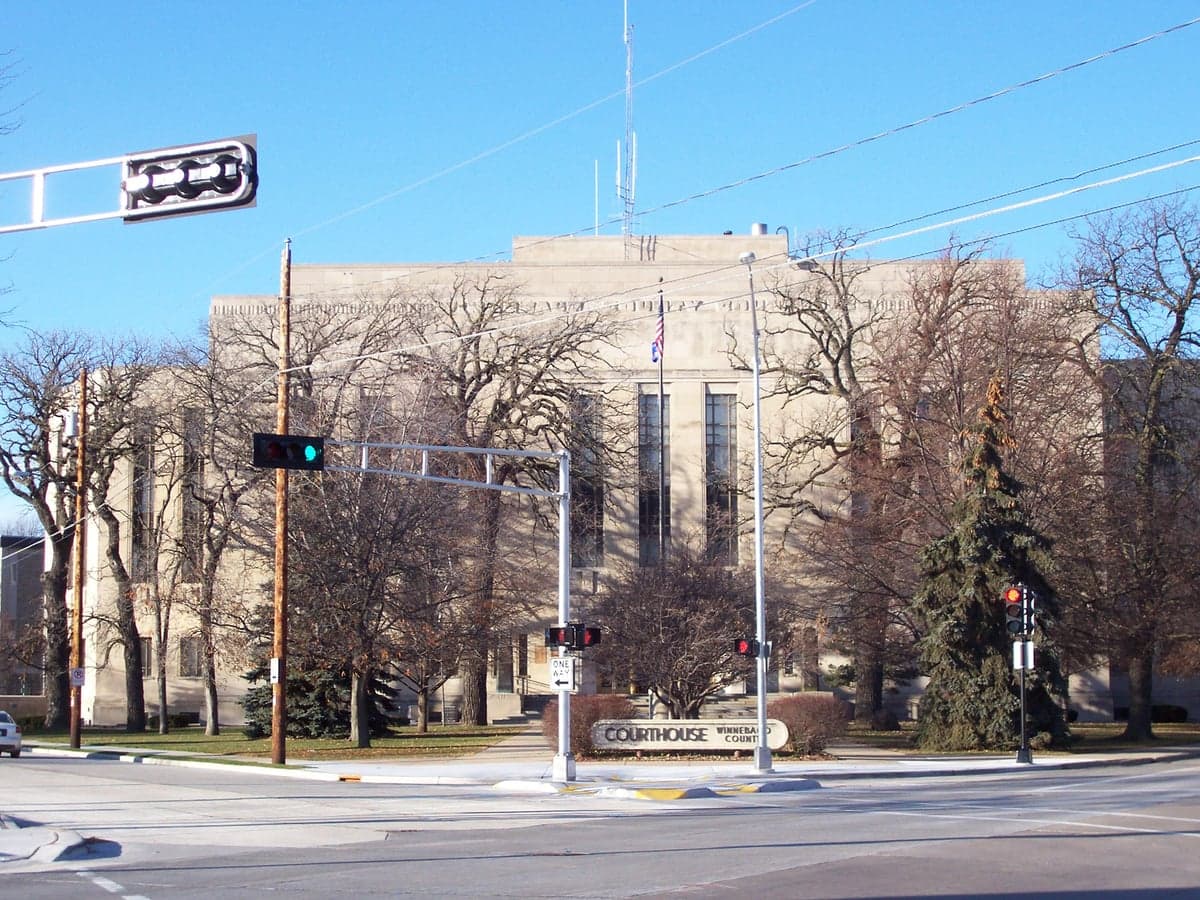
Photo: Wikipedia
Demographics of Winnebago County
Affluence Level in Winnebago County
A middle-class area roughly in line with national averages across income, home values, education, and employment.
People of Winnebago County
The people of Winnebago County, Wisconsin, today number 171,357, forming a predominantly white (85.8%) and culturally rooted community centered on the Fox River valley and Lake Winnebago’s western shore. The county’s identity is shaped by a deep German and Irish Catholic heritage, a strong manufacturing and paper-industry workforce, and a distinctly Midwestern sense of place that prizes stability, family, and local institutions. With a foreign-born population of just 1.6% and a modest 31.0% college-educated rate, Winnebago County remains a more insular, working-to-middle-class region compared to Wisconsin’s faster-growing urban corridors like Dane County.
Settlement & growth (pre-1960)
Before European settlement, the area now known as Winnebago County was home to the Ho-Chunk (Winnebago) people, who lived in villages along the Fox River and Lake Winnebago for centuries. French fur traders and missionaries, including Jean Nicolet in 1634, were the first Europeans to pass through, but they established no permanent settlements. The region remained under French and later British influence until the United States gained control after the War of 1812, with the Ho-Chunk ceding their lands through a series of treaties in the 1830s and 1840s.
American settlement began in earnest in the 1840s, driven by the promise of fertile farmland and the strategic location of the Fox River as a transportation corridor. The first major wave was of Yankee settlers from New York and New England, who founded the city of Oshkosh in 1846, naming it after a Menominee chief. Oshkosh quickly became the county’s commercial and industrial hub, leveraging its position on Lake Winnebago and the Fox River to build a thriving lumber industry. By the 1850s, the city was one of the largest lumber producers in the world, drawing a second wave of immigrants: Irish and German laborers who worked in the sawmills and built the city’s infrastructure. The German influx was especially heavy, with many settling in Oshkosh’s south side and in the rural townships of Algoma and Menasha, where they established Catholic parishes, breweries, and farming communities.
In the 1870s and 1880s, the lumber boom gave way to manufacturing, particularly woodworking, furniture, and later paper production. This shift attracted a third wave of immigrants: Polish and Czech families who found work in the mills and factories of Neenah and Menasha, the twin cities on the county’s northern edge. Neenah, in particular, became a center for the paper industry, with companies like Kimberly-Clark founding operations there in the 1870s. The paper mills drew Scandinavian immigrants—Swedes and Norwegians—who settled in Neenah and the village of Winneconne, adding a Lutheran thread to the county’s predominantly Catholic fabric. By 1900, Winnebago County’s population had grown to roughly 60,000, with Oshkosh, Neenah, and Menasha forming a continuous urbanized corridor along the Fox River.
The early 20th century saw continued industrial expansion, with Oshkosh becoming a center for truck manufacturing (Oshkosh Corporation, founded 1917) and Neenah for paper and printing. The Great Depression slowed growth but did not reverse it, and World War II brought a temporary influx of workers to support wartime production. The post-war period, from 1945 to 1960, saw suburbanization begin in earnest, with families moving from Oshkosh’s dense urban neighborhoods to new subdivisions in the towns of Algoma and Oshkosh (the town, distinct from the city). The county’s population reached 110,000 by 1960, still overwhelmingly white and of Northern European descent, with German, Irish, Polish, and Scandinavian roots dominating.
Modern era (post-1965)
The 1965 Hart-Cellar Act, which reshaped U.S. immigration policy, had a minimal direct impact on Winnebago County. The county’s foreign-born population today stands at just 1.6%, far below the national average, and the region did not experience the large-scale immigration from Asia, Latin America, or Africa that transformed many other Midwestern counties. Instead, the post-1965 demographic story of Winnebago County is one of slow diversification through domestic migration and natural increase, rather than international immigration.
The most significant demographic shift since the 1960s has been the growth of the Hispanic population, which now stands at 4.9% of the county. This community began forming in the 1970s and 1980s, as Mexican and Puerto Rican families moved to the area for work in the paper mills, factories, and agricultural processing plants. The Hispanic population is concentrated in Oshkosh, particularly on the city’s south side, and in Neenah, where a small but visible Latino commercial corridor has developed along Winneconne Avenue. The Black population, at 2.5%, is also primarily urban, with most Black residents living in Oshkosh, where they have established community institutions including churches and a local chapter of the NAACP. The East/Southeast Asian population (2.8%) includes a mix of Hmong families who arrived as refugees in the 1980s and 1990s, and smaller numbers of Chinese, Korean, and Filipino professionals working in the paper industry and at the University of Wisconsin-Oshkosh. The Hmong community is most visible in Oshkosh, where a small but active cultural center serves the population. The Indian-subcontinent population (0.3%) is tiny and largely professional, concentrated among medical staff at hospitals in Oshkosh and Neenah.
Domestically, Winnebago County has experienced modest growth through suburbanization and the expansion of the Fox Cities metropolitan area. The villages of Fox Crossing (formerly the town of Menasha) and Sherwood have seen new housing developments since the 1990s, attracting families from Oshkosh and Appleton seeking larger lots and lower taxes. The county’s population grew from 128,000 in 1970 to 171,357 today, a steady but unspectacular increase driven largely by natural growth and in-migration from other parts of Wisconsin, rather than from coastal or Sun Belt states. The county remains less diverse than the state as a whole (Wisconsin is 80.9% white), and its racial and ethnic composition has changed slowly compared to neighboring Outagamie County, which has seen faster Hispanic growth.
The future
Winnebago County’s population is projected to grow slowly over the next 10–20 years, likely reaching 180,000–185,000 by 2040, driven by continued suburban expansion in the Fox Cities corridor and by the aging-in-place of existing residents. The county’s white population share is expected to decline gradually, from 85.8% to perhaps 80–82% by 2040, as the Hispanic and Asian populations continue to grow through natural increase and modest new immigration. The Hispanic population could reach 7–8% of the county, with the largest gains in Oshkosh and Neenah, where existing communities provide a base for chain migration. The East/Southeast Asian population may grow slightly, particularly if the University of Wisconsin-Oshkosh continues to recruit international students, but the foreign-born share is unlikely to exceed 3%.
The county’s cultural identity is likely to remain predominantly white and Midwestern, but with a slowly expanding multicultural character, particularly in Oshkosh. The paper industry, which has historically anchored the economy, is in long-term decline, and the county is diversifying into healthcare, education, and logistics. This economic shift may attract new residents from other parts of Wisconsin and the Upper Midwest, but Winnebago County is unlikely to experience the rapid demographic change seen in counties like Dane or Milwaukee. The most significant cultural tension may be between the older, more conservative rural townships and the younger, slightly more diverse urban centers of Oshkosh and Neenah.
For someone moving to Winnebago County now, the region offers a stable, family-oriented community with deep historical roots, a strong sense of place, and a pace of change that is slow enough to feel familiar but steady enough to avoid stagnation. The county is becoming slightly more diverse and slightly more suburban, but its essential character—German and Irish Catholic, working-to-middle-class, manufacturing-rooted, and proudly local—will remain recognizable for decades to come.

* Values derived from national, state, county, city and local statistics and may differ in a specific area. Last updated: 2026-06-16T15:46:46.000Z
Narrative content on this page is AI-generated and may contain mistakes. Verify any details that matter before acting on them.
ReloMaps may earn a commission from affiliate links at no extra cost to you.

