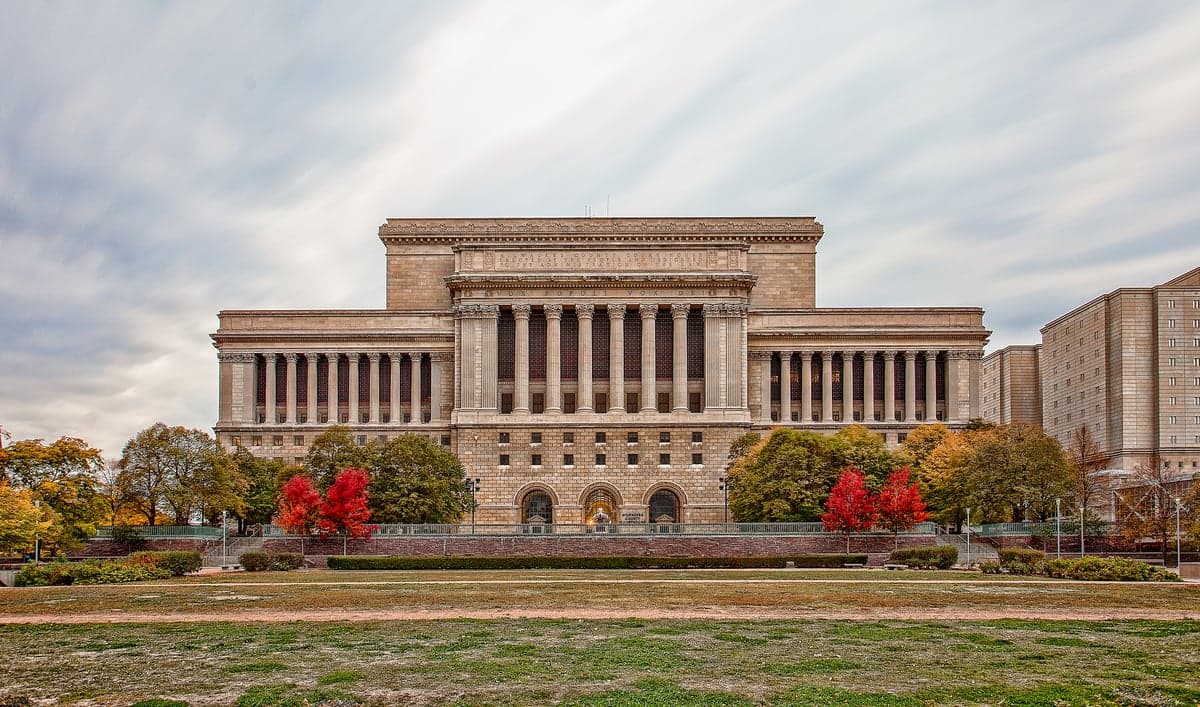
Photo: Wikipedia
Political ClimatePolitical Climate in Milwaukee County
Showing district-level results — no local-only data available.
Local Political AnalysisPolitical Analysis of Milwaukee County
Milwaukee County is the deep-blue anchor of Wisconsin politics, consistently delivering margins of 60-70% for Democratic candidates in statewide races, even as the rest of the state has swung back and forth by razor-thin margins. The county's Cook PVI of R+2 might seem contradictory, but that number reflects the entire Milwaukee media market, which includes heavily Republican Waukesha and Ozaukee counties; the county itself is overwhelmingly Democratic. In 2024, Milwaukee County voted for Kamala Harris by roughly 65-33%, a margin that effectively neutralized the GOP's advantage in the rest of the state. The trajectory here is one of deepening polarization: the city of Milwaukee has become more Democratic and more diverse, while the inner-ring suburbs have shifted leftward as well, though at a slower pace. Meanwhile, the county's far southern and western fringes — places like Franklin, Greendale, and parts of Greenfield — have held steady as the last Republican-leaning pockets within county lines.
How it compares
Wisconsin as a whole is a pure swing state with a Cook PVI of EVEN, meaning it's perfectly balanced between the two parties. Milwaukee County is the single biggest reason Democrats remain competitive statewide: without its massive Democratic turnout, Wisconsin would look more like Iowa or Indiana. The contrast is stark when you compare Milwaukee County to its immediate neighbors. Waukesha County to the west is one of the most Republican counties in the nation, routinely voting 65-70% GOP. Ozaukee and Washington counties are similarly deep red. This creates a political donut effect: a blue urban core surrounded by a red suburban and exurban ring. Within Milwaukee County itself, the variation is significant. The city's north side, including neighborhoods like Sherman Park and Lindsay Heights, votes 95%+ Democratic. The east side and near south side, including Walker's Point and Bay View, are also heavily blue but with more progressive activist energy. The "bungalow belt" suburbs like West Allis and St. Francis are more working-class and have shifted left in recent cycles, while Franklin and Greendale remain the county's most competitive swing precincts, often voting 50-55% Republican in local races.
What this means for residents
For liberal residents, Milwaukee County is a political safe haven where Democratic policies on housing, transit, and public health are the norm. The county board and city council are reliably progressive, and issues like paid sick leave, tenant protections, and police reform are actively debated and often enacted. For conservative residents, the experience is more mixed. You can absolutely live a comfortable life as a Republican in Milwaukee County — especially in Franklin, Greendale, or Hales Corners — but you'll be in the minority in most countywide elections. Many conservatives in the county feel their votes are effectively canceled out by the city's massive Democratic turnout, which can lead to frustration with county-level tax and spending policies. That said, the county's political diversity means that local school board races and municipal elections in the southern suburbs are genuinely competitive, giving conservatives real influence at the hyperlocal level.
One cultural distinction that sets Milwaukee County apart from the rest of Wisconsin is its relationship with state government. The county is frequently at odds with the Republican-controlled state legislature, leading to perennial fights over shared revenue, transit funding, and local control. This dynamic means that residents here live under two competing political realities: a progressive county government pushing for expanded services and a state government that often tries to limit Milwaukee's authority. For anyone moving here, understanding this tension is key — it shapes everything from property taxes to road maintenance to how the public school system operates. The county's political identity is also deeply tied to its labor history, with strong union presence in the building trades, public sector, and manufacturing, which gives local politics a distinctly blue-collar flavor even as the city's cultural scene becomes more cosmopolitan.

State Political ClimatePolitical Climate in Wisconsin
State Political AnalysisPolitical Environment in the State
Wisconsin is the ultimate swing state, with a Cook PVI of EVEN that perfectly captures its knife-edge political balance. Over the past 20 years, the state has lurched from reliably blue in the 1980s and 90s to a dead-even battleground, driven by the collapse of Democratic support in rural areas and the explosive growth of the Democratic vote in the Madison-Milwaukee corridor. The result is a state that flips between parties every election cycle — Trump won it by less than a point in 2016, Biden by a similar margin in 2020, and the 2024 race was again decided by under 30,000 votes. For a relocator, this means your vote genuinely matters here, and the political culture is one of constant, high-stakes competition.
Urban vs. rural divide
The political map of Wisconsin is a tale of three regions. Milwaukee County and Dane County (home to Madison) are the Democratic strongholds, delivering margins of 60-70% for Democrats in statewide races. Together, they account for roughly a quarter of the state's vote. The suburbs around Milwaukee — places like Waukesha County and Ozaukee County — are the GOP's firewall, routinely voting 60-65% Republican. The real story, though, is the rural-urban chasm. In 2012, Barack Obama won 44 of Wisconsin's 72 counties; by 2024, Democrats won just 12. The rural northwoods counties like Vilas and Oneida have shifted hard right, while the Driftless Region in the southwest — historically a Democratic stronghold — has also trended Republican. The key swing counties are the "WOW" counties (Waukesha, Ozaukee, Washington) and the smaller industrial cities like Green Bay and Kenosha, which flipped from Obama to Trump and have stayed competitive. Eau Claire and La Crosse in the west are emerging as purple zones, with growing college populations pulling them leftward.
Policy environment
Wisconsin's policy environment reflects its divided government. The state has a flat income tax rate of 4.4% (down from 7.65% a decade ago), with a 5% sales tax. Property taxes are above the national median but capped by levy limits. The state is a "right-to-work" state (passed in 2015), meaning no one can be forced to join a union as a condition of employment. Education policy is a major battleground: the state has a robust school choice program, including the Milwaukee Parental Choice Program (the oldest in the nation) and a statewide voucher program. The University of Wisconsin system has seen tuition freezes for over a decade, but also budget cuts that have led to program consolidations. Election laws are moderately restrictive: voters must show a photo ID, absentee ballots require a witness signature, and drop boxes were effectively banned by the state Supreme Court in 2022. The state has no sanctuary city laws, and local cooperation with ICE is standard. Gun laws are permissive: Wisconsin is a shall-issue state for concealed carry, with no permit required for open carry, and no "red flag" law. Medical marijuana is illegal, though a low-THC CBD program exists; recreational use is fully illegal.
Recent policy direction
The last five years have seen Wisconsin lurch rightward on several fronts. In 2023, the Republican-controlled legislature passed a flat income tax cut that brought the top rate from 7.65% to 4.4%, and there are ongoing pushes to eliminate the income tax entirely. On education, the legislature expanded the school voucher program to cover all 72 counties in 2023. On gun rights, the state preempted local firearm ordinances in 2022, meaning cities like Madison cannot enact their own restrictions. On abortion, a 1849 law banning the procedure was effectively nullified by a 2023 state Supreme Court ruling that interpreted the law as not applying to consensual abortions; the court is now considering a challenge to the state's ban on medication abortion. On election integrity, the legislature passed a bill in 2024 requiring all absentee ballots to be received by Election Day (eliminating the previous six-day grace period). On parental rights, the state passed a law in 2023 requiring schools to notify parents if a student requests a name or pronoun change. On property rights, the state has no statewide zoning reform, but the legislature has preempted local rent control ordinances. On privacy, Wisconsin has no comprehensive data privacy law, though a 2024 bill to create one is stalled. The overall direction is toward lower taxes, expanded school choice, and tighter election rules, with the state Supreme Court's 4-3 liberal majority (won in 2023) acting as a brake on the most aggressive conservative legislation.
Civil unrest & political movements
Wisconsin has a history of intense political activism. The 2011 Act 10 protests against public sector union restrictions drew over 100,000 people to the Madison Capitol, and the 2020 Kenosha unrest — following the Jacob Blake shooting — saw two people killed and the National Guard deployed. The state has a strong grassroots conservative movement, centered on the Wisconsin Family Action group and the state's network of gun rights activists. The "WOW" counties are a hub for the Tea Party and later the Trump-aligned "Moms for Liberty" chapter. On the left, the Wisconsin Democratic Party is heavily influenced by the progressive "Squad" wing, with Rep. Mark Pocan and Sen. Tammy Baldwin representing the Madison-Milwaukee axis. Immigration politics are relatively quiet compared to border states, but the 2023-2024 migrant surge in Chicago has spilled over into Kenosha and Racine, where local officials have complained about bused-in migrants. Election integrity remains a flashpoint: the 2020 election saw Trump's legal challenges fail, but the 2024 election was again contested, with the state Supreme Court narrowly rejecting a lawsuit to disqualify 200,000 voters. A new resident will notice the ubiquity of political yard signs and the intensity of local news coverage — this is a state where politics is a spectator sport.
Projection
Over the next 5-10 years, Wisconsin is likely to remain a toss-up, but the demographic trends favor Democrats. The Madison and Milwaukee metros are growing faster than the rest of the state, and the college-educated population in the Fox Valley (Appleton, Green Bay) is expanding. The rural counties will continue to bleed population and shift further right, but their electoral weight will shrink. The wild card is the state Supreme Court: with a 4-3 liberal majority until at least 2028, the court is likely to strike down the state's 1849 abortion ban and may order new legislative maps (the current maps are among the most gerrymandered in the country). If that happens, Democrats could win control of the legislature for the first time since 2010, which would dramatically shift policy on everything from taxes to education. In-migration is modest — about 10,000 net new residents per year — but they tend to be younger and more educated, settling in the Madison and Milwaukee suburbs. A relocator moving in now should expect a state that remains deeply divided, with the possibility of a major political realignment if the court orders fair maps. The practical reality is that your local school board and county board elections matter more here than in most states, because the legislature is so polarized that most policy is made at the local level.
For a new resident, the bottom line is that Wisconsin offers a genuinely competitive political environment where your vote carries weight. If you're conservative, you'll find a state that has passed most of the standard conservative agenda — right-to-work, school choice, flat taxes, permissive gun laws — but you'll need to live in the WOW counties or the rural north to feel politically comfortable. If you're liberal, you'll find a vibrant progressive community in Madison and Milwaukee, but you'll be frustrated by the legislature's ability to block your priorities. The state's political culture is intense but not hostile — people argue passionately but generally get along. The key practical takeaway: pay attention to the state Supreme Court elections, because they will determine the future of abortion access, legislative maps, and election laws for the next decade.
* Values derived from national, state, county, city and local statistics and may differ in a specific area. Last updated: 2026-06-16T22:34:19.000Z
Narrative content on this page is AI-generated and may contain mistakes. Verify any details that matter before acting on them.
ReloMaps may earn a commission from affiliate links at no extra cost to you.

