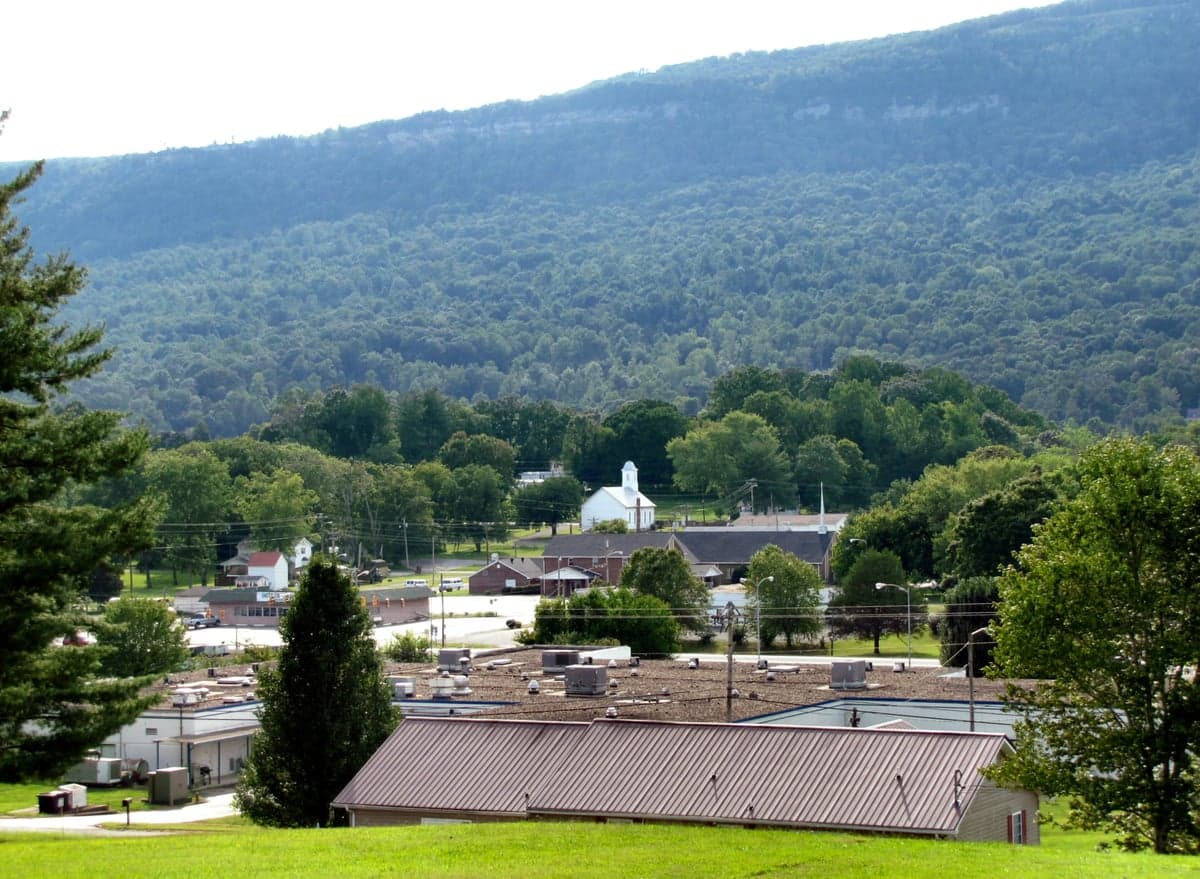
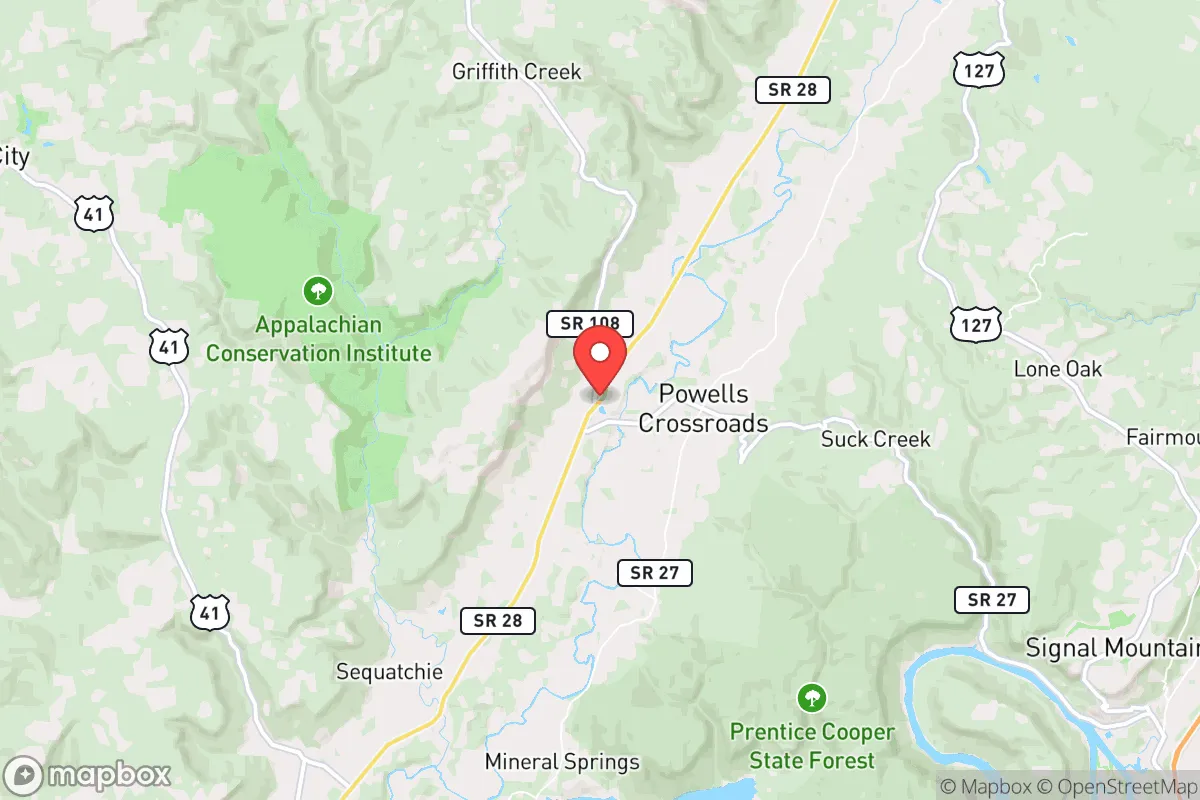
Photo: Wikipedia
Political ClimatePolitical Climate in Whitwell, TN
District shown is the primary district for this city’s centroid. Cities may span multiple districts.
Local Political AnalysisPolitical Analysis of Whitwell, TN
Whitwell, Tennessee, is about as reliably Republican as a small town in the Sequatchie Valley gets. With a Cook Partisan Voting Index (PVI) of R+21, the area votes more than two-thirds of the time for GOP candidates, a pattern that has only solidified over the past decade. Locals will tell you that while the town has always leaned conservative, the shift has become more pronounced since the 2010s, mirroring the broader rural realignment across the state. You don't see many yard signs for Democrats here, and when you do, they're usually on the main road heading toward Dunlap or Jasper, not tucked away in the hollers.
How it compares
Whitwell's R+21 rating is a full 8 points more conservative than Tennessee's statewide PVI of R+13. That gap is significant. While Tennessee as a whole is solidly red, Whitwell sits in a pocket of the state that is even more deeply Republican than the Nashville suburbs or the increasingly competitive areas around Chattanooga. For context, nearby Chattanooga (Hamilton County) leans R+10, and the college town of Sewanee (Franklin County) is closer to R+15. But Whitwell, along with neighboring communities like Jasper and South Pittsburg, is part of the old coal and railroad corridor where Democratic registration was once common but has all but vanished. The contrast is sharpest when you drive 30 minutes east to Signal Mountain, where you'll find a more moderate, educated Republican base, or an hour north to Manchester, where the politics are still conservative but with a libertarian streak from the Bonnaroo crowd.
What this means for residents
For conservative residents, Whitwell is a comfortable place to live politically. Local elections are effectively decided in the Republican primary, and the county commission, school board, and mayor's office are all reliably GOP. You'll find strong support for gun rights, low taxes, and traditional values, and the local churches are deeply woven into community life. For liberal residents, the reality is more isolating. There is no organized Democratic party presence in the immediate area, and openly progressive views can draw quiet stares or awkward silences at the grocery store. That said, most folks are neighborly and won't make a scene—politics just isn't a dinner-table topic unless you're among close friends. The practical effect is that Whitwell's policies lean heavily toward limited government: property taxes are low, zoning is minimal, and the school system emphasizes local control. There's no talk of sanctuary city policies or progressive taxation here, and that's exactly how the majority wants it.
One cultural distinction worth noting: Whitwell's political identity is tied to its history as a mining and railroad town, which gives it a blue-collar, self-reliant character that differs from the more affluent, suburban conservatism found in places like Franklin or Brentwood. You won't find country clubs or political fundraisers here—just a lot of folks who believe the government should stay out of their lives and their wallets. Looking ahead, the trajectory is likely to stay the same or even shift slightly further right, as younger residents move away for jobs and the remaining population ages in place. For anyone moving to Whitwell, the political climate is predictable, stable, and deeply rooted in the local culture—for better or worse, it's not changing anytime soon.

State Political ClimatePolitical Climate in Tennessee
State Political AnalysisPolitical Environment in the State
Tennessee is a solidly Republican state with a Cook PVI of R+13, meaning it votes about 13 points more Republican than the national average in presidential elections. Over the past 20 years, the state has shifted from a competitive purple state—where Democrats still held statewide offices as recently as the early 2000s—to a deeply red stronghold, driven by the realignment of rural and suburban voters and the near-total collapse of the Democratic Party outside of Memphis and Nashville. For a relocator, this means you’re moving into a state where conservative policy is the baseline, but the political experience varies dramatically depending on whether you settle in a booming suburb, a small town, or a deep-blue urban core.
Urban vs. rural divide
The political map of Tennessee is a study in contrasts. The state’s two major metros—Nashville (Davidson County) and Memphis (Shelby County)—are Democratic strongholds, with Nashville voting about 65% for Joe Biden in 2020 and Memphis closer to 80%. These cities drive the state’s minority-party vote and are home to most of its progressive activism, including Black Lives Matter protests and LGBTQ+ advocacy. Knoxville (Knox County) and Chattanooga (Hamilton County) are more competitive but lean Republican, with Knox County voting about 60% for Donald Trump in 2020 and Hamilton County closer to 55%. The real engine of the state’s red lean is the vast rural and exurban territory: counties like Lincoln, Giles, and Fentress routinely vote 80%+ Republican. The most politically distinct suburb is Franklin (Williamson County), one of the wealthiest and fastest-growing counties in the nation, which votes about 70% Republican—a key driver of the state’s rightward tilt as Nashville’s liberal influence is diluted by its conservative suburbs. Murfreesboro (Rutherford County) is another fast-growing exurb that leans red but is becoming more competitive as it absorbs Nashville spillover.
Policy environment
Tennessee’s policy environment is defined by a low-tax, limited-government philosophy that appeals to conservative relocators. There is no state income tax on wages—only a 6.5% flat tax on interest and dividends, which is being phased out by 2029. Sales tax is high, at 7% state rate plus local add-ons (up to 9.75% in Nashville), so the tax burden falls heavily on consumption. The state has a right-to-work law and is a “stand your ground” state with permitless carry of handguns for adults 21 and over (enacted in 2021). Education policy is dominated by school choice: Tennessee has a robust charter school law, a voucher program for low-income students in priority districts (the Education Savings Account program, currently limited to Nashville and Memphis but expanding), and a new law requiring schools to notify parents of any changes to a student’s “services or monitoring” related to mental, emotional, or physical health—a parental rights measure that has drawn national attention. Healthcare policy is notable for the state’s refusal to expand Medicaid under the Affordable Care Act, leaving about 300,000 low-income adults in a coverage gap. Election laws include strict voter ID requirements and a 20-day early voting period, but no-excuse absentee voting was eliminated in 2023.
Recent policy direction
The last five years have seen Tennessee accelerate its conservative policy agenda across multiple fronts. On gun and self-defense law, the 2021 permitless carry law was followed by a 2023 law prohibiting local governments from restricting firearms in parks and public buildings. On parental and education rights, the 2022 “Don’t Say Gay” law (officially the “Prohibition on Classroom Discussion About Sexual Orientation or Gender Identity”) bans such instruction in K-8, and a 2023 law requires school libraries to remove books deemed “harmful to minors.” On speech and privacy, the state passed a 2023 law requiring age verification for adult websites and a 2024 law restricting drag performances in public spaces. On medical and bodily autonomy, Tennessee enacted one of the nation’s strictest abortion bans in 2022 (triggered by Dobbs), with no exceptions for rape or incest and a narrow exception to save the mother’s life. On property rights, the state has strong eminent domain protections and a 2023 law prohibiting foreign adversaries (China, Russia, etc.) from owning agricultural land. On taxation, the phase-out of the hall tax on investment income continues, and a 2024 law cut the franchise tax on businesses. On voting and ballot access, a 2023 law made it a felony for third-party groups to distribute absentee ballot applications to voters who haven’t requested them, and a 2024 law shortened the early voting window from 20 to 14 days in some counties.
Civil unrest & political movements
Tennessee has seen its share of political flashpoints. The 2023 Covenant School shooting in Nashville sparked massive protests at the state capitol, with thousands of demonstrators demanding gun control—only to see the Republican supermajority pass a law allowing teachers to carry firearms on campus. The expulsion of two Democratic state representatives (Justin Jones and Justin Pearson) for leading a gun control protest on the House floor became a national story, with both quickly reappointed by their local councils. Immigration politics are less visible than in border states, but a 2024 law requiring law enforcement to cooperate with federal immigration authorities (the “Truth in Sentencing” act) has drawn opposition from immigrant advocacy groups in Nashville and Memphis. There is no sanctuary city policy in the state; in fact, a 2023 law prohibits local governments from adopting such policies. Election integrity controversies have been relatively muted compared to states like Georgia or Arizona, but a 2023 law created a new election integrity unit within the secretary of state’s office. Secession or nullification rhetoric is rare—Tennessee is not a hotbed of such movements, though a 2023 resolution affirming the state’s right to “interpose” against federal overreach passed the legislature symbolically.
Projection
Over the next 5-10 years, Tennessee is likely to remain solidly Republican, but the nature of that conservatism may shift. The state is growing fast—about 80,000 new residents per year—with most arriving from blue states like California, Illinois, and New York. These newcomers tend to be moderate to conservative on economics but more libertarian on social issues, which could push the state’s politics toward a more “live and let live” flavor over time. The suburbs of Nashville (Franklin, Murfreesboro, Spring Hill) and Knoxville (Farragut, Maryville) are absorbing most of this growth, and their politics are becoming more professional-class Republican rather than rural populist. However, the rural-urban divide will likely deepen as Nashville and Memphis continue to liberalize while the rest of the state holds firm. The biggest wildcard is the state’s education and healthcare policies: if the school choice expansion and parental rights laws attract families who value those things, the conservative majority could solidify. If the Medicaid coverage gap and strict abortion ban drive away young professionals and women of childbearing age, the state could see a slow demographic shift toward the center. For now, the trajectory is clear: Tennessee will be a red state for the foreseeable future, but the shade of red may lighten slightly as the suburbs diversify.
For a new resident, the bottom line is this: if you’re conservative, you’ll find a state that largely aligns with your values on taxes, guns, education, and regulation. If you’re liberal, you’ll find two blue cities where you can live comfortably but will have little influence on state policy. The practical takeaway is to choose your location carefully—your day-to-day experience in Franklin versus Nashville versus a rural county like Lincoln will be vastly different, even though they’re all in the same state. The political climate is stable, predictable, and unlikely to surprise you, which is exactly what most relocators are looking for.
* Values derived from national, state, county, city and local statistics and may differ in a specific area. Last updated: 2026-10-13T20:16:22.000Z
Narrative content on this page is AI-generated and may contain mistakes. Verify any details that matter before acting on them.
ReloMaps may earn a commission from affiliate links at no extra cost to you.

