
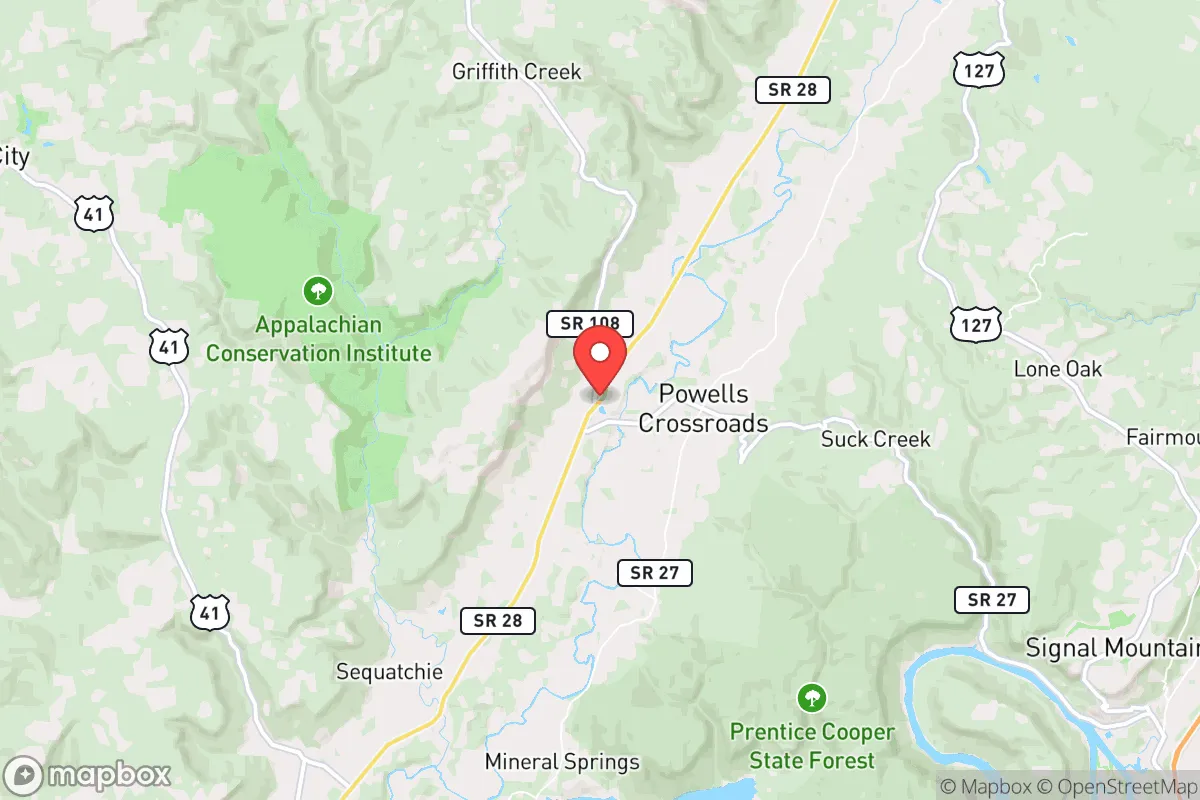
Photo: Wikipedia
Personal Sovereignty in Whitwell, TN
Viable for self-reliance. Generally workable, though some barriers may limit total independence.
What does Personal Sovereignty tell us?
Personal Sovereignty measures your capacity for self-reliance and independence with minimal government friction. Higher scores mean fewer barriers between you and the way you want to live... but it assumes you have the space you need and good neighbors.
What does this tell us?
Personal Sovereignty measures your capacity for self-reliance and independence with minimal government friction. Higher scores mean fewer barriers between you and the way you want to live... but it assumes you have the space you need and good neighbors.
State Policy
Energy independence: Importer (25% of energy produced in-state)
Personal Liberty
Homesteading

Personal Liberty Analysis
Whitwell, Tennessee, offers a notably high degree of personal sovereignty, grounded in Tennessee’s strong state-level protections for individual rights and a local culture that prizes self-reliance. For a relocation-minded individual or family with a conservative-leaning outlook, the area presents a regulatory environment that is generally light-touch, with low taxes, permissive gun laws, and a practical openness to homesteading and off-grid living. The autonomy here is less about abstract philosophy and more about the day-to-day reality of being left alone to make your own choices, provided you respect your neighbors’ similar freedoms.
Tax burden and regulatory posture: how light is the state’s touch?
Tennessee’s tax structure is a major draw for those seeking to keep more of their earnings. The state has no personal income tax on wages, a policy that directly increases disposable income for residents. The primary revenue sources are a state sales tax of 7% and a local option sales tax that brings the total in Marion County to around 9.25%. While this is a regressive tax, it means you are taxed on what you spend, not what you earn or save. Property taxes in Whitwell are low by national standards, with Marion County’s rate typically around $0.70 to $0.80 per $100 of assessed value, keeping annual tax bills on a modest home well under $1,000. The regulatory posture at the county level is similarly restrained. There is no county-wide zoning code in unincorporated Marion County, meaning you have significant latitude in how you use your land, build structures, or operate a home-based business. Permitting for new construction is straightforward, focused on basic health and safety codes rather than aesthetic or land-use restrictions. This creates an environment where you can act on your property without layers of bureaucratic approval.
Self-defense and gun law specifics: what are your rights to carry and protect?
Tennessee is a strong Second Amendment state, and Whitwell residents enjoy some of the most permissive self-defense laws in the country. The state enacted permitless carry (constitutional carry) for handguns in 2021, meaning any law-abiding adult 21 or older can carry a concealed or openly displayed handgun without a permit. This is a foundational liberty for many relocators. For those who still want a permit for reciprocity in other states, Tennessee issues an enhanced handgun carry permit after a background check and training course. The state’s “Stand Your Ground” law is unambiguous: there is no duty to retreat before using force, including deadly force, if you are in a place where you have a legal right to be and reasonably believe it is necessary to prevent death or great bodily harm. Castle Doctrine protections extend to your home, vehicle, and place of business. Long guns, including AR-15 style rifles, are legal to own and carry openly without a permit. There are no state-level magazine capacity bans or firearm registration requirements. For a family prioritizing self-defense, Whitwell sits in a legal environment that places the burden of protection squarely on the individual, with minimal government interference.
Self-reliance and homesteading viability: lot sizes, zoning, and off-grid feasibility
Whitwell’s setting in the Sequatchie Valley and surrounding foothills makes it a practical location for a self-reliant lifestyle. The key factor is the absence of restrictive zoning in unincorporated areas. You can find residential lots ranging from half-acre to multi-acre parcels, with many properties under $100,000 that include a house and enough land for a substantial garden, small orchard, or livestock. The county does not prohibit chickens, goats, or even larger livestock on residential parcels, though you should check for any subdivision-specific covenants if buying in a planned community. Off-grid living is feasible, though not entirely unregulated. Rainwater collection is legal and common for irrigation, but you will need a well for potable water. Solar panels are unrestricted, and many rural homes already rely on them. Septic systems require a permit and inspection, which is standard. The local building codes are based on the International Residential Code (IRC), but enforcement is generally practical and not overly burdensome. For a family wanting to raise food, generate their own power, and reduce dependence on municipal services, Whitwell offers a low-barrier entry point compared to more regulated states in the Northeast or West Coast.
Personal liberties: parental rights, medical autonomy, speech, and property
Tennessee has been at the forefront of several personal liberty issues that matter to conservative families. Parental rights are strongly protected in state law, with statutes affirming parents’ fundamental right to direct the upbringing, education, and healthcare of their children. The state has passed laws requiring parental consent for medical procedures and restricting certain curriculum in public schools. Medical autonomy is a mixed picture: Tennessee has some of the strictest laws regarding abortion, with a near-total ban, which aligns with the values of many in this audience. However, the state also has a broad medical conscience clause allowing healthcare providers to refuse participation in procedures they object to. On the vaccine front, Tennessee has passed laws prohibiting vaccine mandates by private businesses in many contexts, and religious and medical exemptions are available for school-required vaccinations. Free speech is robustly protected under the Tennessee Constitution, which explicitly states that “no law shall be passed to abridge the freedom of speech.” Property rights are also strong, with the state having a right-to-farm law that protects agricultural operations from nuisance lawsuits, and a relatively low rate of eminent domain use. The overall legal climate in Whitwell and Marion County is one where the default assumption is that you are free to act unless a specific law says otherwise, rather than needing permission for every decision.
Compared to many other parts of the country, Whitwell, TN, offers a genuinely high degree of personal sovereignty. The combination of no income tax, permissive gun laws, minimal zoning, and strong protections for parental and property rights creates an environment where self-reliance is not just possible but encouraged. For a family or individual who values being left alone to live their own life, make their own decisions, and provide for their own security, Whitwell represents a place where the government’s role is intentionally limited. It is not a libertarian utopia—there are still taxes, building codes, and state laws you must follow—but the baseline level of freedom here is significantly higher than in most urban or coastal areas, making it a serious contender for anyone prioritizing autonomy in their relocation decision.

* Values derived from national, state, county, city and local statistics and may differ in a specific area. Last updated: 2026-10-13T20:16:22.000Z
Narrative content on this page is AI-generated and may contain mistakes. Verify any details that matter before acting on them.
ReloMaps may earn a commission from affiliate links at no extra cost to you.

