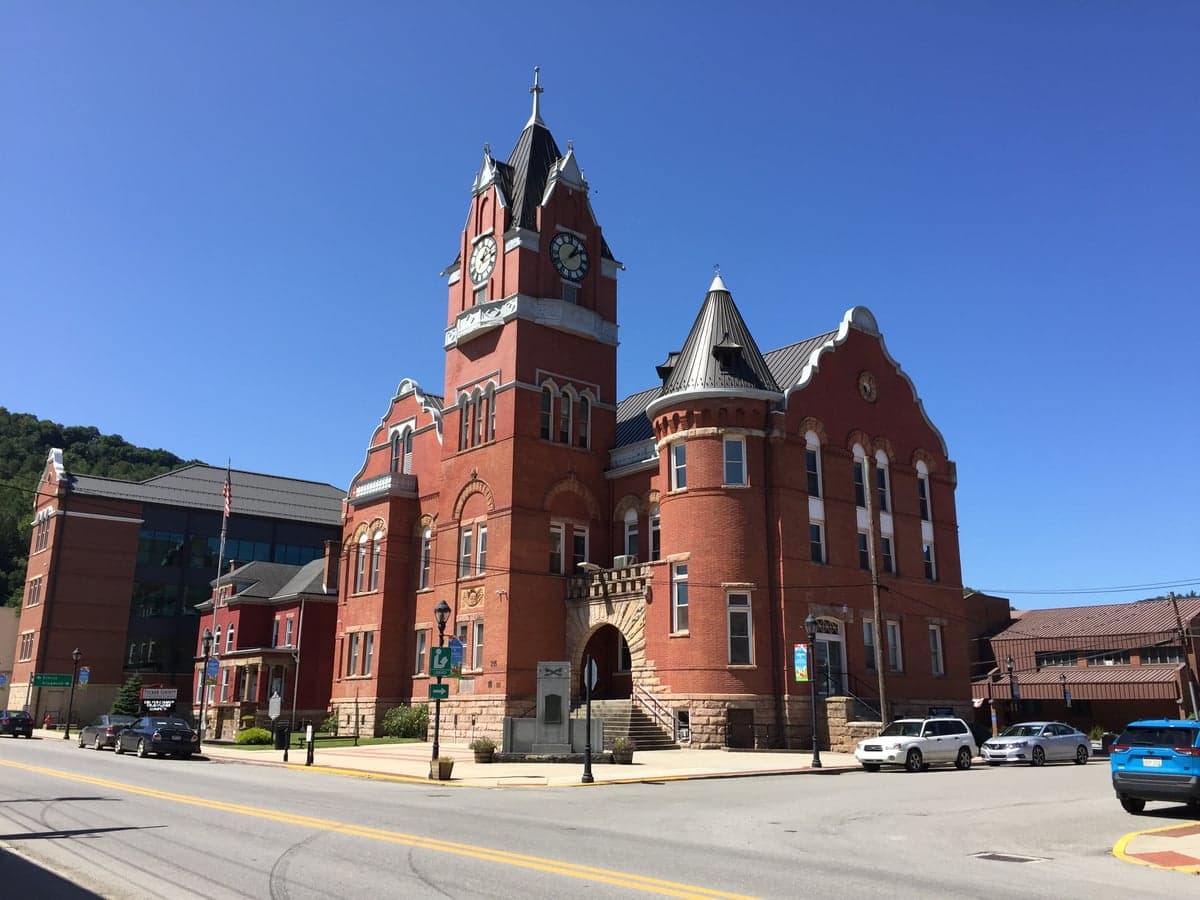
Photo: Wikipedia
Political ClimatePolitical Climate in Tucker County
Showing district-level results — no local-only data available.
Local Political AnalysisPolitical Analysis of Tucker County
Tucker County, West Virginia, is a deeply Republican stronghold with a Cook PVI of R+20, meaning it votes about 20 points more Republican than the national average. The county has been trending even redder in recent cycles, with Donald Trump winning over 75% of the vote in 2020 and 2024, up from around 70% in 2016. This shift mirrors the broader state trend, but Tucker County’s rural, resource-dependent economy and older demographic base make its conservatism particularly entrenched.
How it compares
West Virginia as a whole is also heavily Republican, but Tucker County is notably more conservative than the state average. While the state’s Cook PVI is not publicly calculated at the state level, statewide elections typically see Republicans winning by 30-40 points—meaning Tucker County’s R+20 is actually less red than the state as a whole. This is because Tucker County contains a few small pockets of Democratic resistance. The town of Davis, with its younger, more transient population drawn by outdoor recreation and the nearby ski resort at Canaan Valley, often votes 10-15 points more Democratic than the rest of the county. Thomas, a tiny artsy community, also leans slightly left, with precincts there occasionally breaking 40% for Democrats. In contrast, Parsons, the county seat, and Hendricks are reliably deep red, often delivering 80%+ Republican margins. The swing precincts are in the unincorporated areas around Hambleton and St. George, where economic anxiety over coal and timber jobs can shift votes between parties, though they’ve moved decisively right since 2016.
What this means for residents
For conservative residents, Tucker County is a comfortable place where their values are reflected in local policy—low taxes, limited regulation, and a strong Second Amendment culture. The county commission and school board are uniformly Republican, and social issues like abortion or gun control rarely spark public debate. For liberal residents, the reality is more isolating. They often find community in Davis or Thomas, where progressive candidates can win local races (like town council seats), but they have little influence on county-wide decisions. National politics can feel like a distant shouting match, as local elections focus on road maintenance, school funding, and timber rights. The county’s strong Republican lean means that Democratic voters often feel their votes are symbolic rather than decisive, though they take comfort in the fact that local officials are generally pragmatic and focused on economic development rather than culture wars.
Culturally, Tucker County stands apart from the rest of West Virginia in a few ways. The presence of the Monongahela National Forest and the Canaan Valley National Wildlife Refuge has fostered a small but vocal environmentalist community, which sometimes clashes with the dominant extractive industries. This tension is unique—most of the state doesn’t have the same mix of tourism-driven conservation and resource extraction. Policy-wise, the county has been slower to embrace the full-throated anti-regulation stance of the state legislature, with local officials often pushing for stricter zoning around the ski areas to protect property values. In practice, this means a conservative county that occasionally votes for environmental protections, a nuance that surprises outsiders but makes perfect sense to anyone who’s seen the way a clear-cut hillside can hurt the fall foliage tourism season.

State Political ClimatePolitical Climate in West Virginia
State Political AnalysisPolitical Environment in the State
West Virginia has become one of the most reliably Republican states in the nation, a dramatic shift from its 20th-century identity as a Democratic stronghold. The state voted for Donald Trump by nearly 39 points in 2020 and again by a similar margin in 2024, making it the second-most Republican state in the country after Wyoming. This transformation has been building for decades, driven by the collapse of organized labor's political influence, cultural realignment around social issues, and a steady exodus of younger, more moderate voters from the state's industrial towns.
Urban vs. rural divide
The political map of West Virginia is less about urban-rural tension and more about degrees of rural conservatism. The state's largest metro area, Charleston (Kanawha County), is the closest thing to a political battleground, voting for Trump by a relatively modest 12 points in 2024. Morgantown, home to West Virginia University, is the state's most liberal pocket, with Monongalia County voting for Trump by only 8 points, and the city itself often electing Democrats to local office. Huntington (Cabell County) leans Republican by about 20 points, reflecting its working-class, union-heavy base that has shifted hard right since 2016. The real Republican strongholds are the rural, resource-extraction counties in the south and north-central regions. Mingo County and Logan County in the southern coalfields routinely vote 80%+ Republican, while the Eastern Panhandle counties like Berkeley and Jefferson have become reliably red as well, driven by an influx of conservative-leaning retirees and commuters from the D.C. area. The only county that voted for Joe Biden in 2020 was Jefferson County, and even that flipped to Trump in 2024.
Policy environment
West Virginia's policy environment is aggressively conservative, with a low-tax, low-regulation posture that has attracted some business relocation but also created fiscal challenges. The state has no personal property tax on vehicles or business inventory, and the corporate net income tax is a flat 6.5%. In 2023, the legislature passed a historic 21% personal income tax cut, with a trigger mechanism for further reductions as revenue allows. The regulatory climate is among the most business-friendly in the country, with a "red tape reduction" office and a right-to-work law that has weakened union influence. On education, the state has a robust charter school law and a school choice program that allows public funds to follow students to private or homeschool settings. Healthcare is a mixed bag: the state expanded Medicaid under the Affordable Care Act, but the legislature has repeatedly rejected efforts to create a state-based insurance exchange or to expand abortion access. Election laws are moderately restrictive: voters must show a photo ID, and the state has a 10-day early voting period but no no-excuse absentee voting. The state also has a "stand your ground" self-defense law and a permitless carry law for firearms.
Recent policy direction
The last five years have seen a sharp rightward turn across multiple policy fronts. In 2021, the legislature passed the West Virginia Human Life Protection Act, which bans abortion at conception with no exceptions for rape or incest, only for medical emergencies. This law is currently blocked by court order but remains on the books. In 2022, the state enacted a permitless carry law, allowing any adult who can legally possess a firearm to carry it concealed without a permit. The same year, the legislature passed the Parental Bill of Rights, requiring schools to notify parents of any curriculum involving "sexually explicit content" and to obtain parental consent for any mental health screenings. On property rights, the state has a strong eminent domain protection law that limits government seizure of private land, and it passed a constitutional carry amendment in 2024 that further entrenches gun rights. On voting, the state implemented a voter ID law in 2020 and has resisted efforts to expand mail-in voting. The legislature also passed a privacy law in 2023 that restricts government surveillance of electronic communications without a warrant, though it exempts law enforcement in certain cases. The overall direction is toward maximizing individual liberty in the realms of guns, property, and parental rights, while sharply restricting medical and bodily autonomy.
Civil unrest & political movements
West Virginia has a long history of labor activism, but the modern political movements are overwhelmingly conservative. The 2021 West Virginia teachers' strike was a rare example of left-leaning collective action, with educators walking out over pay and benefits, but it did not fundamentally alter the state's political trajectory. The Coalition for West Virginia, a conservative advocacy group, has been highly effective in pushing the legislature rightward on taxes and education. There is a small but vocal secessionist movement in the Eastern Panhandle, where some residents have floated the idea of joining Virginia or forming a new state, driven by frustration with the state's economic stagnation and perceived neglect from Charleston. Immigration politics are largely symbolic in a state with one of the smallest foreign-born populations in the country, but the legislature has passed resolutions opposing "sanctuary cities" and supporting border security. Election integrity controversies have been minimal compared to other states, though the 2020 election saw some local Republican officials question the security of mail-in ballots. The most visible flashpoint for a new resident would be the ubiquity of political signage and the strong cultural identification with the Republican Party, especially in rural areas.
Projection
Over the next 5-10 years, West Virginia is likely to become even more Republican, but with a twist. The state is losing population overall, but the people moving in are disproportionately conservative retirees from the Northeast and Mid-Atlantic, drawn by low taxes and a slower pace of life. The Eastern Panhandle, in particular, is seeing an influx of former D.C. area residents who are fleeing high taxes and crime, and they tend to be even more conservative than native West Virginians. Meanwhile, younger, more moderate West Virginians continue to leave for job opportunities in larger cities, accelerating the state's rightward drift. The Democratic Party in the state is essentially a rump organization, with no statewide elected officials and a shrinking base in Morgantown and Charleston. The biggest wild card is the state's economic future: if the coal industry continues to decline and the state fails to diversify, the tax base will shrink, potentially forcing the legislature to reconsider its low-tax posture. But for the foreseeable future, a new resident can expect a deeply conservative political environment where Republican primaries are the only meaningful elections, and where the culture war issues of guns, abortion, and education dominate public discourse.
For a conservative relocator, West Virginia offers a political environment that aligns closely with their values: low taxes, strong gun rights, parental control over education, and a culture that prizes self-reliance. For a liberal relocator, the state will feel like a political island, with little representation at the state level and a social climate that can be unwelcoming. The practical takeaway is that West Virginia is a place where your vote matters less in the general election—the outcome is a foregone conclusion—but where local politics, especially school board and county commission races, can have a real impact on your daily life. If you're moving here, be prepared to engage with a community that takes its politics seriously, but also one where neighborly relationships often transcend partisan divides, especially in smaller towns where everyone knows each other.
* Values derived from national, state, county, city and local statistics and may differ in a specific area. Last updated: 2026-10-05T19:27:19.000Z
Narrative content on this page is AI-generated and may contain mistakes. Verify any details that matter before acting on them.
ReloMaps may earn a commission from affiliate links at no extra cost to you.

