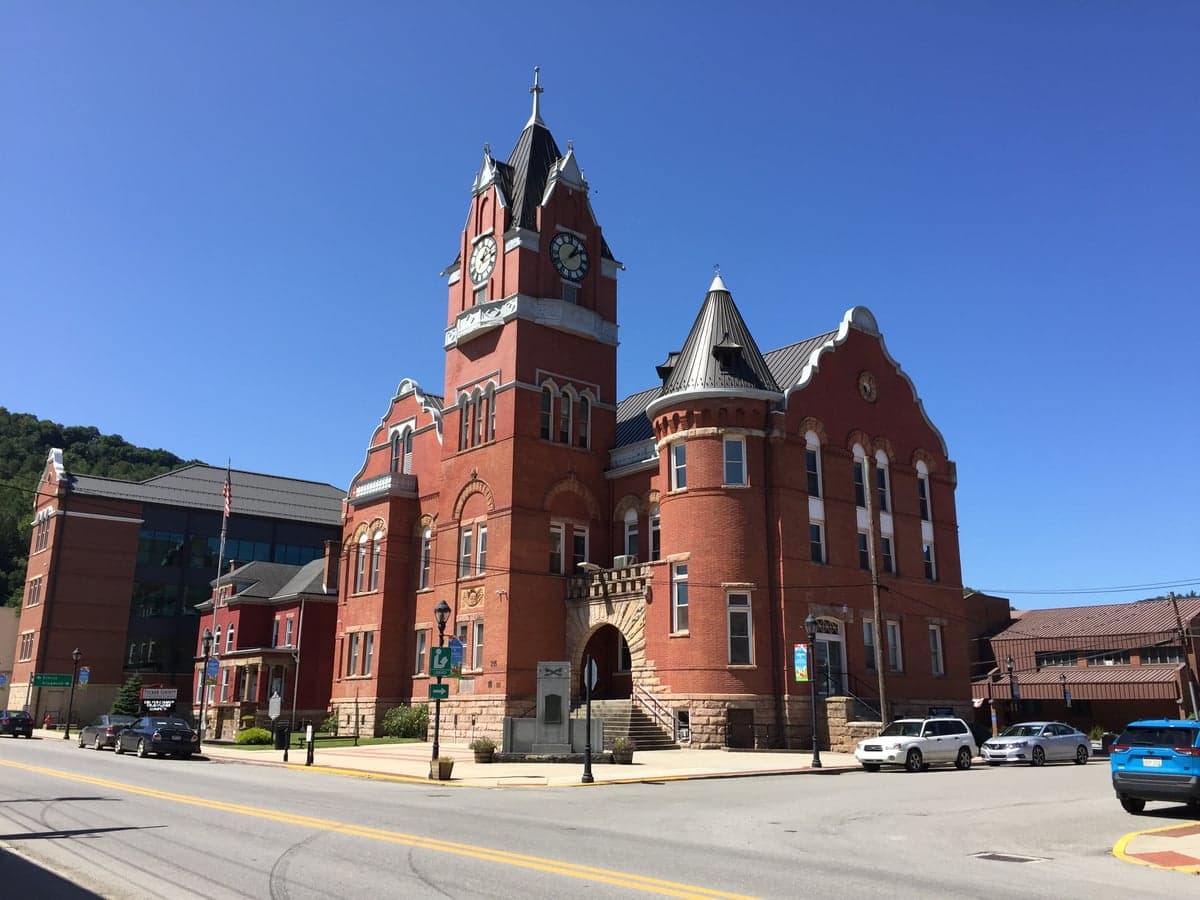
Photo: Wikipedia
Demographics of Tucker County
Affluence Level in Tucker County
A below-average socioeconomic profile. Incomes, home values, and educational attainment trail the U.S., with higher poverty and unemployment.
People of Tucker County
Tucker County, West Virginia, is home to approximately 6,698 residents, making it one of the state’s most sparsely populated counties. The population is overwhelmingly white (97.0%) and native-born, with a foreign-born share of just 0.2%—among the lowest in the nation. This is a deeply rooted, rural Appalachian community where family surnames trace back to the 18th and 19th centuries, and where the dominant cultural identity is shaped by Scots-Irish heritage, Protestant Christianity, and a self-reliant, conservative ethos. The county’s character is defined not by diversity of origin but by continuity of place: most residents live in the county seat of Parsons, the historic railroad town of Thomas, or the outdoor-recreation hub of Davis, with smaller populations scattered in hamlets like Hambleton, Hendricks, and St. George.
Settlement & growth (pre-1960)
Before European settlement, the area now known as Tucker County was part of the hunting grounds of the Shawnee and Mingo peoples, who used the Cheat River and Blackwater River valleys for seasonal camps. No permanent Native villages existed within the county’s boundaries; the region was a contested buffer zone between the Iroquois Confederacy to the north and the Cherokee to the south. The first Europeans to explore the area were likely French fur traders in the early 1700s, but no permanent French or British settlements took hold until after the American Revolution.
The first permanent settlers arrived in the 1790s and early 1800s, almost exclusively Scots-Irish and English migrants from the Shenandoah Valley and eastern Virginia. These families—names like Parsons, Minear, and Hinkle—followed the Cheat River northward, claiming land under Virginia’s headright system. They were subsistence farmers, hunters, and later timber cutters. The county was officially formed in 1856 from parts of Randolph County and named for Henry St. George Tucker, a Virginia judge. The first county seat was St. George, a tiny settlement that remains a ghost of its former self today.
The defining economic event for Tucker County was the arrival of the West Virginia Central and Pittsburgh Railway in the 1880s. The railroad opened the county’s vast virgin forests of red spruce and hemlock to industrial logging. This brought a second wave of settlers: German and Irish immigrants who worked as railroad laborers and sawmill hands, and a smaller number of Italian immigrants who arrived in the 1890s to build railroad grades and bridges. These groups concentrated in the new railroad towns of Thomas and Davis, which boomed as company towns for the Babcock Lumber Company and the Davis Coal & Coke Company. By 1910, Tucker County’s population peaked at 18,675, more than double its current size.
Coal mining became the dominant industry after 1900, with deep mines opening along the Blackwater River near Hendricks and Hambleton. This attracted a third wave: Eastern European immigrants, primarily Poles and Hungarians, who settled in company housing in these mining camps. A small number of African American miners also came from the Deep South during the Great Migration, but their numbers were never large—the 1930 census recorded only 112 Black residents in the county. The Great Depression and the subsequent decline of the coal industry after World War II triggered a massive outmigration. By 1960, the population had fallen to 7,500, and the ethnic enclaves of Thomas, Davis, and Hendricks had largely assimilated into the broader white Appalachian culture.
Modern era (post-1965)
The 1965 Hart-Cellar Act had virtually no effect on Tucker County. The foreign-born population today is 0.2%, and the county has not experienced the immigration-driven diversification seen in urban West Virginia or the Washington, D.C., exurbs. Instead, the demographic story of the past 60 years is one of continued population decline and aging. The county lost residents in every decade from 1960 to 2020, with the steepest drop occurring between 1980 and 2000 as the last coal mines closed and young adults left for jobs in Morgantown, Charleston, or out of state.
Domestic migration has been minimal and largely negative. A small number of retirees and second-home buyers from the Washington, D.C., and Pittsburgh metro areas have moved into Davis and Thomas since the 1990s, drawn by the outdoor recreation of the Monongahela National Forest and the Blackwater Falls State Park. These newcomers are typically older, white, and politically moderate, and they have not significantly altered the county’s racial or ethnic composition. The Hispanic population is 0.4%, the Black population is 0.0%, and the East/Southeast Asian population is 0.1%—statistically negligible. The Indian-subcontinent population is 0.0%.
The county’s educational attainment remains low: only 24.2% of adults hold a bachelor’s degree or higher, compared to the West Virginia average of 21.1% and the national average of 33.7%. This reflects the legacy of a resource-extraction economy that did not require higher education and the ongoing outmigration of college-bound youth. The median age has risen to 47.3 years, well above the national median of 38.8, as younger families leave and the population ages in place.
The future
Tucker County’s population is projected to continue declining slowly, likely falling below 6,000 by 2040. The county will become less diverse, not more, as the small non-white populations that existed in the early 20th century have already left or died out. No new immigrant groups are arriving, and domestic in-migration from outside Appalachia is limited to a thin stream of retirees and remote workers who can afford the area’s low housing costs. The county’s cultural identity will remain overwhelmingly white, native-born, and rooted in Scots-Irish Appalachian traditions, with a growing tension between long-time residents and the newer “amenity migrants” in Davis and Thomas who advocate for tourism-driven development and environmental conservation over resource extraction.
For someone moving in now, Tucker County offers a stable, homogeneous community where social networks are deep and change is slow. The lack of diversity means that newcomers who are not white and native-born may face social isolation, but for those seeking a quiet, rural life with strong community ties and access to some of the best hiking and fishing in the eastern United States, the county remains a viable choice. The future is not one of transformation but of gradual thinning—a place that will look much the same in 2040 as it does today, only with fewer people and older homes.

* Values derived from national, state, county, city and local statistics and may differ in a specific area. Last updated: 2026-10-05T19:27:19.000Z
Narrative content on this page is AI-generated and may contain mistakes. Verify any details that matter before acting on them.
ReloMaps may earn a commission from affiliate links at no extra cost to you.

