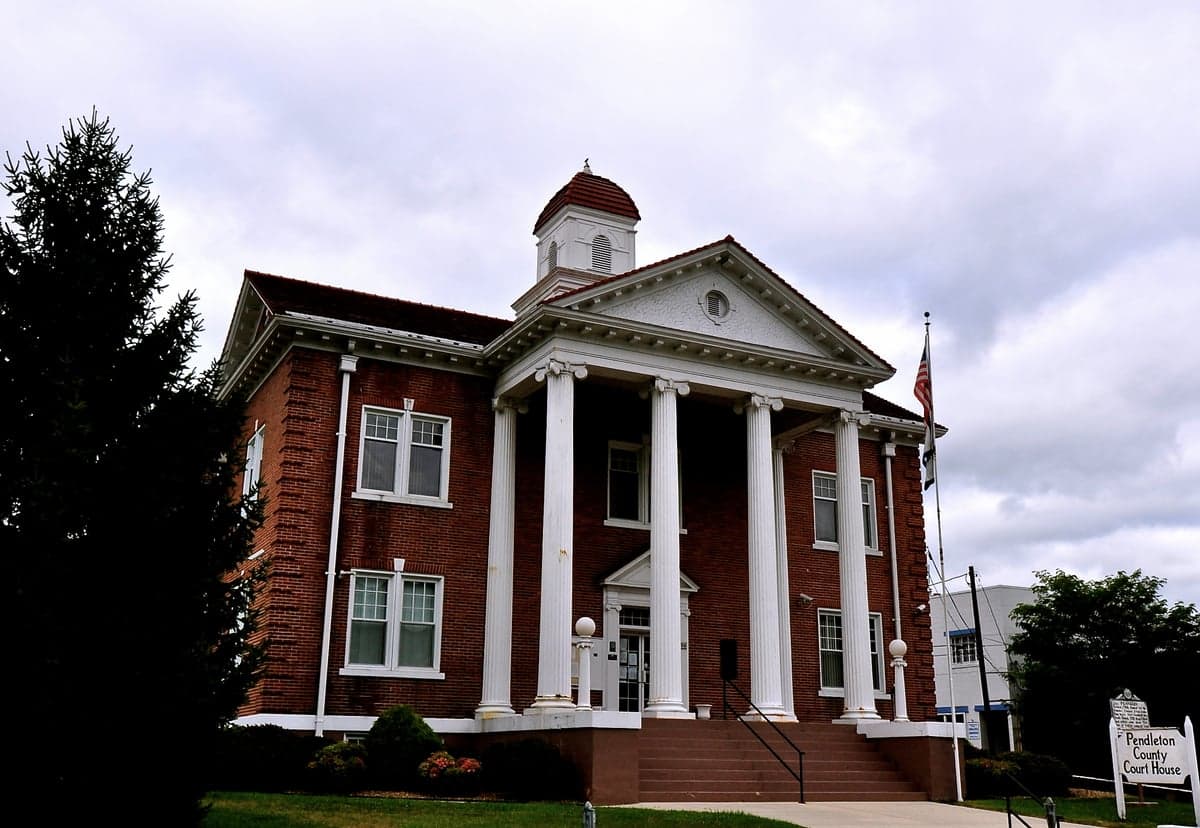
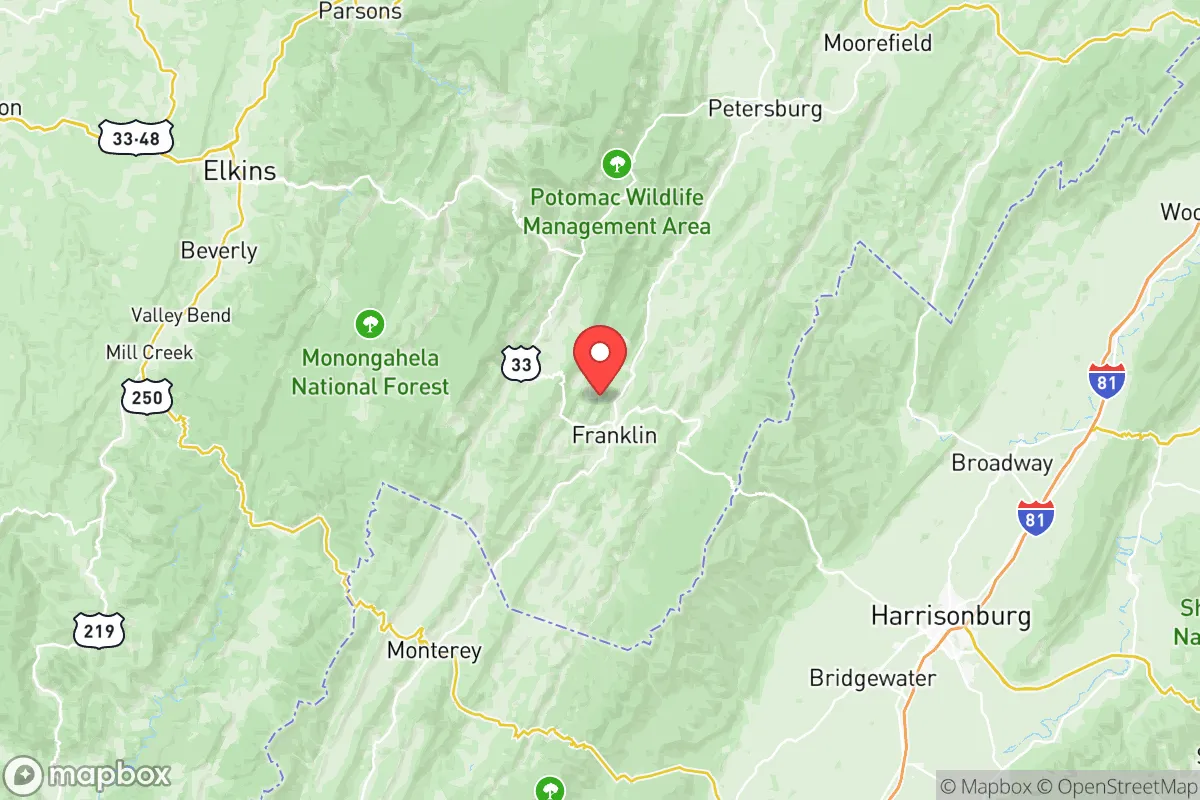
Photo: Wikipedia
Political ClimatePolitical Climate in Pendleton County
Showing district-level results — no local-only data available.
Local Political AnalysisPolitical Analysis of Pendleton County
Pendleton County is one of the most reliably Republican counties in West Virginia, with a Cook Partisan Voting Index (PVI) of R+22, meaning it votes about 22 points more Republican than the national average. This isn't a recent shift—the county has voted for the GOP presidential candidate in every election since 2000, and the margins have only grown wider. In 2020, Donald Trump carried Pendleton County with over 76% of the vote, a number that would have been unthinkable even 20 years ago when George W. Bush won it with a still-strong but less dominant 62%. The trajectory is clear: Pendleton is moving deeper red, driven by cultural conservatism and a growing distrust of federal environmental policies that affect the region's timber and outdoor recreation economies.
How it compares to West Virginia as a whole
West Virginia as a state is also deeply Republican—it voted for Trump by 39 points in 2020—but Pendleton County is notably more conservative than the state average. While the state's Cook PVI isn't officially published, most estimates place it around R+19 to R+21, meaning Pendleton is slightly to the right of the rest of West Virginia. The difference comes down to demographics: Pendleton has fewer union households than the coal-heavy southern coalfields, and its population is older and whiter than the state average. The county also lacks the kind of college town (like Morgantown or Huntington) that creates blue pockets elsewhere. That said, there are subtle variations within Pendleton. The town of Franklin, the county seat, is the most reliably red precinct, often voting 80%+ Republican. Circleville and Upper Tract are also deeply conservative. The only precinct that ever flirts with purple is Brandywine, where a handful of second-home owners from Northern Virginia and Maryland have moved in, bringing slightly more moderate views on issues like land conservation and local taxes. But even Brandywine hasn't voted Democratic for president since 2008.
What this means for residents
For conservative residents, the political climate is comfortable and affirming. Local offices—county commission, school board, sheriff—are held by Republicans, and there's little pressure to moderate views. Gun rights are broadly supported, and the county's resistance to state-level renewable energy mandates is a point of pride. For liberal or moderate residents, life is more isolating. There's no active Democratic party committee in the county, and progressive viewpoints are rarely voiced in public meetings. Socially, most people keep politics to themselves to avoid friction, but the 2020 election saw a few "Blue Lives Matter" signs and a handful of "Biden" yard signs in Franklin that were quickly vandalized. The practical effect is that liberal-leaning residents often drive to Harrisonburg, VA (about 45 minutes from Franklin) for cultural events or to find like-minded community. The county's politics also shape policy: Pendleton has resisted expanding broadband access through federal grants, citing distrust of government oversight, which has slowed internet development in rural areas.
Culturally, Pendleton County's politics are tied to its identity as a place where self-reliance and tradition matter more than party labels. The county's strong support for the Second Amendment isn't just political—it's a practical reality for hunting and predator control. The local resistance to zoning laws, even as second-home development increases, reflects a deep-seated libertarian streak that crosses party lines. In the near future, expect Pendleton to stay R+22 or even drift further right as younger residents move away and retirees from red states move in. The only wildcard is if federal land management policies—like expanded national forest protections—push some voters toward third-party candidates, but that's a long shot. For now, Pendleton County is a place where the political temperature is warm for conservatives and cool for everyone else, and that's unlikely to change anytime soon.

State Political ClimatePolitical Climate in West Virginia
State Political AnalysisPolitical Environment in the State
West Virginia has been one of the most reliably Republican states in the nation for over two decades, but that wasn’t always the case. As recently as the 1990s, the state was a Democratic stronghold at the local level, with a strong union and coal-mining heritage that kept it voting blue in presidential races through 1996. The shift began in earnest around 2000, accelerated by cultural and economic realignment, and by 2024, Donald Trump carried the state by nearly 40 points — the largest margin of any state. Today, the dominant coalition is a mix of rural, working-class, and evangelical voters who prioritize gun rights, energy independence, and limited government, while the old Democratic machine has largely collapsed, surviving only in a few isolated pockets.
Urban vs. rural divide
The political map of West Virginia is starkly divided between its small, struggling cities and its vast, deeply conservative rural expanse. The only real blue dot left is Morgantown, home to West Virginia University, which consistently votes Democratic — in 2024, Monongalia County went for Kamala Harris by about 8 points, driven by the student population and a more educated, younger workforce. Charleston, the capital, is a purple-to-light-blue area, with Kanawha County often within a few points of the national average, though it’s been trending right. Huntington and Wheeling are solidly red now, having flipped hard after the coal downturn. The real engine of the state’s Republican dominance is the rural south and central regions — places like Logan, Mingo, and McDowell counties, where Trump routinely pulls 80% of the vote. The eastern panhandle, including Martinsburg and Berkeley County, has become a conservative stronghold as well, fueled by in-migration from the D.C. suburbs and a strong libertarian streak. If you’re moving to Morgantown, you’ll find a liberal bubble; anywhere else, expect a deeply red environment.
Policy environment
West Virginia’s policy environment is among the most conservative in the country, with a strong emphasis on low taxes, limited regulation, and cultural traditionalism. The state has no personal income tax on Social Security benefits, and in 2023, lawmakers passed a phased elimination of the state income tax on wages, cutting rates by 21% initially with further reductions tied to revenue triggers. Property taxes are among the lowest in the nation, capped by the state constitution at 1% of assessed value for owner-occupied homes. The regulatory posture is aggressively pro-business, especially for energy extraction — coal, natural gas, and timber — with minimal environmental review for permits. Education policy is a flashpoint: the state passed a broad school choice law in 2021, creating Education Savings Accounts (ESAs) that let families use public funds for private or homeschool expenses, though implementation has been rocky. Healthcare is mixed — the state expanded Medicaid under the ACA, but abortion is heavily restricted, with a near-total ban in effect since 2022 (only exceptions for rape, incest, and medical emergency). Election laws are moderately restrictive: voter ID is required, early voting is available for 10 days, and no-excuse absentee voting is allowed. The state has no ballot initiative process, meaning all policy changes go through the legislature.
Recent policy direction
The last five years have seen West Virginia accelerate its conservative agenda across nearly every front. On gun and self-defense law, the state passed constitutional carry in 2016 and has repeatedly expanded it — no permit needed to carry concealed, and “stand your ground” is on the books. Parental and education rights are a top priority: the 2021 ESA law was followed by a 2023 bill banning “divisive concepts” in public schools (critical race theory, gender identity instruction), and a 2024 law requiring schools to notify parents of any changes to a child’s mental or physical health. Speech and privacy are generally strong — no social media censorship laws, but also no broad data privacy statute. Medical and bodily autonomy is sharply divided: the abortion ban is total, but medical marijuana was legalized in 2017 (though no dispensaries in some counties), and a 2023 law protects doctors who refuse to perform gender-affirming care for minors. Property rights are robust — the state has strong eminent domain protections, and a 2022 law made it easier to sue local governments for regulatory takings. Taxation is trending downward, with the income tax phase-out and a 2024 cut to the corporate net income tax from 6.5% to 5.5%. Voting and ballot access have tightened slightly: a 2021 law shortened the early voting period and added stricter ID requirements, but no major voter suppression controversies have emerged.
Civil unrest & political movements
West Virginia has a long history of labor activism, but today’s political movements are largely conservative and culturally focused. The most visible flashpoint in recent years was the 2018 statewide teachers’ strike, which shut down every public school for nine days and won a 5% pay raise — a rare moment of cross-partisan labor solidarity. Since then, the state has seen organized opposition to vaccine mandates (2021-2022), with large rallies at the Capitol in Charleston. The West Virginia Citizens Defense League is a powerful gun-rights group that regularly turns out hundreds for rallies. On the left, the West Virginia Working Families Party has a small but vocal presence in Morgantown and Charleston, focusing on healthcare and union rights. Immigration politics are muted — the state has a tiny foreign-born population (about 1.5%), and there are no sanctuary cities. Secession or nullification rhetoric is rare, though some rural counties have passed symbolic “Second Amendment sanctuary” resolutions. Election integrity controversies are minimal; the state uses paper ballots and has had no major fraud allegations. A new resident would notice that political signs and flags are ubiquitous, especially in rural areas, but actual conflict is rare — most people keep their heads down and go about their business.
Projection
Over the next 5-10 years, West Virginia is likely to become even more Republican, but with a twist. The state is losing population — it’s one of only three states that shrank in the 2020 Census — and the people leaving tend to be younger and more moderate, while those moving in are often retirees or remote workers from deep-red areas of the Midwest and South. This demographic shift will reinforce the conservative tilt, but it may also create new tensions. The eastern panhandle, especially around Martinsburg and Shepherdstown, is growing fast with ex-D.C. commuters who bring more libertarian and moderate views, potentially creating a purple corridor. Meanwhile, the coal counties in the south will continue to hollow out, reducing their political weight. The income tax phase-out, if fully implemented, could attract more remote workers and small businesses, but the state’s poor infrastructure and healthcare system remain major drags. Expect continued battles over education funding, abortion access (with possible further restrictions), and energy policy — the state is betting heavily on carbon capture and hydrogen to revive its economy. A person moving in now should expect a deeply conservative environment that is stable but slowly evolving, with the biggest changes coming from who moves in and who leaves.
For a new resident, the bottom line is this: West Virginia offers a low-cost, low-tax, high-freedom lifestyle for those who align with its conservative values, especially on guns, energy, and family policy. If you’re conservative, you’ll find a welcoming community and a government that largely stays out of your way. If you’re liberal, you’ll need to be comfortable being in the minority — Morgantown and Charleston offer some refuge, but the state’s politics will feel restrictive, particularly on social issues. The practical takeaway is to visit first, talk to locals, and understand that the state’s charm comes with trade-offs: beautiful scenery and low crime, but also limited services, poor roads, and a shrinking population. It’s a place where your vote matters a lot, but only if you’re voting red.
* Values derived from national, state, county, city and local statistics and may differ in a specific area. Last updated: 2026-10-05T19:22:27.000Z
Narrative content on this page is AI-generated and may contain mistakes. Verify any details that matter before acting on them.
ReloMaps may earn a commission from affiliate links at no extra cost to you.

