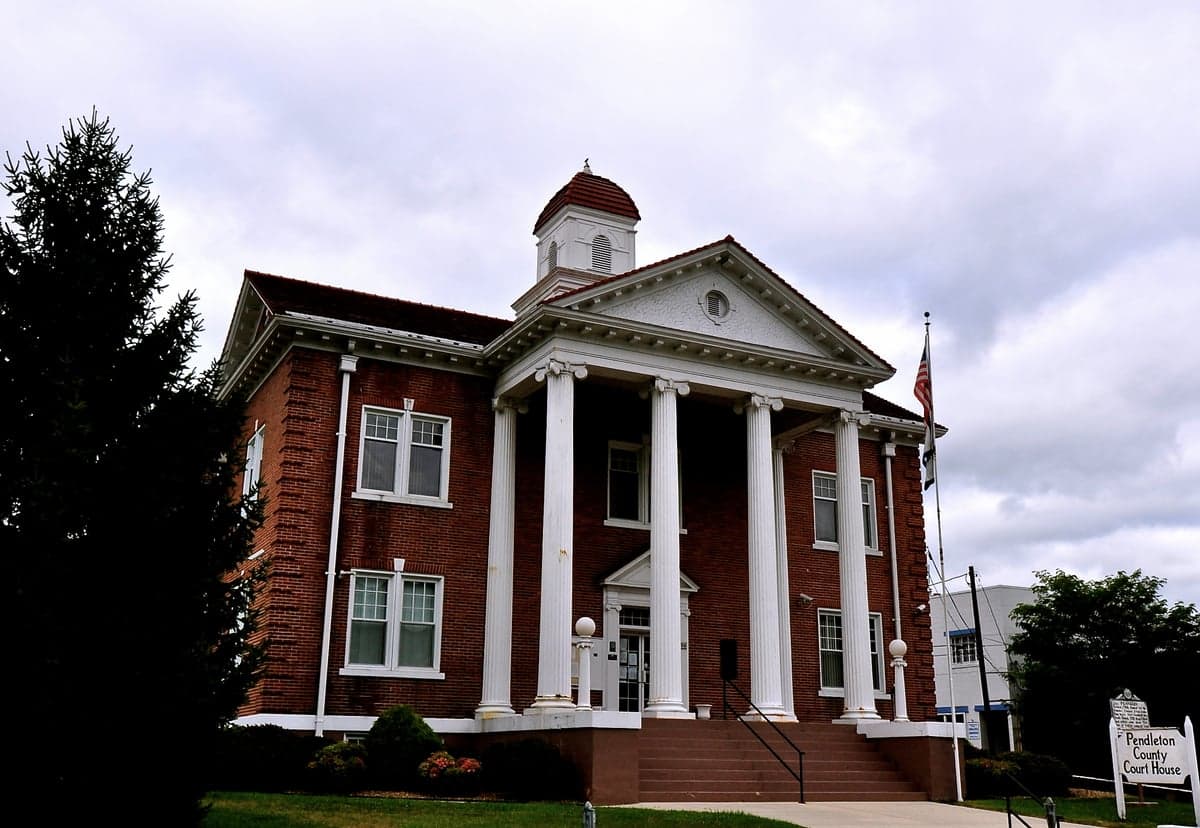
Photo: Wikipedia
Demographics of Pendleton County
Affluence Level in Pendleton County
A middle-class area roughly in line with national averages across income, home values, education, and employment.
People of Pendleton County
Pendleton County, West Virginia, is home to 6,111 residents who form one of the most ethnically homogeneous populations in the eastern United States, with 94.8% identifying as white and a foreign-born share of just 0.1%. This is a deeply rural, low-density county where the population has been declining for decades, and where the human story is one of early settlement by Scots-Irish and German pioneers, followed by a long, slow outmigration of younger generations. The county’s distinctive identity today is shaped by its isolation in the Allegheny Mountains, a strong tradition of family farming and hunting, and a population that is older and less formally educated than the state average, with only 20.5% holding a college degree.
Settlement & growth (pre-1960)
Long before European arrival, the land that is now Pendleton County was part of the hunting and trading grounds of the Seneca and other Iroquoian nations, as well as the Shawnee and Cherokee. The region was sparsely populated by Native peoples, who used the South Branch Potomac River valley as a travel corridor. European exploration began in the late 1600s, but permanent settlement did not take hold until after the French and Indian War, when the 1768 Treaty of Fort Stanwix opened the area to colonial expansion.
The first wave of settlers arrived in the 1770s, primarily Scots-Irish and German farmers pushing west from the Shenandoah Valley. These families were drawn by cheap land grants and the promise of fertile bottomland along the South Branch. They established the county’s earliest communities, including Franklin (the county seat, founded 1794), Upper Tract, and Circleville. The Germans, many of whom were Lutheran or Reformed, clustered in the northern part of the county around Moatstown and Brandywine, while the Scots-Irish, predominantly Presbyterian, settled more widely. A small number of English families also arrived, but the county’s cultural foundation was firmly Scots-Irish and German by 1800.
Throughout the 19th century, Pendleton County remained a subsistence farming region, with little industrial development. The county’s population peaked at 9,949 in 1900, then began a long decline as young people left for factory jobs in the Ohio Valley and Mid-Atlantic cities. The timber industry provided a brief economic boost in the early 1900s, with logging camps around Riverton and Onego, but the work was seasonal and did not anchor families. The Great Depression accelerated outmigration, and by 1940 the population had fallen to 8,845. No significant new immigrant groups arrived during this period; the county remained overwhelmingly native-born white, with a tiny Black population (mostly descendants of a few freed families who stayed after the Civil War) concentrated near Sugar Grove.
Modern era (post-1965)
The 1965 Hart-Cellar Act, which reshaped U.S. immigration, had virtually no effect on Pendleton County. The foreign-born population today is 0.1% — essentially zero. The county did not experience the post-1965 waves of Asian, Hispanic, or Indian immigration that transformed urban and suburban America. Instead, the modern demographic story is one of continued domestic outmigration and natural decrease (more deaths than births).
Since 1965, the county’s population has fallen from roughly 8,000 to 6,111, a decline of nearly 25%. Young adults leave for education and employment in Harrisonburg, Virginia, or the Eastern Panhandle, and few return. The Hispanic population, at 1.9%, is the only minority group to show any growth, driven by a small number of migrant farmworkers and their families who have settled in the Franklin area. The Black population, at 2.1%, is largely composed of long-standing families rather than new arrivals. East/Southeast Asian and Indian communities are negligible, each at 0.1%. Suburbanization has not occurred; there are no subdivisions or exurban developments. The county’s housing stock is aging, and many homes in outlying hamlets like Moyers and Champe stand empty or are used only seasonally.
The county’s racial and ethnic homogeneity is reinforced by its economy. Pendleton County has no major employers outside of government (the school system, county administration) and a few small manufacturing plants. The largest private employer is the Pendleton County Board of Education. There is no significant immigrant-service infrastructure, no ethnic grocery stores, and no religious institutions serving non-Christian communities. The county’s cultural identity remains rooted in its Scots-Irish and German heritage, with strong traditions of hunting, fishing, and evangelical Protestantism.
The future
Pendleton County’s population is projected to continue declining over the next 10-20 years, as the existing population ages and outmigration of young adults persists. The median age is already above 47, well over the national average. The county is not becoming more diverse; the Hispanic share may inch upward slowly, but from a very low base, and the white share will remain above 90% for the foreseeable future. New communities are not forming — the population is dispersing as families leave rural hollows and the remaining residents concentrate in Franklin and a few other service centers.
The county’s cultural identity is likely to remain stable, as there are no demographic or economic forces pushing toward change. The few newcomers who arrive are typically retirees from the Mid-Atlantic seeking cheap land and quiet, or remote workers who value the county’s low cost of living and natural beauty. These in-migrants are overwhelmingly white and native-born, reinforcing the existing character. The county will not become a destination for immigrant communities, nor will it suburbanize. Its future is one of slow, steady shrinkage, with a population that is older, whiter, and more rural than almost any other county in West Virginia.
For someone moving in now, Pendleton County offers a deeply traditional, low-density way of life with strong community ties and minimal diversity. It is a place where the human history is written in the names of families who have been on the same land for 250 years, and where the future looks very much like the present — only smaller. The county is not changing, and for those seeking a stable, homogeneous, rural environment, that is precisely its appeal.

* Values derived from national, state, county, city and local statistics and may differ in a specific area. Last updated: 2026-10-05T19:22:27.000Z
Narrative content on this page is AI-generated and may contain mistakes. Verify any details that matter before acting on them.
ReloMaps may earn a commission from affiliate links at no extra cost to you.

