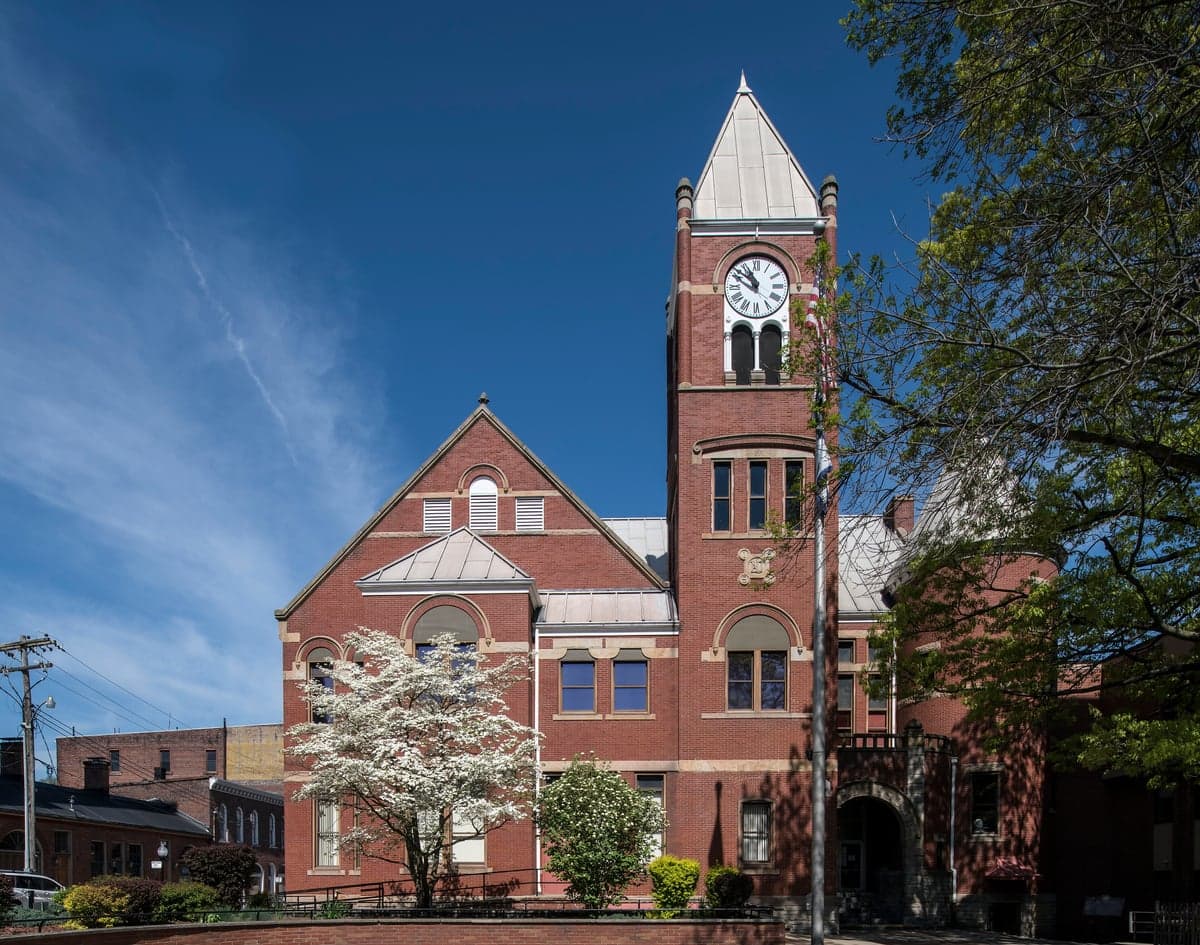
Photo: Wikipedia
Political ClimatePolitical Climate in Monongalia County
Showing district-level results — no local-only data available.
Local Political AnalysisPolitical Analysis of Monongalia County
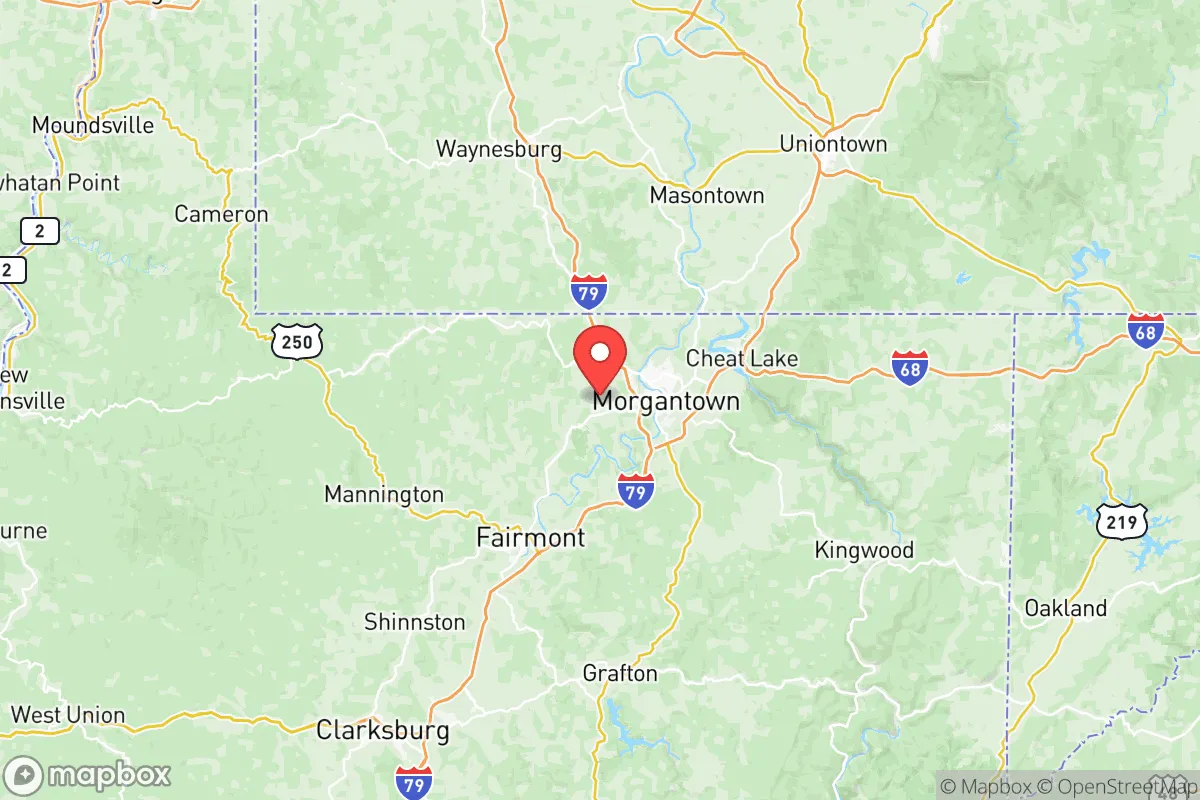
Monongalia County is a fascinating political outlier in deep-red West Virginia, leaning Republican overall with a Cook PVI of R+20, but that number masks a sharp urban-rural divide that makes it one of the most politically dynamic places in the state. The county has been trending redder over the last decade, driven by rural precincts outside Morgantown, but the city itself—home to West Virginia University—remains a stubborn blue island. In 2024, the county voted for Trump by a comfortable margin, but Morgantown's core precincts, like those around the downtown and the Evansdale campus, consistently break for Democrats, sometimes by double digits. Meanwhile, towns like Star City and Granville are more purple, often swinging with the national mood, while rural communities like Blacksville, Cassville, and Osage are deeply conservative, often voting 70%+ Republican. The result is a county that feels like two different political worlds sharing the same ZIP code.
How it compares
Monongalia County's R+20 PVI is nearly identical to West Virginia's statewide R+21, but the comparison is deceptive because the county's political geography is far more polarized than the state as a whole. Statewide, West Virginia is uniformly red outside of a few small blue dots like Charleston and the Eastern Panhandle; Monongalia, by contrast, has a genuine two-party contest within its borders. The Morgantown city council is reliably Democratic, and the county commission has a 2-1 Republican majority, reflecting the split. In state legislative races, the county sends a mix of Republicans and Democrats to Charleston, unlike most West Virginia counties that are all-Republican. The key difference is that Monongalia's blue vote is concentrated and vocal, while the state's Democratic Party has collapsed outside of a few urban pockets. So while the PVI numbers look similar, the lived political experience is much more competitive and contested in Monongalia than in, say, Wetzel or Marion County.
What this means for residents
For conservative residents, Monongalia County is a comfortable place to live politically, with Republican majorities in most rural and suburban precincts and a county commission that generally reflects their values. They can expect lower taxes and fewer regulations than in blue states, and the local GOP is active and organized. For liberal residents, the picture is more complicated: Morgantown provides a progressive bubble with a Democratic city government, a strong local food co-op, and active social justice groups, but they are a clear minority in the county at large. Statewide policies—like abortion restrictions, gun laws, and education funding—are set by a supermajority Republican legislature in Charleston, which can feel frustrating for Morgantown progressives. The upside is that the university environment creates a tolerant, diverse community within the city, and local elections are genuinely competitive, giving Democrats a real chance to influence city and county policy.
Culturally, the divide between Morgantown and the rest of the county is stark. In the city, you'll find craft breweries, a vibrant farmers market, and a young, transient population shaped by the university. Drive 15 minutes out to Westover or Cheat Lake, and the vibe shifts to family-oriented suburbs with churches, chain restaurants, and a more traditional Appalachian sensibility. The county's gun culture is strong—open carry is common in rural areas—but Morgantown has a more relaxed, college-town feel. Property taxes are low by national standards, and the cost of living is a major draw for both conservatives and liberals. The biggest policy distinction within the county is land use: rural residents fiercely oppose zoning and development restrictions, while Morgantown has embraced smart-growth planning and density. That tension—between the city's progressive urbanism and the county's libertarian rural ethos—defines Monongalia's political character more than any single election result.

State Political ClimatePolitical Climate in West Virginia
State Political AnalysisPolitical Environment in the State
West Virginia is one of the most reliably Republican states in the nation, carrying a Cook Partisan Voting Index of R+21, meaning it votes about 21 points more Republican than the national average. This wasn't always the case—as recently as the 1990s, the state was a Democratic stronghold, but a dramatic realignment over the past two decades has flipped it decisively red. Today, the dominant coalition is a mix of rural conservatives, working-class voters who have abandoned the national Democratic Party, and a growing number of transplants drawn by low taxes and a traditional lifestyle. The shift has been so complete that in 2024, Donald Trump won the state by nearly 40 points, with every single county voting Republican for the first time in modern history.
Urban vs. rural divide
The political map of West Virginia is surprisingly uniform compared to most states—there are no major Democratic strongholds left. The largest city, Charleston, once a union-heavy Democratic bastion, has trended rightward, though it remains the most competitive area in the state. Kanawha County, which contains Charleston, voted for Trump by about 20 points in 2024—still red, but notably less so than the rest of the state. Morgantown, home to West Virginia University, is the most liberal-leaning city, with younger voters and academics creating a small blue pocket in Monongalia County, which still went Republican but by a narrower margin. On the other end, the rural southern coalfields—places like Logan, Mingo, and McDowell counties—are among the most Republican in the nation, often voting 80% or higher for GOP candidates. The eastern panhandle, including Martinsburg and Charles Town, has seen an influx of former Washington D.C. area residents, which has slightly moderated the politics there, but these areas remain solidly red. The divide isn't really urban versus rural in the traditional sense—it's more about education levels and exposure to out-of-state migration, with college towns and exurbs showing the faintest signs of purple.
Policy environment
West Virginia's policy environment is aggressively conservative by national standards. The state has no personal income tax on most earned income after a 2023 phase-out, though it does tax interest and dividends, and sales tax is a moderate 6%. Property taxes are among the lowest in the country, a major draw for relocators. The regulatory posture is business-friendly, with right-to-work laws on the books and a legal climate that favors employers. Education policy has shifted sharply: the state passed one of the nation's broadest school choice laws in 2021, creating education savings accounts usable for private school tuition, homeschooling costs, and other expenses. Healthcare is a mixed bag—Medicaid expansion was accepted under the Affordable Care Act, but the state has not pursued a state-based exchange and has some of the highest rates of chronic disease and opioid-related deaths in the nation. Election laws have tightened: voter ID is required, early voting is available but limited, and absentee voting requires an excuse. The state also passed a law in 2023 banning ballot drop boxes, a move that drew national attention.
Recent policy direction
The last few years have seen a flurry of legislation that signals where the state is headed. On gun and self-defense law, West Virginia is a constitutional carry state—no permit needed for concealed carry—and in 2023, it passed a law prohibiting state and local law enforcement from enforcing any future federal gun restrictions, a direct challenge to federal authority. Parental and education rights have been a major focus: the 2021 education savings account law was expanded in 2023, and the state passed a "Parents' Bill of Rights" in 2022 requiring schools to notify parents about curriculum changes and medical services. On speech and privacy, the state has no broad privacy law, but it passed a law in 2023 protecting students from being compelled to use pronouns that don't align with their biological sex. Medical and bodily autonomy is heavily restricted: abortion is banned at all stages of pregnancy with very narrow exceptions, and the state has not expanded access to gender-affirming care for minors, with a ban passed in 2023. Property rights are strong, with no state-level rent control and a robust homestead exemption. Taxation is trending downward: the income tax phase-out is ongoing, and there's talk of eliminating the tax on interest and dividends entirely. Voting and ballot access has tightened, with the drop box ban and stricter ID requirements, though voter registration remains relatively easy online.
Civil unrest & political movements
West Virginia has a history of labor activism, but that has largely faded as the coal industry declined. The most visible political movements today are on the right: the state was an early hotbed for the Tea Party, and more recently, groups focused on election integrity and Second Amendment sanctuary counties have been active. In 2020 and 2021, there were protests at the state capitol in Charleston against COVID-19 restrictions, drawing thousands. The "sanctuary city" debate is essentially nonexistent—no West Virginia jurisdiction has declared itself a sanctuary for undocumented immigrants, and the state passed a law in 2020 requiring all law enforcement to cooperate with federal immigration authorities. Secession and nullification rhetoric is present but fringe; the 2023 gun law that nullifies federal firearms restrictions is the most concrete example of this trend. Election integrity controversies have been minimal compared to other states, though the 2020 election saw some local disputes over absentee ballot procedures. A new resident would notice that political signs and flags are ubiquitous, especially in rural areas, and that political conversations are common and direct. There's little of the guardedness you'd find in more polarized states—people here are generally happy to tell you exactly where they stand.
Projection
Over the next 5-10 years, West Virginia is likely to remain deeply Republican, but the character of that Republicanism may shift. The state is losing population overall, but the areas that are growing—the eastern panhandle around Martinsburg and the Morgantown area—are attracting more moderate, educated newcomers who may push the state slightly toward the center on some issues. The southern coalfields will continue to shrink and become even more conservative. The biggest wildcard is the state's economy: if the transition away from coal accelerates, the political coalition that currently dominates could fracture. However, the in-migration of remote workers and retirees, drawn by low taxes and a slower pace of life, will likely reinforce the state's conservative bent, as these newcomers tend to be fiscally conservative even if they're more moderate on social issues. The policy direction is clear: continued tax cuts, expanded school choice, and further restrictions on abortion and transgender rights. A move toward privatizing the state's workers' compensation system or further deregulating healthcare is possible. The Democratic Party in West Virginia is essentially a non-factor at the state level and will remain so for the foreseeable future.
For someone moving to West Virginia, the practical takeaway is straightforward: if you're conservative, you'll find a state that largely aligns with your values on taxes, guns, education, and social issues. If you're liberal, you'll be in a clear minority, but you won't face hostility in most everyday settings—the state's politics are intense but generally polite in person. The low cost of living and lack of income tax are genuine benefits, but they come with trade-offs in public services and infrastructure. The state is politically stable and unlikely to see dramatic shifts, so what you see now is largely what you'll get for the next decade. Just be prepared for a lot of political yard signs and a population that's not shy about discussing them.
* Values derived from national, state, county, city and local statistics and may differ in a specific area. Last updated: 2026-07-02T21:07:50.000Z
Narrative content on this page is AI-generated and may contain mistakes. Verify any details that matter before acting on them.
ReloMaps may earn a commission from affiliate links at no extra cost to you.

