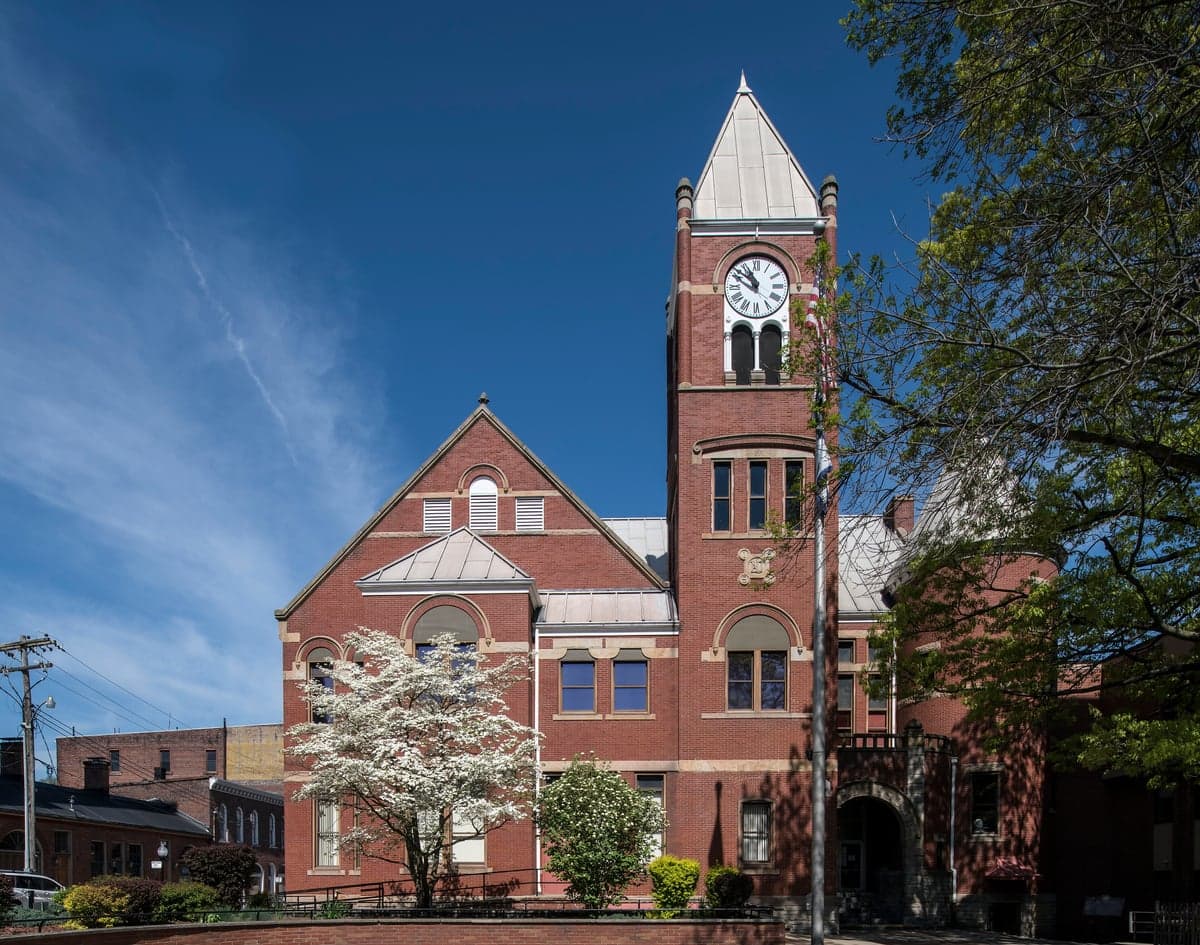
Photo: Wikipedia
Demographics of Monongalia County
Affluence Level in Monongalia County
A middle-class area roughly in line with national averages across income, home values, education, and employment.
People of Monongalia County
Monongalia County, home to 106,520 residents, is a predominantly white (86.2%) and highly educated (47.9% college-educated) Appalachian county anchored by Morgantown and West Virginia University. Its population is notably less diverse than the national average, with a foreign-born share of just 3.0%, yet it has experienced modest growth from international graduate students and professionals tied to the university and healthcare sectors. The county’s identity is a blend of historic Scots-Irish and German settlement roots, a strong university-town character, and a slowly diversifying demographic base that remains distinct from the broader Rust Belt or Sun Belt patterns.
Settlement & growth (pre-1960)
Before European settlement, the region now known as Monongalia County was part of the hunting and trading grounds of the Shawnee, Delaware (Lenape), and Mingo peoples, with the Monongahela River serving as a key travel corridor. The area saw little permanent Native settlement, but seasonal camps and trails dotted the river valleys. French and British traders passed through in the early 1700s, but no permanent colonial outposts were established until after the French and Indian War (1754–1763).
The first permanent European settlers were largely Scots-Irish and German pioneers who pushed west from Pennsylvania and Maryland along the Monongahela River after the 1768 Treaty of Fort Stanwix opened the region to Anglo-American settlement. These families, often Presbyterian or Lutheran, established small farms and riverfront communities. The town of Morgantown, founded in 1772 by Zackquill Morgan, became the county seat and a trading hub for the surrounding agricultural settlements. Other early hamlets like Granville and Star City grew as river landings and mill sites. The county was formally created in 1776 from part of Augusta County, Virginia, and named for the Monongahela River.
Through the 19th century, the population remained overwhelmingly of British Isles and German stock, with small numbers of free Black families and, later, freed slaves after the Civil War. The arrival of the Baltimore and Ohio Railroad in the 1850s spurred the growth of coal mining in the county’s southern and eastern townships. Mining camps and company towns like Osage, Cassville, and Jakes Run attracted a new wave of immigrants: Italian, Polish, and Hungarian laborers arrived in the 1880s–1910s to work the coal seams. These groups formed small ethnic enclaves in the mining patches, with Catholic churches and fraternal societies anchoring their communities. By 1920, the county’s population had grown to roughly 33,000, with about 5–7% foreign-born, mostly from Southern and Eastern Europe.
The post-World War II era brought a different kind of migration: the expansion of West Virginia University (WVU) in Morgantown drew faculty, administrators, and students from across the state and the broader Mid-Atlantic. The GI Bill fueled enrollment growth, and the university became the county’s largest employer. Suburban development spread into Westover and Cheat Lake, where new ranch-style homes housed a growing middle class of professionals and returning veterans. By 1960, the county’s population had reached about 55,000, still overwhelmingly white and native-born, but with a growing professional and academic class that distinguished Morgantown from the surrounding coal-dependent towns.
Modern era (post-1965)
The 1965 Hart-Cellar Act had a limited direct impact on Monongalia County compared to major metropolitan areas, but it did open the door for a small but steady stream of international graduate students and faculty at WVU. The university’s engineering, medical, and business programs attracted students from East and Southeast Asia (primarily China, South Korea, and Vietnam), as well as from India. These groups remain the largest foreign-born populations in the county today. The East/Southeast Asian community makes up about 2.4% of the county’s population, while the Indian subcontinent community accounts for roughly 1.1%. Many of these individuals settle in Morgantown proper, particularly in neighborhoods near the university campus and the WVU Medicine Ruby Memorial Hospital complex.
Domestic migration patterns since 1970 have been shaped by two countervailing forces. On one hand, the decline of the coal industry in the 1980s and 1990s led to outmigration from the county’s southern mining towns like Osage and Cassville, as younger residents left for jobs in the Carolinas, Texas, or the Ohio Valley. On the other hand, the growth of WVU and the healthcare sector (WVU Medicine is now the county’s largest employer) attracted in-migration from other parts of West Virginia and neighboring states. The county’s Hispanic population, now 3.1%, grew modestly after 2000, driven by a mix of construction and service-sector workers, as well as a small number of agricultural laborers in the county’s rural eastern townships. The Black population, at 3.5%, is concentrated in Morgantown and reflects both long-standing African American families and a newer cohort of university-affiliated professionals.
Suburbanization has been most pronounced around Cheat Lake, where lakefront homes and newer subdivisions have drawn affluent professionals and retirees. The town of Granville has also seen new residential development, including student-oriented apartment complexes. Meanwhile, the county’s rural areas—towns like Blacksville and Wadestown in the western panhandle—have experienced population stagnation or decline, as younger residents move toward Morgantown or leave the region entirely.
The future
Monongalia County’s population is projected to grow slowly, driven primarily by the continued expansion of WVU and WVU Medicine. The county’s foreign-born share, while low, will likely increase modestly as the university recruits more international students and faculty, particularly from East and Southeast Asia and India. These groups are expected to remain concentrated in Morgantown, with some dispersal into Cheat Lake and Granville as families seek better schools and housing. The Hispanic and Black populations are likely to grow slowly, primarily through domestic migration from other parts of the country, but the county will remain far less diverse than the U.S. average for the foreseeable future.
The cultural identity of the county is evolving from a historically Appalachian, coal-and-farming base toward a more university-centered, professional-service economy. This shift is creating a cultural divide between the Morgantown-Cheat Lake corridor, which is becoming more educated, more secular, and more politically moderate, and the county’s rural towns, which retain a more traditional, conservative, and church-oriented character. The county’s overall political leanings reflect this split: Monongalia County voted for Donald Trump in 2024, but by a narrower margin than most West Virginia counties, with Morgantown’s precincts leaning Democratic.
For someone moving in now, Monongalia County offers a distinctive blend: a small-city university environment with strong healthcare and education sectors, surrounded by rural Appalachian landscapes. The population is stable and slowly diversifying, but newcomers should expect a community that remains predominantly white, native-born, and culturally rooted in West Virginia traditions. The county is not a high-growth, high-diversity destination like a Sun Belt suburb, but rather a steady, institution-anchored community where the university and hospital shape daily life and long-term prospects.

* Values derived from national, state, county, city and local statistics and may differ in a specific area. Last updated: 2026-07-02T21:07:50.000Z
Narrative content on this page is AI-generated and may contain mistakes. Verify any details that matter before acting on them.
ReloMaps may earn a commission from affiliate links at no extra cost to you.

