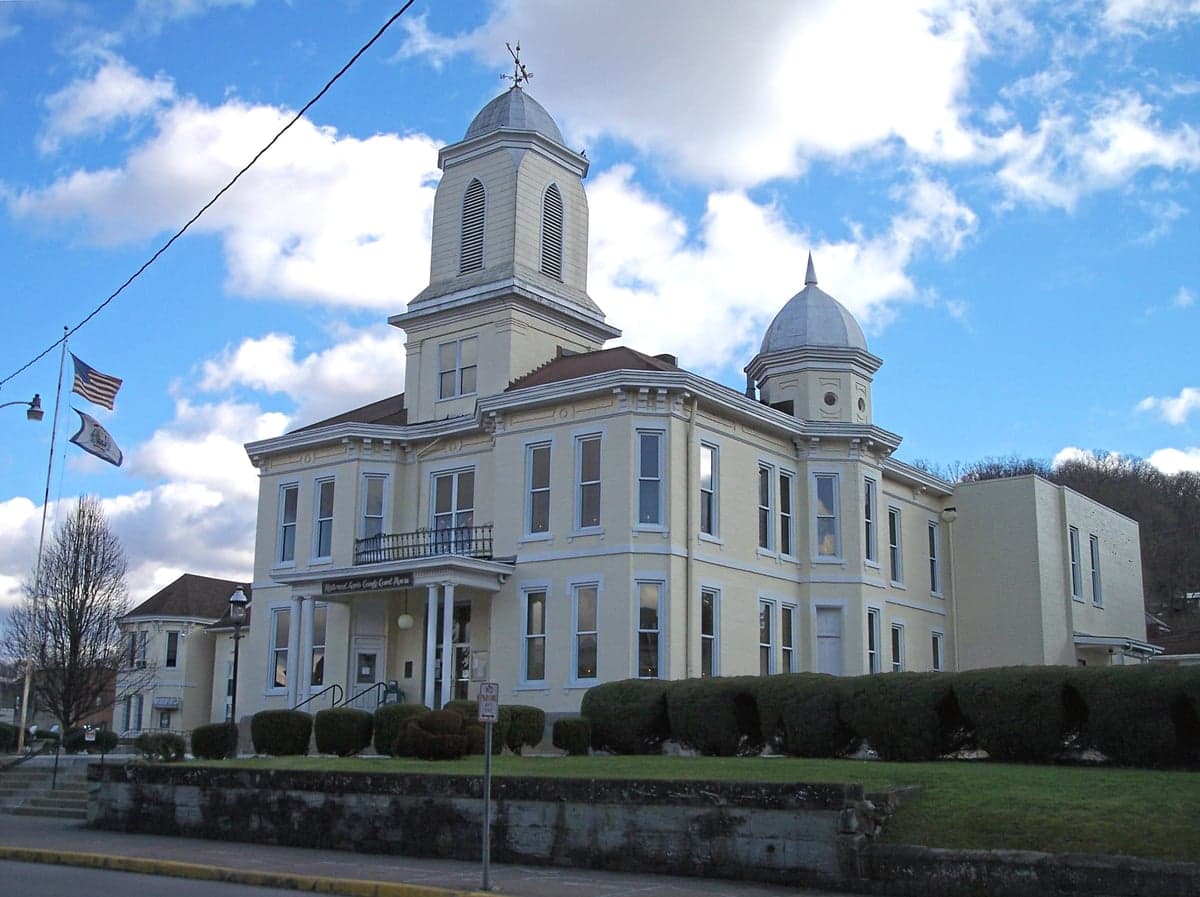
Photo: Wikipedia
Political ClimatePolitical Climate in Lewis County
Showing district-level results — no local-only data available.
Local Political AnalysisPolitical Analysis of Lewis County
Lewis County leans solidly Republican with a Cook PVI of R+20, making it slightly less red than West Virginia's statewide R+21 but still deeply conservative. The county has been reliably red for decades, though the margins have tightened a bit in presidential races since 2016 — Trump won 74% of the vote here in 2020, down from 79% in 2016 — as some suburban precincts around Weston have shifted toward Democrats. If you're moving here, you're moving into a place where Republican signs outnumber Democratic ones by a wide margin, but the kind of Republicanism you'll find varies a lot from town to town. Weston, the county seat, is the pivot point: its downtown precincts have trended bluer over the last two cycles, driven by younger residents and state workers. Meanwhile, rural areas like Alum Bridge and Ireland stay deeply red, often voting 80%+ Republican. Swing precincts are almost nonexistent — the only real split is in the Howell Tract area near the Upshur County line, where registered Democrats still show up but often split tickets for local offices.
How it compares to the rest of West Virginia
At R+20, Lewis County is a hair less conservative than the state's R+21 average, but that's a meaningful difference inside West Virginia's political map. The gap comes from Weston's small but persistent Democratic base — about 30% of registered voters in the county seat still carry a Democratic registration, mostly from the United Mine Workers and teacher union days. That compares to places like Buckhannon or Elkins, where Democratic registration has collapsed. Countywide, though, the voting patterns mirror much of north-central West Virginia: heavy on coal and natural gas support, strong Second Amendment sentiment, and a general distrust of federal environmental regulations. The state as a whole has been trending red since 2000, but Lewis County's shift has been slower — it only flipped from Democratic to Republican control of the county commission in 2014, later than many neighboring counties. For context, surrounding Harrison County (Clarksburg) is R+15 and has more labor union holdout, while Lewis is more uniformly conservative outside Weston proper.
What this means for residents
For conservative residents, Lewis County offers a comfortable environment where most local officials share their views on taxes, gun rights, and energy development. The county commission and board of education have been Republican-majority since the mid-2010s, meaning zoning is minimal, property taxes stay low, and the county generally avoids progressive social initiatives. For liberal or moderate residents, the reality is more nuanced — you won't find many overtly progressive policies, but you also won't face the kind of sharp polarization you'd see in a fast-growing suburb. The local Democratic Party is small but active, mostly centered in Weston's historic district, and it's common for Democrats to win seats on the city council and school board. The biggest challenge for progressives is on cultural issues: the county passed a Second Amendment sanctuary resolution in 2020, and abortion-related ballot measures routinely pass with 70%+ support. What matters most day-to-day is that the political climate here is civil compared to many places — neighbors disagree without hostility, and local governance is low-drama. If you're a liberal renter in Weston, you'll find the county frustrating on issues like rental inspections, but you won't be treated poorly for your politics.
One real distinction in Lewis County is the lingering influence of union politics, even in a Republican county. The United Mine Workers still has a presence in the southern part of the county near Camden, and it's not uncommon to see union Democrat candidates win local races in precincts around the old mining camps. That's fading fast — younger workers in the natural gas fields around West Milford lean hard right — but it gives the political culture a working-class flavor rather than the suburban conservatism you'd find in Morgantown or Charles Town. The county's drug policy is another distinctive point: officials here have been more willing than the state average to fund harm reduction programs, including a needle exchange in Weston that survived a 2022 county commission challenge. It's not a liberal county by any stretch, but it's a pragmatic one, and that matters more in daily life than the R+20 label suggests. Over the next decade, expect the red to deepen slightly as older union Democrats pass away, but Weston's small blue pocket will likely stick around as an affordable option for remote workers priced out of Morgantown.

State Political ClimatePolitical Climate in West Virginia
State Political AnalysisPolitical Environment in the State
West Virginia is one of the most reliably Republican states in the nation, with a Cook Partisan Voting Index of R+21, meaning it votes about 21 points more Republican than the national average in presidential elections. This wasn’t always the case—as recently as the 1990s, the state was a Democratic stronghold, but a seismic shift began in the 2000s as cultural and economic ties to the national Democratic Party frayed. Over the last 20 years, the GOP has swept nearly every statewide office, and the legislature has become overwhelmingly Republican, driven by a working-class electorate that now reliably backs conservative candidates by margins of 30 to 40 points in most counties.
Urban vs. rural divide
The political map of West Virginia is starkly divided between a handful of small urban centers and the vast rural expanse. The state’s largest metro area, Charleston (Kanawha County), leans Republican but is more competitive—Trump won it by about 12 points in 2020, while rural counties like Mingo and Logan gave him 75-80% of the vote. Morgantown (Monongalia County), home to West Virginia University, is the state’s most liberal pocket, often voting Democratic by single digits due to the academic and student population. Huntington (Cabell County) and Wheeling (Ohio County) are reliably Republican but less lopsided than the coal country counties. The rural southern coalfields—places like Beckley (Raleigh County) and Bluefield (Mercer County)—are deeply red, with GOP margins often exceeding 50 points. The divide isn’t just about population density; it’s about economic identity, with unionized industrial workers in the north (especially around Weirton and Parkersburg) still showing some Democratic lean, while the southern coalfields have shifted hard right over cultural and gun issues.
Policy environment
West Virginia’s policy environment is aggressively conservative by national standards. The state has no personal income tax on most wages (phased out starting in 2022, with a 3.99% top rate on high earners), and the sales tax is a low 6%. Property taxes are among the lowest in the country, capped by the state constitution. The regulatory posture is business-friendly, with right-to-work laws and a weak collective bargaining environment—public sector unions have been curtailed since 2016. Education policy is a flashpoint: the state has a robust charter school law (passed 2019) and a school voucher program (the Hope Scholarship, enacted 2021) that lets families use public funds for private or homeschool expenses. Healthcare is mixed—Medicaid expansion under the ACA was adopted in 2013, covering about 200,000 residents, but the state has some of the strictest abortion laws in the nation (a near-total ban with no exceptions for rape or incest, effective 2022). Election laws are restrictive: voter ID is required, early voting is limited to 10 days, and no-excuse absentee voting was ended in 2021. The state also has a constitutional carry law (permitless concealed carry, effective 2016) and strong castle doctrine protections.
Recent policy direction
Over the last five years, West Virginia has moved decisively toward a maximalist conservative agenda. In 2022, the legislature passed a near-total abortion ban (HB 302) with no exceptions for rape or incest, only for medical emergencies—one of the strictest in the country. On gun rights, the state enacted permitless carry in 2016 and preempted local gun ordinances in 2015, meaning cities like Charleston cannot pass their own restrictions. Parental rights in education were strengthened with the 2021 “Parental Bill of Rights” (HB 2080), which requires schools to notify parents of any curriculum changes and allows them to opt children out of sex education. On speech and privacy, the state passed a law in 2023 (SB 496) prohibiting social media platforms from censoring users based on political viewpoints, though it faces legal challenges. Medical and bodily autonomy is limited: gender-affirming care for minors was banned in 2023 (HB 2007), and the state has no shield laws for out-of-state abortion seekers. Property rights are strong, with no statewide zoning in most rural areas and a 2022 law (HB 4001) limiting eminent domain for carbon pipelines. Voting access tightened in 2021 with SB 1, which shortened early voting and banned ballot drop boxes. Taxation is trending downward: the personal income tax rate was cut from 6.5% to 3.99% in 2022, with a goal of full elimination by 2026.
Civil unrest & political movements
West Virginia has a history of labor militancy, but recent political movements are dominated by cultural and economic grievances. The 2018 teachers’ strike—the largest in state history—shut down all 55 counties for nine days and won a 5% pay raise, but it was a rare moment of cross-partisan unity. Since then, organized labor has lost influence as right-to-work laws took hold. On the right, the “Second Amendment Sanctuary” movement swept through over 30 counties in 2019-2020, with local resolutions vowing not to enforce certain gun laws. Immigration politics are muted—the state has one of the smallest foreign-born populations in the U.S. (about 1.5%)—but there are no sanctuary policies, and a 2020 law (HB 4520) requires local law enforcement to cooperate with ICE. Election integrity controversies flared after 2020, with the GOP-controlled legislature passing SB 1 in 2021 to tighten voting rules, citing unsubstantiated fraud claims. There’s a small but vocal secessionist movement in the eastern panhandle (around Martinsburg and Charles Town), where some residents feel culturally aligned with Virginia and have floated proposals to break away—though nothing serious has materialized. Visible flashpoints include the 2022 protests over the Mountain Valley Pipeline, which saw clashes between environmental activists and law enforcement in Lewisburg and Fayetteville.
Projection
Over the next 5-10 years, West Virginia is likely to become even more Republican, but with a twist. The state is losing population—down about 3% since 2020—and the exodus is concentrated among younger, more moderate residents, leaving an older, whiter, and more conservative electorate. In-migration is minimal, mostly retirees from the Midwest and some remote workers drawn to cheap land in the eastern panhandle (around Shepherdstown and Harpers Ferry). These newcomers tend to be more libertarian than traditional conservative, favoring low taxes and gun rights but sometimes clashing on environmental issues (e.g., opposition to mountaintop removal mining). The Democratic Party is essentially a non-factor in statewide races; the real political fights will be within the GOP, between the establishment wing (pro-business, pro-energy) and the populist wing (anti-vaccine, anti-establishment). Expect further tax cuts, continued erosion of public education funding (vouchers will expand), and a hardening of social conservative positions on abortion and transgender rights. The state’s economic dependence on natural gas and coal means climate policy will remain a wedge, but the decline of coal will accelerate, potentially creating a new political cleavage around economic diversification versus preservation of the old economy.
For a new resident, the bottom line is this: if you’re conservative, you’ll find a state that matches your values on guns, taxes, and social issues, with a government that’s actively moving in your direction. If you’re liberal, you’ll be in a distinct minority, especially outside Morgantown and a few college towns—expect to feel politically isolated, but you’ll also enjoy some of the lowest costs of living in the country and a hands-off government in your daily life. The state’s trajectory is toward deeper red, but with a libertarian streak that values individual freedom over government intervention, which can appeal to both sides on different issues. Just know that the political climate is intense, and local politics—especially in county commissions and school boards—can be more contentious than the national headlines suggest.
* Values derived from national, state, county, city and local statistics and may differ in a specific area. Last updated: 2026-06-29T10:27:28.000Z
Narrative content on this page is AI-generated and may contain mistakes. Verify any details that matter before acting on them.
ReloMaps may earn a commission from affiliate links at no extra cost to you.

