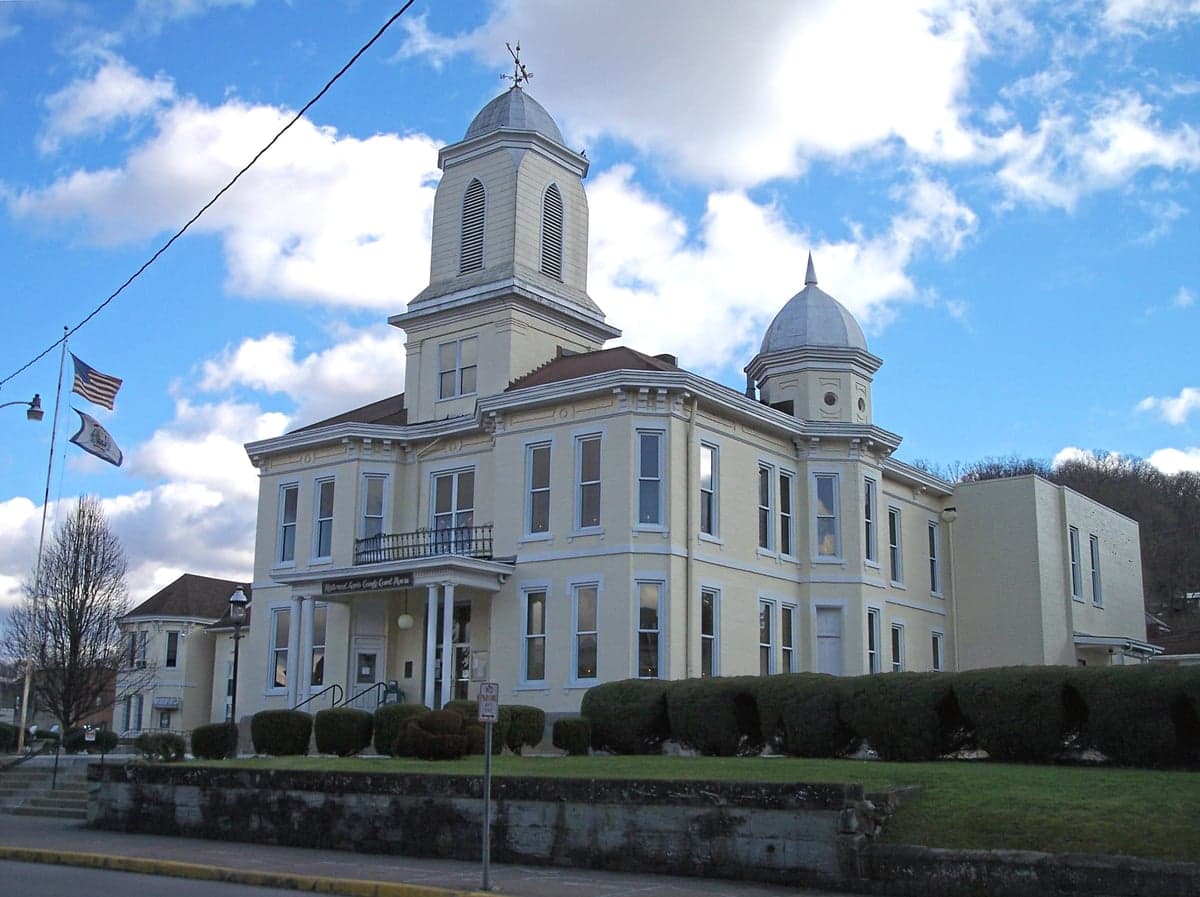
Photo: Wikipedia
Demographics of Lewis County
Affluence Level in Lewis County
A below-average socioeconomic profile. Incomes, home values, and educational attainment trail the U.S., with higher poverty and unemployment.
People of Lewis County
The people of Lewis County, West Virginia today are a predominantly White (91.2%) and historically rooted population of 16,808, characterized by a strong sense of local identity and a deeply rural, small-town way of life. With no foreign-born residents reported and a college education rate of just 17.5%, the county’s population is one of the most ethnically homogenous and least globally connected in the state. Its distinctive markers include a deeply ingrained Appalachian culture, a reliance on resource-based industries like timber and natural gas, and a population that has steadily declined for decades, creating an aging demographic profile.
Settlement & growth (pre-1960)
Before European settlement, the area that is now Lewis County was part of the vast hunting grounds of the Shawnee and Mingo peoples, with the West Fork River serving as a key travel corridor. The region saw no permanent European settlements until after the French and Indian War, when the 1768 Treaty of Fort Stanwix opened the land to colonial settlers. These first pioneers were overwhelmingly of Scots-Irish and German ancestry, migrating from Pennsylvania and the Shenandoah Valley along the Great Wagon Road.
The county was formally created in 1816 from a portion of Harrison County and named for Colonel Charles Lewis, a Virginia frontiersman killed in the Battle of Point Pleasant. The earliest settlements clustered along the West Fork River, with the town of Weston, established in 1818, quickly becoming the county seat and commercial hub. The arrival of the Baltimore and Ohio Railroad in the 1850s transformed Weston into a manufacturing and transportation center, drawing a second wave of settlers — primarily Irish immigrants who worked on railroad construction and later in the town’s booming glass and pottery factories.
The post-Civil War era saw the expansion of the timber and coal industries, which attracted a smaller but notable influx of Italian and Polish immigrants to work in the sawmills and mines. Towns like Jane Lew, founded as a railroad stop in the 1880s, grew around these industries, while Alum Bridge and Vadis developed as rural crossroads serving the farming and logging communities. The population peaked at around 20,000 in the early 1900s, fueled by the glass-making industry in Weston, which at one point employed over 1,000 workers. The Great Depression and the subsequent decline of small-scale manufacturing led to a slow population drain that accelerated after World War II, as younger residents left for industrial jobs in Ohio and Michigan.
Modern era (post-1965)
The 1965 Hart-Cellar Act, which dramatically reshaped the immigrant makeup of most American counties, had virtually no effect on Lewis County. The county’s foreign-born population remains at 0.0%, a figure that has held steady for decades. Instead, the primary demographic force since the 1970s has been out-migration. The collapse of the glass industry in Weston in the 1980s and 1990s — with factories like the Weston Cut Glass Company closing — eliminated the county’s largest employer and spurred a steady exodus of working-age families.
Domestic in-migration has been minimal and largely limited to retirees and a small number of amenity migrants drawn to the area’s low cost of living and hunting and fishing opportunities. The racial composition has remained remarkably stable: Census data shows the White population share has hovered near 95% or higher for the entire post-1965 period. The Hispanic population (1.5%), nearly double what it was in 2000, represents the most significant demographic shift, driven largely by Mexican-American families moving into the region for work in the natural gas fields that have boomed since the late 2000s. The Black population (0.3%) and East/Southeast Asian population (0.4%) are negligible and consist almost entirely of transient professionals associated with the gas industry, the state hospital in Weston, or small medical practices. The Indian subcontinent population is reported at 0.0%, and no enclave of any immigrant group has formed. Suburbanization has not occurred in the conventional sense; the small towns of Weston, Jane Lew, and Roanoke have simply contracted, with housing spread more thinly across the countryside as farms were subdivided.
The future
The population of Lewis County is projected to continue its long-term decline, driven by an aging demographic and the out-migration of young adults. The median age of 47.2 is significantly higher than the national average, and the county’s school enrollment has dropped by roughly 15% since 2010. The natural gas industry, while providing a temporary economic floor, has not reversed the trend of population loss. The Hispanic population may grow modestly, potentially reaching 3-5% within two decades, but Lewis County is unlikely to see any meaningful racial or ethnic diversification beyond that. The East/Southeast Asian and Black populations will likely remain at trace levels.
Culturally, the county’s identity is becoming more self-consciously “Appalachian” rather than more cosmopolitan. The absence of any significant new immigrant communities means the county’s social fabric will remain shaped overwhelmingly by the descendants of its 19th-century Scots-Irish and German settlers. For the foreseeable future, Lewis County will be a place defined more by what it has lost — population, industry, youth — than by what it is gaining.
The bottom line for someone moving in now is that Lewis County offers a quiet, affordable, and deeply rooted rural lifestyle, but one that is contracting rather than growing. New residents will find a community that is overwhelmingly White and native-born, with little exposure to diversity or global culture. The county is best suited for those seeking low taxes, space, and a pace of life that has changed little in decades — and who are comfortable with the demographic reality of a shrinking population that is growing older and more homogenous.

* Values derived from national, state, county, city and local statistics and may differ in a specific area. Last updated: 2026-06-29T10:27:28.000Z
Narrative content on this page is AI-generated and may contain mistakes. Verify any details that matter before acting on them.
ReloMaps may earn a commission from affiliate links at no extra cost to you.

