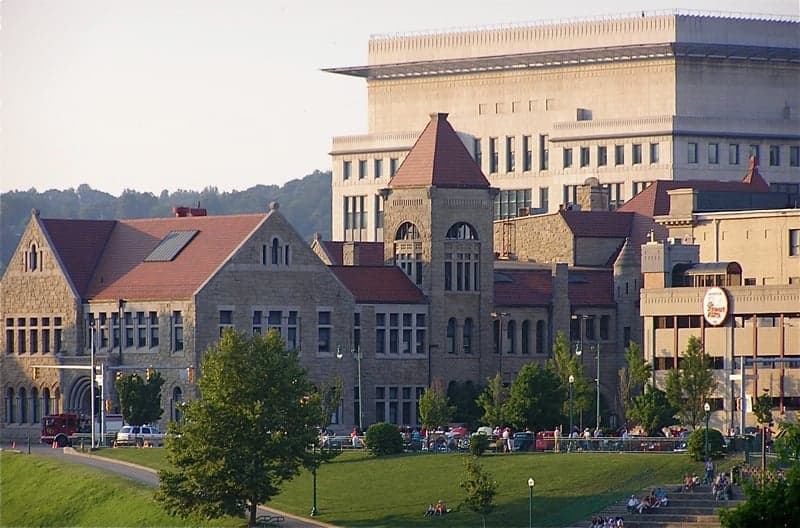
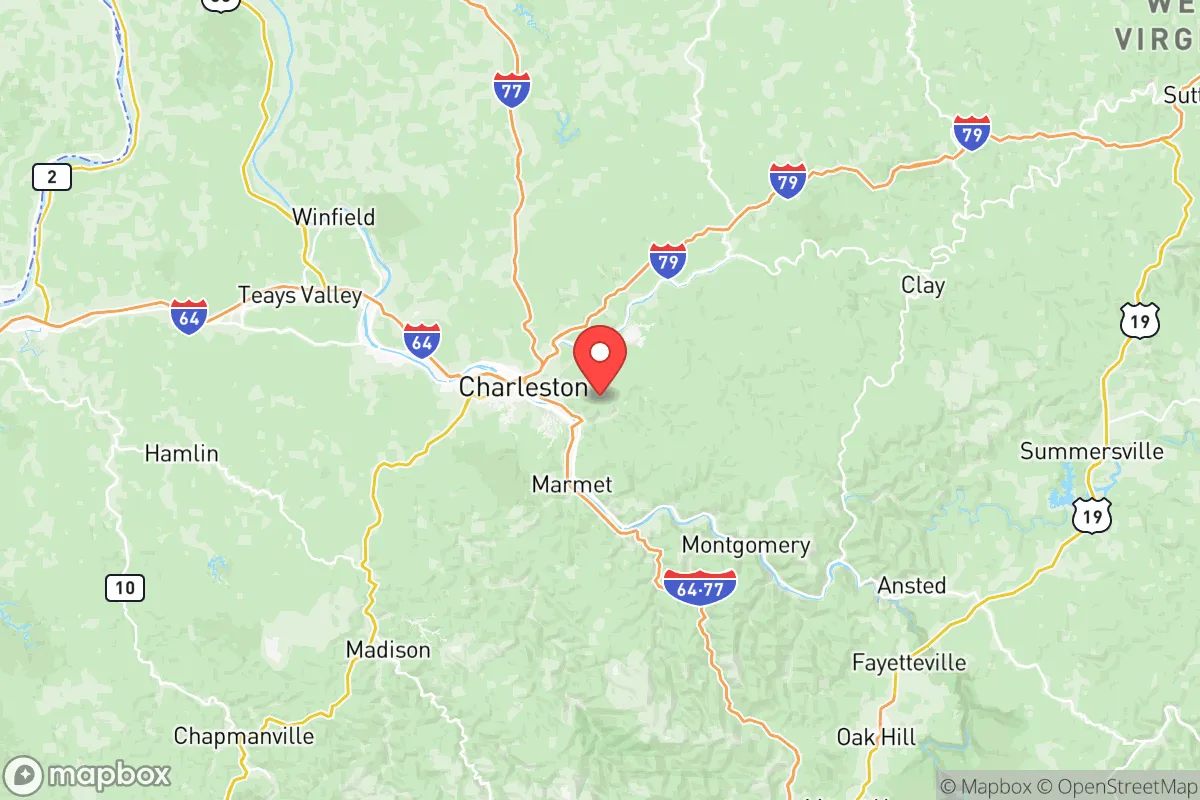
Photo: Wikipedia
Political ClimatePolitical Climate in Kanawha County
Showing district-level results — no local-only data available.
Local Political AnalysisPolitical Analysis of Kanawha County
Kanawha County, anchored by Charleston, is a reliable Republican stronghold with a Cook PVI of R+22, making it slightly more conservative than West Virginia as a whole (R+21). This isn't a new development—the county has been trending red for decades, but the shift has accelerated since 2016, driven by cultural and economic realignment. While the county as a whole votes heavily Republican, the political map is far from uniform: Charleston's downtown and West Side precincts often vote Democratic, while suburbs like South Charleston, St. Albans, and the fast-growing communities of Cross Lanes and Nitro are deeply red. The swing precincts tend to be in the more rural eastern parts of the county, like Clendenin and Elkview, where economic anxiety and gun rights often trump party loyalty.
How it compares
Compared to the rest of West Virginia, Kanawha County is a microcosm of the state's political trajectory but with a few key differences. The county's R+22 PVI is a point more conservative than the state's R+21, but that gap masks internal variation. In the 2024 presidential election, Kanawha County voted for Donald Trump by about 62% to 36%, while the state overall went 63% to 35%—so the county is actually slightly less Trumpy than the state average. This is because Charleston's urban core still provides a Democratic floor of about 35-40% in presidential races, whereas many rural counties in southern West Virginia (like Mingo or McDowell) routinely hit 75-80% Republican. The real difference is in local races: Kanawha County has a more competitive Democratic bench than most of the state, with Charleston's city council and county commission often featuring contested primaries, while in much of the state, local offices are effectively uncontested Republican seats.
What this means for residents
For conservative residents, Kanawha County offers a comfortable political environment where Republican candidates are the default in most countywide and state legislative races. The county commission, sheriff's office, and school board are all Republican-controlled, and conservative voters can expect their views on taxes, energy policy, and Second Amendment rights to be reflected in local governance. For liberal residents, the reality is more nuanced: while they are a clear minority countywide, they hold significant influence in Charleston city politics, where Democrats control the mayor's office and city council. This creates a kind of two-tier political system—progressive policies on housing, public transit, and social services are possible within city limits, but countywide issues like zoning, road funding, and economic development tend to reflect conservative priorities. The practical effect is that a liberal resident in Charleston can live in a blue bubble, while a conservative in St. Albans or Nitro experiences a uniformly red environment.
Culturally, Kanawha County is more diverse than the rest of West Virginia, with a larger professional class tied to the state government, healthcare (Charleston Area Medical Center, WVU Medicine), and the chemical industry (Dow, DuPont). This creates a more moderate, pragmatic conservatism compared to the populist, anti-establishment strain dominant in the state's coal fields. Policy-wise, the county has been a battleground over issues like opioid settlement spending, with Charleston pushing for more treatment-focused approaches while county officials favor law enforcement. Looking ahead, the county's political trajectory is likely to follow the state's—slowly reddening as older Democratic voters die off and younger residents, even in Charleston, drift right on cultural issues. But the presence of a sizable government and healthcare workforce means Kanawha County will probably never become as deeply red as the state's rural southern counties, maintaining a slightly more competitive, if still Republican-dominated, political landscape.

State Political ClimatePolitical Climate in West Virginia
State Political AnalysisPolitical Environment in the State
West Virginia is one of the most reliably Republican states in the nation, carrying a Cook Partisan Voting Index of R+21, meaning it votes about 21 points more Republican than the national average. This wasn't always the case—as recently as the 1990s and early 2000s, the state was a Democratic stronghold at the local level, even as it began trending right in presidential races. The shift accelerated dramatically after 2008, driven by cultural realignment and the decline of organized labor and the coal industry. Today, the state is dominated by a conservative coalition that blends Appalachian populism with traditional GOP economic and social positions, though significant pockets of Democratic resistance remain in a few specific metros and university towns.
Urban vs. rural divide
The political map of West Virginia is starkly divided between its small, struggling industrial cities and its vast, deeply conservative rural expanse. Charleston, the capital and largest city, is the state's most significant Democratic-leaning area, anchored by government workers, healthcare professionals at WVU Medicine, and a shrinking but still present union base. Morgantown, home to West Virginia University, is a blue dot in a red sea, with student and faculty populations pushing it left on social issues and environmental policy. Huntington and Wheeling have trended Republican in recent cycles, though they remain more moderate than the surrounding counties. The rural counties—especially in the southern coalfields like Mingo, Logan, and McDowell—are now among the most Republican in the nation, having flipped from solidly Democratic to overwhelmingly GOP in less than two decades. The eastern panhandle, including Martinsburg and Berkeley County, has seen explosive growth from Washington D.C. exurban migration, bringing a mix of fiscal conservatives and some more moderate suburbanites.
Policy environment
West Virginia's policy environment reflects its deep-red lean. The state has no state income tax on Social Security benefits and has been phasing down its personal income tax, with a 2023 law cutting rates by 21.25% over several years. Property taxes are among the lowest in the nation, capped by the state constitution. The regulatory posture is strongly pro-business and pro-energy, with the state aggressively courting natural gas, petrochemical, and manufacturing projects. Education policy has been a major battleground: the state passed a robust school choice law in 2021, creating Education Savings Accounts (ESAs) that allow public funds to follow students to private or homeschool settings. Healthcare is a mixed picture—West Virginia expanded Medicaid under the Affordable Care Act, but the state has some of the strictest abortion laws in the country, with a near-total ban in effect after a 2022 trigger law. Election laws have tightened: the state requires voter ID, has restricted absentee voting, and passed a law limiting ballot drop boxes. Gun laws are among the most permissive nationally, with constitutional carry (no permit needed for concealed carry) enacted in 2016.
Recent policy direction
The last five years have seen West Virginia accelerate its conservative policy agenda. On gun and self-defense law, the state passed a "Stand Your Ground" law in 2023 and preempted local governments from enacting their own firearm ordinances. Parental and education rights have been a focus: the 2021 ESA law was expanded in 2023, and the state passed a law requiring schools to notify parents of "sexually explicit" instructional materials. On speech and privacy, West Virginia has no broad data privacy law, but it passed a 2023 law restricting TikTok on government devices. Medical and bodily autonomy is sharply divided: the abortion ban has no exceptions for rape or incest, only for medical emergencies, while the state has legalized medical cannabis (though the program has been slow to implement). Property rights were strengthened with a 2022 law limiting eminent domain for carbon pipeline projects. Taxation continues trending downward, with the 2023 income tax cut and a 2024 law exempting military pensions from state tax. Voting and ballot access has tightened with the 2023 voter ID law and restrictions on third-party ballot collection.
Civil unrest & political movements
West Virginia has a notable history of labor and environmental activism, though the character of these movements has shifted. The 2018 statewide teachers' strike—which shut down every public school for nine days—was a rare moment of cross-partisan mobilization, drawing support from both progressive and conservative rural communities. The coal industry's decline has fueled populist anger on both sides, with some communities embracing Trump's promises to revive mining while others push for economic diversification and environmental justice. There have been scattered protests over the abortion ban, particularly in Charleston and Morgantown, but they remain smaller than in neighboring states. The state has seen some election integrity activism since 2020, with a few counties conducting hand-count audits, though no major controversies have emerged. Immigration politics are less visible here than in border states, but the state has passed laws requiring local cooperation with federal immigration enforcement. There is no significant secession or nullification movement, though some rural counties have passed symbolic resolutions asserting local control over public health mandates.
Projection
Over the next 5-10 years, West Virginia is likely to become even more Republican, though the character of that conservatism may shift. The eastern panhandle's growth from D.C. exurbs will bring more college-educated, fiscally conservative but socially moderate voters, potentially creating a tension with the more culturally traditional southern coalfields. The state's population continues to decline overall, with out-migration concentrated among younger, more liberal residents, reinforcing the conservative tilt. The energy transition will remain a defining issue—as coal fades, natural gas and petrochemical development (including the controversial Mountain Valley Pipeline) will shape both the economy and political alignments. The Democratic Party's base will likely shrink further to Morgantown, Charleston, and a few other small cities, with rural areas becoming even more uniformly Republican. A new resident moving in now should expect a state that is culturally and politically conservative, with low taxes, permissive gun laws, and a strong emphasis on local control, but also one that is grappling with economic transition and population loss.
For someone considering a move to West Virginia, the practical takeaway is straightforward: you'll find a state that is deeply Republican, with policies to match, but with meaningful local variation. If you're conservative, you'll feel at home in most of the state, with low taxes, strong gun rights, and a government that shares your values. If you're liberal, you'll find your community in Morgantown or Charleston, but you should be prepared for a state government that is actively moving in the opposite direction on most issues. The political climate is stable and predictable—no one is surprised by a Republican sweep here—but the economic headwinds and demographic decline mean that politics alone won't solve the state's deeper challenges.
* Values derived from national, state, county, city and local statistics and may differ in a specific area. Last updated: 2026-07-02T21:58:06.000Z
Narrative content on this page is AI-generated and may contain mistakes. Verify any details that matter before acting on them.
ReloMaps may earn a commission from affiliate links at no extra cost to you.

