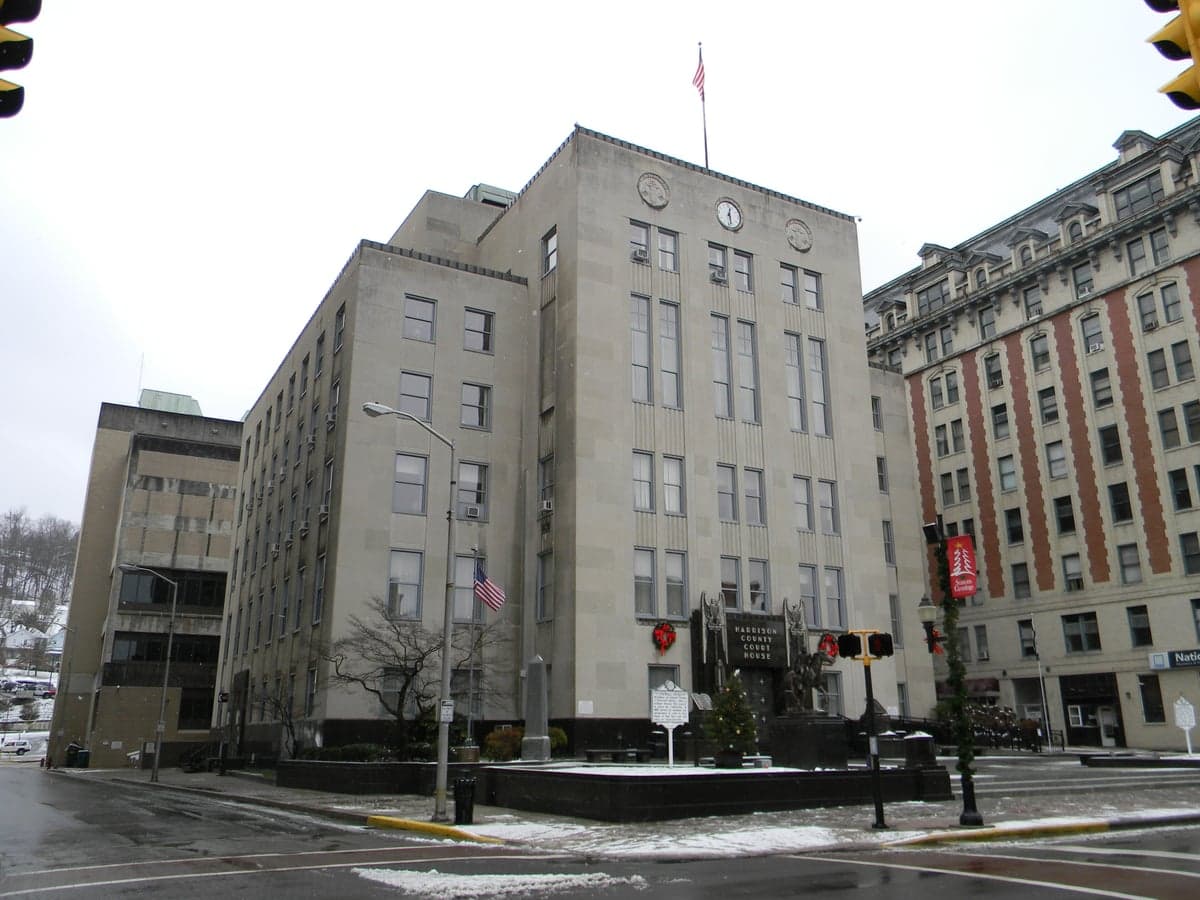
Photo: Wikipedia
Political ClimatePolitical Climate in Harrison County
Showing district-level results — no local-only data available.
Local Political AnalysisPolitical Analysis of Harrison County
Harrison County, West Virginia, is a solidly Republican stronghold with a Cook Partisan Voting Index of R+20, meaning it votes about 20 points more Republican than the national average. This isn't a recent shift—the county has been trending red for decades, but the acceleration since 2016 has been stark. In 2020, Donald Trump carried Harrison County with 68% of the vote, up from 63% in 2016, while the county's Democratic registration advantage has eroded from a 2-to-1 margin in 2008 to nearly even today. The county seat, Clarksburg, still shows some Democratic leanings, particularly in its downtown precincts and around the West Virginia University Medicine campus, but the surrounding towns tell a different story. Bridgeport, the county's largest suburb, is a deep-red bastion where Republicans routinely win 75% or more of the vote, while Shinnston and Nutter Fort have become swing precincts that now lean Republican by 5-10 points. The rural areas—Anmoore, Lost Creek, and the communities along Route 19—are reliably conservative, with GOP candidates often winning by 30 points or more.
How it compares to West Virginia as a whole
Harrison County's R+20 PVI places it slightly more Republican than the state average, which is roughly R+19 based on recent election results. The key difference is that Harrison County is more suburban and economically diverse than the state's deeply rural counties. While West Virginia's coal-heavy southern counties like Mingo and McDowell have swung even harder to the right (often R+40 or more), Harrison County's politics are shaped more by natural gas, healthcare, and small business interests than by mining. The county's Democratic Party, though diminished, remains more organized than in many parts of the state, with active precinct committees in Clarksburg and Bridgeport. However, the trajectory is clear: in 2008, Barack Obama won Harrison County by 8 points; by 2024, the Republican margin had grown to 36 points. The state as a whole has followed a similar pattern, but Harrison County's shift has been more gradual and less extreme than in the coalfields.
What this means for residents
For conservative residents, the political climate is comfortable and affirming. Local government, from the county commission to the school board, is dominated by Republicans, and policy debates tend to focus on tax cuts, economic development, and Second Amendment rights. Bridgeport's conservative voters see their values reflected in the city's low taxes and pro-business zoning. For liberal residents, the reality is more isolating. Clarksburg's progressive community—centered around the university and the arts scene—often feels like a blue island in a red sea. Democratic candidates rarely win countywide races, and progressive policy proposals on issues like renewable energy or criminal justice reform face an uphill battle. However, the county's political homogeneity means less gridlock on local issues; infrastructure projects, road improvements, and economic incentives for natural gas development typically pass with bipartisan support. The real tension is cultural: the county's strong evangelical and gun-rights culture clashes with the more secular, urban values of Clarksburg's small liberal enclave.
One notable distinction is Harrison County's relationship with the state's opioid crisis. While the county has been hit hard by addiction, its political response has been more treatment-focused than punitive, with local Republicans supporting needle exchange programs and recovery housing—a stance that puts them at odds with the state's more conservative southern counties. This pragmatic streak reflects the county's history as a transportation and manufacturing hub, where practical problem-solving often trumps ideological purity. Looking ahead, the county's political future will likely mirror its economic trajectory: as natural gas development continues and Clarksburg's healthcare sector grows, the Republican lean will probably deepen, but the county's moderate, business-friendly conservatism may keep it from becoming as polarized as other parts of West Virginia. For now, Harrison County offers a clear-eyed picture of what a solidly red, post-industrial American county looks like—politically dominant, culturally divided, but still capable of surprising pragmatism.

State Political ClimatePolitical Climate in West Virginia
State Political AnalysisPolitical Environment in the State
West Virginia has been one of the most reliably Republican states in the nation for over two decades, but that wasn't always the case. As recently as the 1990s, the state was a Democratic stronghold at the local level, though it often broke for conservative Democrats in presidential races. The shift accelerated after 2000, and by 2016, Donald Trump carried the state by nearly 42 points. In 2024, Trump won West Virginia by roughly 39 points, with every single county voting red for the first time in modern history. The dominant political coalition today is a mix of rural, working-class voters, coal and natural gas industry interests, and culturally conservative families who have moved left-to-right on economic and social issues.
Urban vs. rural divide
The political map of West Virginia is less about urban-rural splits and more about degrees of Republican dominance. The largest metro area, Charleston (Kanawha County), is still reliably red but with a slightly more moderate tilt—Trump won Kanawha by about 18 points in 2024, compared to 40+ points in rural counties like Mingo or Logan. The second-largest city, Huntington (Cabell County), leans Republican but has a noticeable Democratic minority, particularly around Marshall University. Morgantown, home to West Virginia University, is the most politically mixed area in the state; Monongalia County went for Trump by only about 12 points in 2024, and the city itself has a visible progressive student population. The Eastern Panhandle counties—Berkeley, Jefferson, and Morgan—are a fascinating case: they're growing fast due to Washington D.C. exurbs, and while still Republican, they're less conservative than the rest of the state, with Jefferson County voting Trump by only 8 points. Meanwhile, the southern coalfields (Boone, McDowell, Wyoming counties) are among the most Republican in the nation, often voting 80%+ for GOP candidates. The north-central region around Clarksburg and Fairmont is solidly red but with a stronger union Democratic legacy that occasionally shows up in local races.
Policy environment
West Virginia's policy environment is aggressively conservative by national standards. The state has no personal income tax on Social Security benefits and has been phasing down its personal income tax—the rate dropped from 6.5% to 4.82% in 2023, with a goal of elimination. Sales tax is 6%, with no local add-ons. Property taxes are among the lowest in the nation, capped by the state constitution at 1.5% of assessed value. The regulatory posture is strongly pro-business, especially for energy extraction: the state has a "right-to-work" law (2016), no state-level minimum wage above the federal $7.25, and a "regulatory sandbox" program for small businesses. Education policy is a flashpoint: the state passed a broad school choice law in 2021 (HB 2013) creating education savings accounts, and in 2023 expanded it to all families regardless of income. The state also has a "Don't Say Gay" style law (HB 4654, 2023) restricting classroom discussion of sexual orientation and gender identity. Healthcare is a mixed bag: West Virginia expanded Medicaid under the ACA, but the state has some of the strictest abortion laws in the country—a near-total ban with no exceptions for rape or incest, only for medical emergencies. Election laws are moderately restrictive: voter ID is required (with a broad list of acceptable IDs), no-excuse absentee voting is allowed, and early voting runs 10 days. The state purged over 100,000 inactive voters from rolls in 2022.
Recent policy direction
The last five years have seen a sharp rightward acceleration. On gun and self-defense law, West Virginia became a constitutional carry state in 2016, and in 2023 passed a "Second Amendment Preservation Act" (SB 10) that purports to nullify federal gun laws—though it's largely symbolic. Parental and education rights have been a major focus: the 2021 "Parental Bill of Rights" (HB 4011) requires schools to notify parents of any medical or mental health services sought by a minor, and the 2023 "Save Women's Sports Act" (HB 5742) bans transgender athletes from female sports. On speech and privacy, the state passed a law in 2023 (HB 3034) prohibiting social media platforms from deplatforming users based on political views, though it's been challenged in court. Medical and bodily autonomy is sharply restricted: the 2022 abortion ban (HB 302) is one of the nation's strictest, and the state has no shield laws for out-of-state abortion seekers. Property rights are strongly protected: the state has a "right to farm" law (2019) shielding agricultural operations from nuisance lawsuits, and a 2023 law (HB 2003) limits local governments' ability to regulate short-term rentals. Taxation is trending toward elimination: the income tax is on a glide path to zero, and the state eliminated the business franchise tax in 2023. Voting and ballot access tightened slightly: the 2021 election integrity law (SB 1) shortened the absentee ballot request window and banned ballot harvesting.
Civil unrest & political movements
West Virginia has a long history of labor activism, but modern political movements are dominated by conservative and libertarian strains. The 2021 teachers' strike was a notable exception—a rare left-leaning protest that shut down schools statewide for nine days and won a 5% pay raise. The coal industry remains a powerful political force, with regular rallies supporting mining jobs and opposing environmental regulations. The Second Amendment sanctuary movement is strong: over 40 counties have passed resolutions declaring themselves "sanctuary counties" for gun rights. Immigration politics are low-key—the state has a tiny foreign-born population (about 1.5%)—but there's a 2023 law (HB 2006) requiring local law enforcement to cooperate with ICE. Nullification rhetoric is common: the 2023 gun law and a 2021 "critical race theory" ban (HB 4011) both contain language asserting state supremacy over federal mandates. Election integrity controversies have been minimal compared to other states; the 2020 election results were certified without major disputes, though the legislature passed SB 1 anyway. Visible flashpoints include occasional protests at the state capitol over abortion rights (2022) and transgender issues (2023), but these are small compared to larger states. The Mountain Party, a small progressive third party, has some local presence in Morgantown and Charleston but hasn't won a statewide race.
Projection
Over the next 5-10 years, West Virginia's political trajectory is likely to remain deeply Republican, but with some interesting wrinkles. The Eastern Panhandle will continue to grow as D.C. exurbs expand, potentially moderating those counties slightly—but they're still likely to stay red, just less overwhelmingly so. The southern coalfields will continue to depopulate, concentrating political power in the more moderate north and east. The income tax phase-out will likely be completed by 2030, making the state even more attractive to retirees and remote workers from high-tax states—but this in-migration could bring more moderate or libertarian-leaning voters rather than hardline conservatives. The energy transition will be the wild card: as coal declines, the state is betting on natural gas, carbon capture, and even small modular nuclear reactors (a 2023 law, HB 3482, incentivizes them). If these industries take off, they could reshape the economy and politics. Demographic trends are stark: West Virginia is the only state that lost population in the 2020 census, and it's aging fast. Younger, more educated residents tend to leave, which reinforces the conservative tilt. A new resident moving in now should expect a state that remains solidly red, with low taxes, strong gun rights, and limited government services, but also with a slowly diversifying economy and a growing tension between the old coal-based politics and a newer, more tech-and-service-oriented future.
For someone choosing West Virginia, the practical takeaway is straightforward: you'll find a state where conservative values are deeply embedded in law and culture, taxes are low and getting lower, and the pace of life is slow. If you're conservative, you'll feel at home almost anywhere, though Morgantown and the Eastern Panhandle offer more diversity of thought. If you're liberal, you'll be in a clear minority, but you'll find like-minded communities in Charleston, Morgantown, and Shepherdstown—just expect to drive a bit to find them. The state's biggest draw for relocators is economic freedom and low cost of living, but the trade-off is limited public services, a shrinking population, and a political environment that's unlikely to change direction anytime soon.
* Values derived from national, state, county, city and local statistics and may differ in a specific area. Last updated: 2026-08-04T02:30:23.000Z
Narrative content on this page is AI-generated and may contain mistakes. Verify any details that matter before acting on them.
ReloMaps may earn a commission from affiliate links at no extra cost to you.

