Photo: Wikipedia
Demographics of Harrison County
Affluence Level in Harrison County
A middle-class area roughly in line with national averages across income, home values, education, and employment.
People of Harrison County
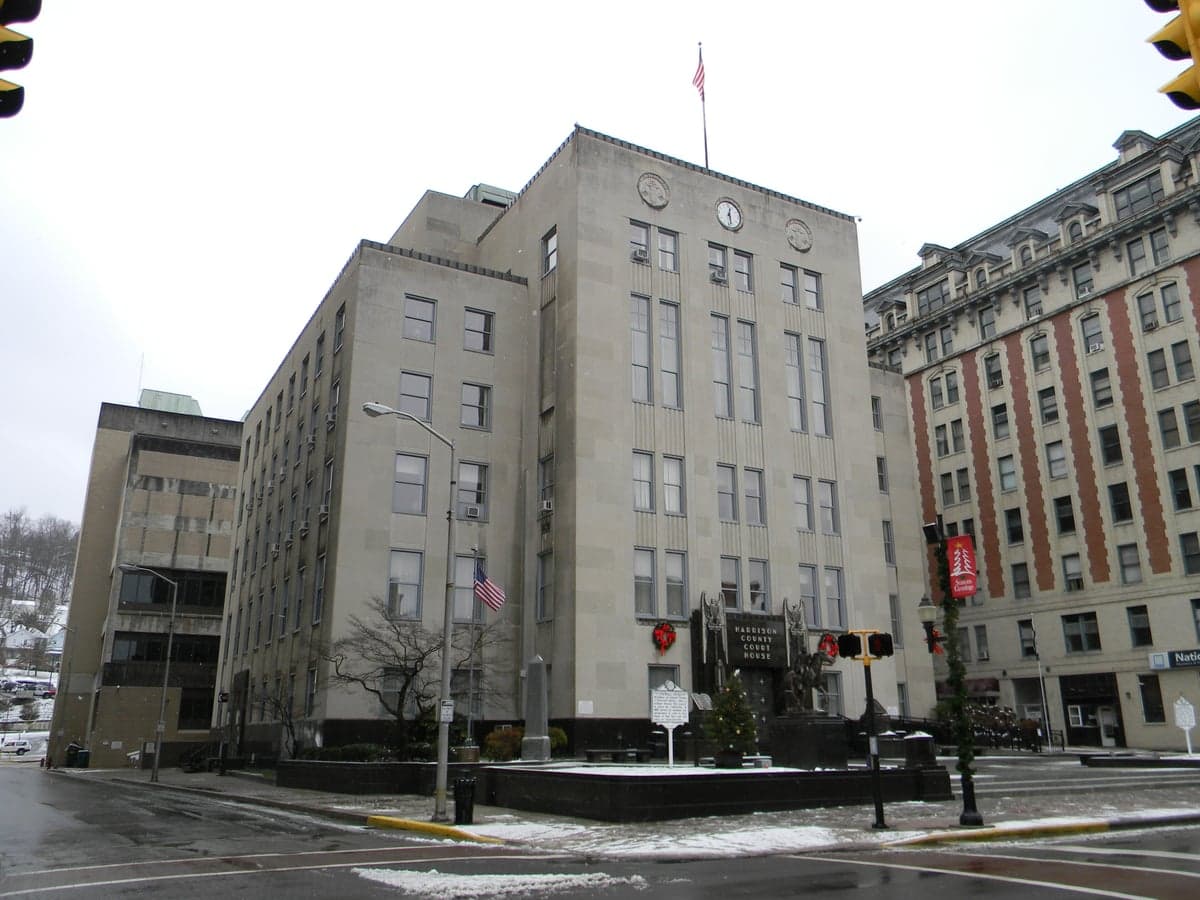
Harrison County, West Virginia, is home to 65,407 residents, a population that is 92.3% white and deeply rooted in the state’s Appalachian heritage. The county’s character is defined by its small industrial cities—Clarksburg, Bridgeport, and Shinnston—and a culture shaped by generations of European immigrants and internal U.S. migrants who came for coal, glass, and manufacturing. With a foreign-born population of just 0.3%, Harrison County remains one of the least ethnically diverse counties in the nation, a place where family ties, local industry, and a conservative-leaning civic identity still anchor daily life.
Settlement & growth (pre-1960)
Before European settlement, the region now known as Harrison County was part of the hunting grounds of the Seneca and other Iroquoian peoples, as well as the Shawnee and Delaware. The area was sparsely populated by Native nations, who used the West Fork River valley for seasonal travel and trade. European incursion began in earnest after the French and Indian War, when the British Crown opened the region to settlement through land grants to veterans.
The first permanent settlers were predominantly Scots-Irish and English, arriving in the 1770s and 1780s. These families—names like Davisson, Jackson, and Prunty—pushed up the West Fork River and established homesteads around what would become Clarksburg, the county seat founded in 1785. The Scots-Irish brought a fiercely independent, Presbyterian-influenced culture that emphasized self-reliance and local governance, traits that still echo in the county’s political leanings. By the early 1800s, the population grew slowly, centered on subsistence farming and small-scale milling.
The real demographic transformation came with the industrial boom of the late 19th and early 20th centuries. The discovery of high-grade bituminous coal in the county’s northern and eastern seams, combined with the arrival of the Baltimore and Ohio Railroad in the 1850s, turned Harrison County into a mining and transportation hub. Towns like Shinnston (incorporated 1852) and Lumberport grew as coal camps and rail stops. At the same time, the natural gas boom of the 1890s—the county sits atop the vast Appalachian Basin—spurred the glass industry. Clarksburg became a center for hand-blown glass, and Bridgeport, just south, grew as a manufacturing and railroad town.
These industries pulled in a wave of Southern and Eastern European immigrants between 1880 and 1920. Italians, Poles, and Slovaks arrived to work the mines and glass factories, settling in ethnic enclaves in Clarksburg’s North View and Adamston neighborhoods, and in the mining patches around Enterprise and Lost Creek. A smaller number of Irish immigrants, many of whom had worked on the railroad, also settled in the county. By 1920, Harrison County’s population peaked at over 80,000, making it one of West Virginia’s most populous counties.
The Great Depression and the decline of the coal industry in the 1930s and 1940s triggered a slow outmigration. Many families left for industrial jobs in Ohio, Michigan, and Pennsylvania. The post-World War II era saw a modest revival, driven by the expansion of the federal government—the FBI’s Fingerprint Identification Division opened in Clarksburg in 1944, bringing a wave of white-collar jobs—and the growth of local manufacturing, including the Owens-Illinois glass plant in Clarksburg and the Pittsburgh Plate Glass (PPG) facility in Bridgeport. The county’s population stabilized around 70,000 through the 1950s, with a culture that remained overwhelmingly white, working-class, and politically conservative.
Modern era (post-1965)
The 1965 Hart-Cellar Act, which opened U.S. immigration to non-European nations, had almost no effect on Harrison County. The county’s foreign-born population today is just 0.3%, and the vast majority of those are European-born or Canadian. Unlike the booming Sun Belt or coastal metros, Harrison County did not receive significant immigration from Asia, Latin America, or Africa. The small Hispanic population (2.2%) and East/Southeast Asian population (0.7%) are concentrated in Clarksburg and Bridgeport, often tied to professional roles at the FBI’s Criminal Justice Information Services (CJIS) complex or at West Virginia University’s nearby medical campus in Morgantown. The Black population (1.3%) is a remnant of the pre-1960 coal and railroad era, with most families living in Clarksburg’s historic neighborhoods.
The dominant demographic story since 1965 has been domestic outmigration and suburbanization. The collapse of the coal and glass industries in the 1970s and 1980s led to a steady population decline, from 77,710 in 1970 to 65,407 in 2020. Young adults left for jobs in the Carolinas, Texas, and the Ohio Valley. Those who stayed increasingly moved from Clarksburg’s older urban core to the newer subdivisions of Bridgeport, which has become the county’s economic and retail hub. Bridgeport’s population grew by 15% between 2000 and 2020, while Clarksburg’s shrank by 12%. The county’s college-educated share (25.9%) is below the national average, reflecting the loss of younger, more educated workers.
Politically, Harrison County has shifted sharply to the right. In 2024, the county voted for Donald Trump by a margin of over 40 points, a reflection of its white, working-class, and culturally conservative base. The county’s few non-white residents are concentrated in Clarksburg, but even there, the population is 90% white. The Indian-subcontinent population (0.1%) is negligible, consisting of a handful of medical professionals and IT workers.
The future
Harrison County’s population is projected to continue its slow decline, falling to around 60,000 by 2040, according to state demographers. The county is aging—the median age is 44, compared to 38 nationally—and the birth rate is below replacement. The only growth areas are Bridgeport and the Interstate 79 corridor, where new housing developments and retail centers attract retirees and a few remote workers from the East Coast. The county’s racial and ethnic composition will remain overwhelmingly white, with only modest increases in Hispanic and East/Southeast Asian populations driven by niche professional recruitment at the FBI and healthcare sectors.
Culturally, Harrison County is becoming more polarized between the small, conservative-leaning towns and the slightly more diverse, suburbanizing Bridgeport area. The county’s identity as a coal-and-glass community is fading, replaced by a service-based economy anchored by the FBI, healthcare, and retail. For a newcomer, the county offers low housing costs, strong community ties, and a slower pace of life, but limited job diversity and a population that is both aging and shrinking.
Harrison County is becoming a quieter, older, and more insular version of its industrial past. For someone moving in now, the county offers a stable, low-cost, and culturally conservative environment, but one with limited demographic change and a population that is slowly contracting. The people who remain are deeply rooted, and the sense of place is strong—but the county is not a destination for those seeking diversity or rapid growth.

* Values derived from national, state, county, city and local statistics and may differ in a specific area. Last updated: 2026-08-04T02:30:23.000Z
Narrative content on this page is AI-generated and may contain mistakes. Verify any details that matter before acting on them.
ReloMaps may earn a commission from affiliate links at no extra cost to you.

