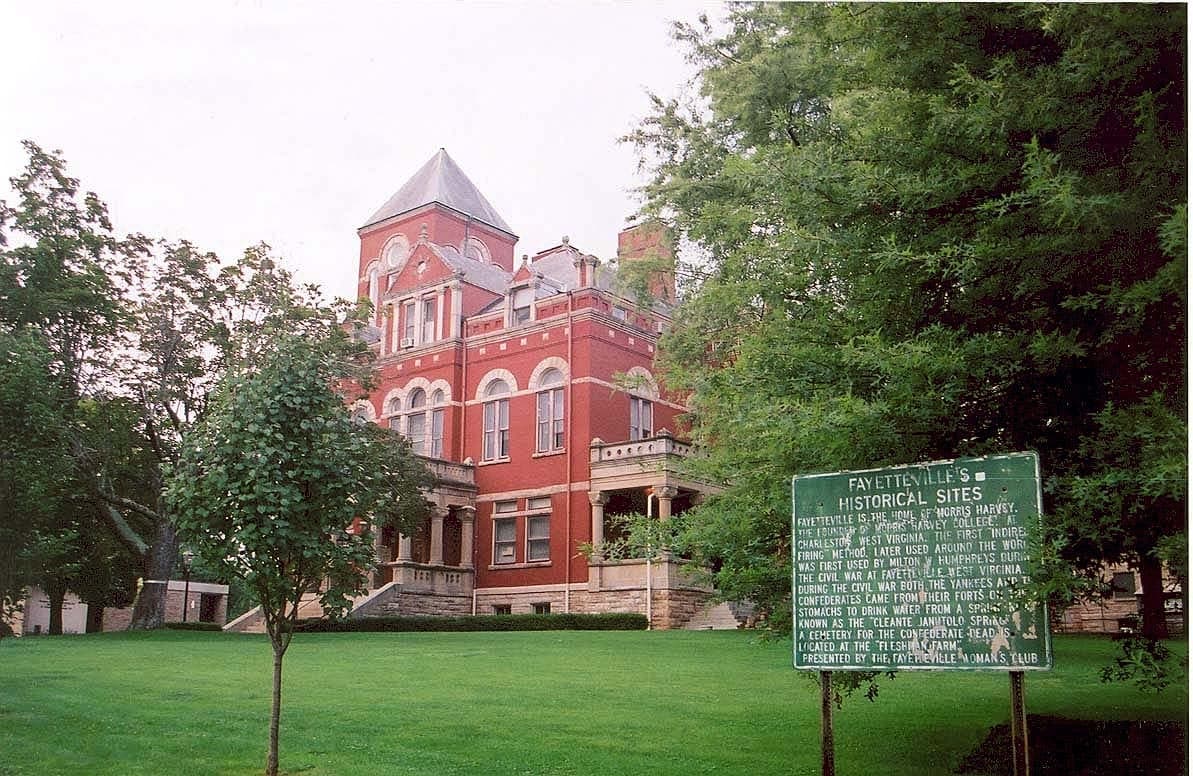
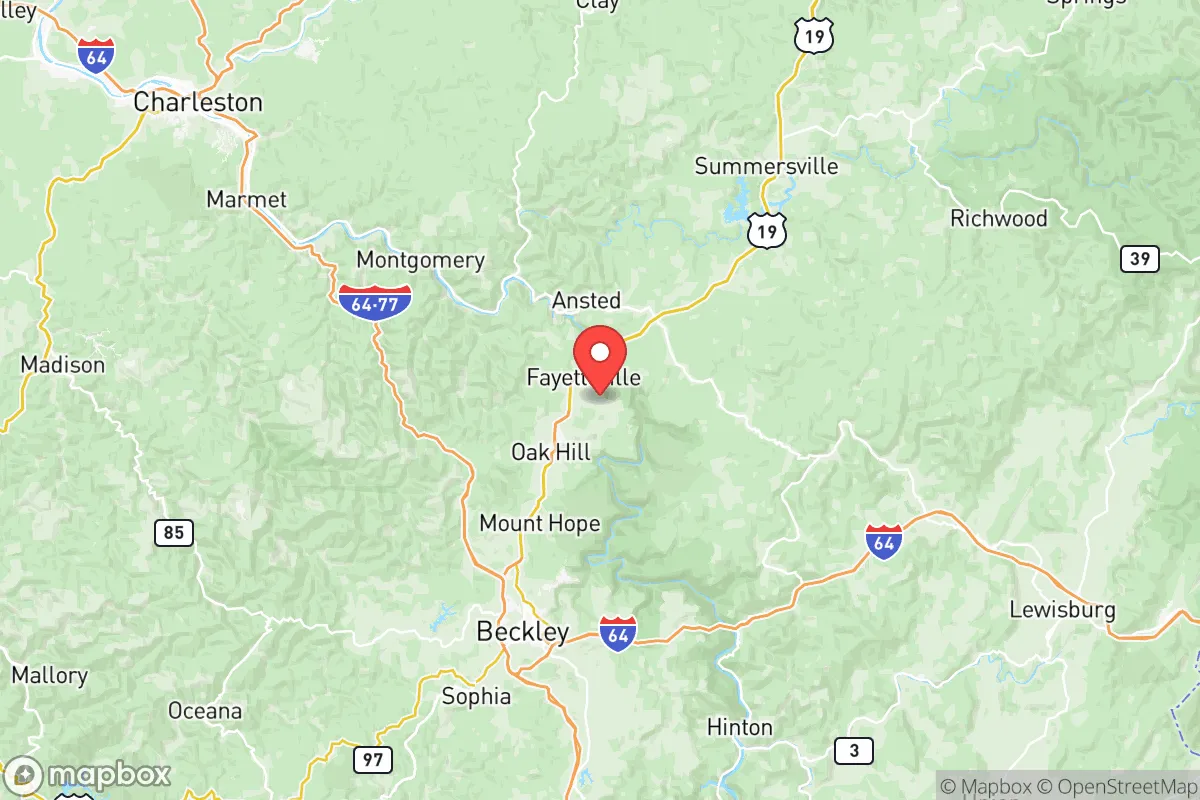
Photo: Wikipedia
Political ClimatePolitical Climate in Fayette County
Showing district-level results — no local-only data available.
Local Political AnalysisPolitical Analysis of Fayette County
Fayette County, West Virginia, is a deeply red area that has become even more Republican in recent cycles, carrying a Cook Partisan Voting Index of R+22. That makes it slightly more conservative than the state as a whole, which sits at R+21, but the real story is how that Republican dominance has solidified. As recently as 2000, the county was a reliable Democratic stronghold in presidential races, but the shift has been dramatic and lasting. Today, the only real political question in a countywide election is the margin of the Republican victory, though local pockets of blue still exist in places like Fayetteville and Oak Hill.
How it compares to West Virginia as a whole
While West Virginia has moved from a swing state to a deep red one over the past two decades, Fayette County has moved even faster and further to the right. The R+22 PVI is a full point more conservative than the state's R+21, a gap that reflects the county's strong cultural and economic ties to coal mining and outdoor recreation. In the 2024 presidential election, Donald Trump carried Fayette County by a margin significantly larger than his statewide win, with rural precincts in places like Ansted and Montgomery voting overwhelmingly Republican. The only exceptions are the college town of Fayetteville, home to the New River Gorge National Park and a growing population of younger, more liberal transplants, and parts of Oak Hill near the high school, where precincts sometimes split closer to 55-45 Republican. These blue-leaning pockets are small, however, and they don't change the county's overall trajectory, which is steadily moving rightward as older Democratic voters age out and younger conservative families move in.
What this means for residents
For conservative residents, Fayette County offers a political environment where their values are the clear majority, from local school board decisions to county commission meetings. Republican candidates rarely face serious primary challenges, and general elections are usually decided in the primary. For liberal residents, the reality is more isolating. While Fayetteville provides a small, welcoming bubble with its arts scene and outdoor-oriented community, the broader county can feel unwelcoming for progressive activism. Local Democratic clubs exist but have little influence on policy, and running for office as a Democrat is often a symbolic gesture. That said, the county's politics are not as polarized on a personal level as in many urban areas; neighbors of different political stripes still cooperate on community projects, especially around the national park and local festivals like Bridge Day.
One notable cultural distinction is the county's relationship with the New River Gorge National Park and Preserve, which was designated in 2020. This federal presence has brought an influx of tourists and new residents, many of whom lean left, creating a subtle but real tension between long-time locals who see the park as a government overreach and newcomers who view it as an economic lifeline. The county commission has generally supported the park, but local politics around land use and development can get heated. For now, Fayette County remains a reliably Republican place where the biggest political fights are over how to balance economic growth with preserving the area's traditional way of life, not over which party holds power.

State Political ClimatePolitical Climate in West Virginia
State Political AnalysisPolitical Environment in the State
West Virginia is one of the most reliably Republican states in the nation, carrying a Cook Partisan Voting Index of R+21, meaning it votes about 21 points more Republican than the country as a whole. This wasn't always the case—as recently as the 1990s, the state was a Democratic stronghold at the local level, but a seismic shift began in the early 2000s over cultural and energy issues. Today, the GOP controls every statewide office, both U.S. Senate seats, and supermajorities in the state legislature, with Donald Trump winning the state by nearly 39 points in 2020 and over 40 points in 2024. The trajectory has been a steady, accelerating march rightward over the past two decades, driven by the collapse of the old coal-aligned Democratic machine and the rise of a populist, culturally conservative Republican coalition.
Urban vs. rural divide
The political map of West Virginia is starkly divided between a handful of small urban centers and the vast, deeply red rural expanse. The state's largest city, Charleston, and its surrounding Kanawha County are a rare blue dot, often voting Democratic by narrow margins in presidential races thanks to a concentration of government workers, healthcare professionals, and union members. Morgantown, home to West Virginia University, is another liberal-leaning pocket, where the student population and academic workforce push the county toward the center or slightly left. Huntington and Wheeling are more competitive but have trended Republican in recent cycles as their industrial bases have shrunk. Outside these islands, the state is overwhelmingly conservative. The southern coalfields—places like Logan, Mingo, and McDowell counties—were once the most reliably Democratic region in America but flipped hard to the GOP starting in 2008, driven by opposition to the Obama administration's climate policies and a cultural realignment. The eastern panhandle, including Martinsburg and Berkeley County, has grown rapidly with commuters from the D.C. metro area, bringing a mix of fiscal conservatives and some moderate-to-liberal newcomers, but the area still votes solidly red. The rural divide is less about geography and more about density: the fewer people per square mile, the more Republican the vote.
Policy environment
West Virginia's policy environment is aggressively conservative, with a focus on low taxes, deregulation, and cultural conservatism. The state has no personal income tax on Social Security benefits and has been phasing down its personal income tax rate, which was cut from 6.5% to 3.99% as of 2024, with a goal of eventual elimination. Sales tax is a relatively low 6%, and property taxes are among the lowest in the nation, capped by the state constitution. The regulatory posture is business-friendly, especially for energy extraction, manufacturing, and outdoor recreation. Education policy has been a flashpoint: the state passed one of the nation's broadest school choice laws in 2021, creating Education Savings Accounts (ESAs) that allow public funds to follow students to private or homeschool settings. Healthcare is a mixed bag—West Virginia expanded Medicaid under the Affordable Care Act, but the legislature has resisted further expansion of government-run options and has passed restrictions on abortion, including a near-total ban with limited exceptions. Election laws have tightened: the state requires voter ID, limits absentee voting, and has purged inactive voters from rolls. There is no early voting by mail without an excuse, though in-person early voting is available. The overall environment is one where conservative priorities are enacted quickly and with little opposition, while liberal residents find themselves swimming against a strong tide.
Recent policy direction
The last few years have seen West Virginia accelerate its conservative agenda across multiple fronts. On gun and self-defense law, the state became a constitutional carry state in 2016, allowing permitless concealed carry, and has preempted local gun ordinances, meaning a city like Charleston cannot impose its own restrictions. Parental and education rights were expanded with the 2021 ESA law and a 2023 law requiring schools to notify parents of any changes to a student's health or well-being, including gender identity discussions. Speech protections are strong, with no hate speech laws and a state-level version of the First Amendment that courts have interpreted broadly. On privacy and surveillance, the state has been slower to act, but a 2024 law restricts the use of facial recognition technology by law enforcement without a warrant. Medical and bodily autonomy is sharply restricted: abortion is banned at all stages of pregnancy except in cases of rape, incest, or medical emergency, and there are no exceptions for fetal anomalies. Property rights are robust, with strong eminent domain protections and a right-to-farm law that shields agricultural operations from nuisance lawsuits. Taxation is trending downward, with the income tax cut and a 2024 law exempting military pensions from state income tax. Voting and ballot access has been restricted: the state ended same-day voter registration in 2021 and requires a notarized application for absentee ballots. The direction is clear: the state is moving to lock in conservative policies before any potential demographic or political shift, betting that low taxes and cultural alignment will attract new residents.
Civil unrest & political movements
West Virginia has a history of labor militancy, but modern political movements are more focused on cultural and economic populism. The 2018 teachers' strike, which shut down schools across the state for nine days, was a rare moment of cross-partisan labor action, winning a 5% pay raise and drawing national attention. Since then, teacher activism has faded as the legislature has shifted further right. On the right, the state has seen a rise in Second Amendment sanctuary resolutions, with over 40 counties declaring themselves sanctuaries from any future federal gun restrictions. Immigration politics are muted—West Virginia has one of the smallest foreign-born populations in the country—but the legislature passed a 2024 law requiring local law enforcement to cooperate with federal immigration authorities, with no sanctuary cities allowed. There have been no major secession or nullification movements, though some rural counties have floated the idea of joining neighboring states in protest of COVID-era restrictions. Election integrity controversies have been minimal compared to other states, with no major fraud cases and a generally accepted voting process. A newcomer would notice a low-key political culture: people are passionate about their views but rarely confrontational in daily life, and the biggest flashpoints tend to be around energy policy and school curriculum rather than street-level protests.
Projection
Over the next 5-10 years, West Virginia is likely to become even more Republican, but with a shifting internal dynamic. The state is losing population overall, particularly in the rural south, while the eastern panhandle grows with commuters from the D.C. area. This in-migration could introduce a small but noticeable moderate-liberal presence in places like Shepherdstown and Charles Town, but it won't be enough to flip any statewide races. The income tax phase-down will continue, making the state more attractive to retirees and remote workers, but the aging population and opioid crisis will strain public services. The political center of gravity will remain in the rural and small-town areas, where cultural conservatism and distrust of federal authority are deeply embedded. A relocator moving in now should expect to find a state where conservative policies are the default, where change happens slowly and deliberately, and where the political conversation is dominated by energy, education, and the struggle to reverse population decline. Liberal residents will find themselves in a clear minority, with little hope of changing state policy, but with strong local communities in Charleston, Morgantown, and a few other enclaves.
For someone choosing West Virginia, the bottom line is straightforward: if you align with conservative values on taxes, guns, education, and cultural issues, you will find a state that is actively shaping itself to your preferences. If you lean liberal, you will need to accept that your vote will rarely carry statewide elections and that state policy will often run counter to your views. The trade-off is a low cost of living, beautiful natural scenery, and a pace of life that feels disconnected from the national political chaos. The state is what it is—unapologetically red, increasingly so, and unlikely to change course anytime soon.
* Values derived from national, state, county, city and local statistics and may differ in a specific area. Last updated: 2026-06-15T16:20:23.000Z
Narrative content on this page is AI-generated and may contain mistakes. Verify any details that matter before acting on them.
ReloMaps may earn a commission from affiliate links at no extra cost to you.

