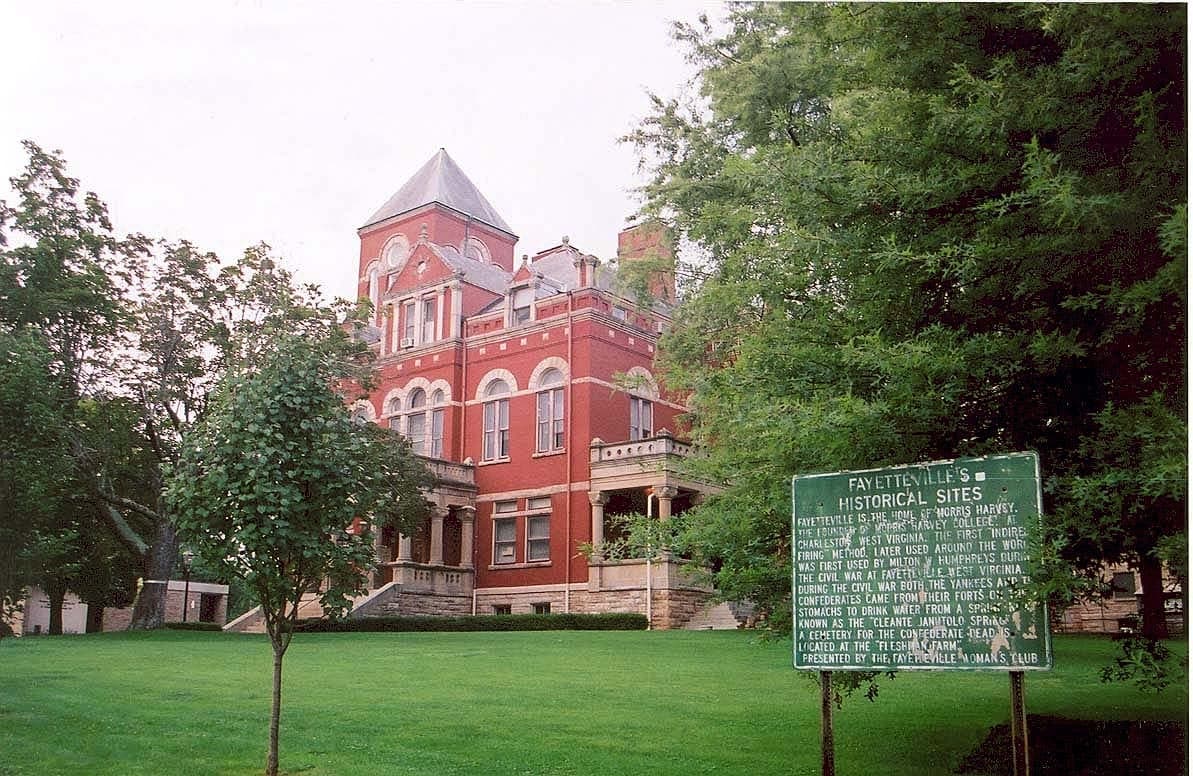
Photo: Wikipedia
Demographics of Fayette County
Affluence Level in Fayette County
A below-average socioeconomic profile. Incomes, home values, and educational attainment trail the U.S., with higher poverty and unemployment.
People of Fayette County
The people of Fayette County, West Virginia today number just under 40,000, making it one of the state's more sparsely populated counties with a density of roughly 50 people per square mile. The population is overwhelmingly white (91.7%) and native-born (only 0.3% foreign-born), with a small Black community (4.5%) and a Hispanic share of 1.3%. The county's identity remains deeply rooted in its Appalachian coal-mining heritage, with a distinctive working-class character that sets it apart from West Virginia's more suburban eastern panhandle or the college towns of Morgantown and Huntington.
Settlement & growth (pre-1960)
Long before European settlement, the region now comprising Fayette County was part of the ancestral homeland of the Shawnee and Cherokee nations, who used the New River and Kanawha River valleys as hunting grounds and travel corridors. The area saw no permanent European settlement until after the American Revolution, when the Virginia General Assembly created Fayette County in 1831 from parts of Greenbrier, Kanawha, and Nicholas counties. The county was named for the Marquis de Lafayette, the French general who aided the American cause.
The first major wave of settlers were Scots-Irish and English pioneers who pushed westward through the Appalachian Mountains in the 1790s and early 1800s, following the New River and Kanawha River valleys. These early families—names like Tyree, Gwinn, and Skaggs—established small farms and river-based communities in what would become Fayetteville (the county seat, founded 1837) and Ansted (originally called "Gap Mills," settled in the 1830s). The rugged terrain and thin mountain soils limited agriculture, so the population grew slowly through the antebellum period.
The defining event in Fayette County's human history was the arrival of the Chesapeake and Ohio Railway (C&O) in the 1870s. The railroad's completion through the New River Gorge in 1873 opened the county's immense bituminous coal seams to national markets. This triggered a massive immigration wave between 1880 and 1920, drawing European immigrants—primarily Italians, Poles, Hungarians, and Slovaks—who came to work the deep mines. These groups settled in company towns that sprang up along the railroad and river: Mount Hope, Oak Hill, Scarbro, Thurmond, and Pax. Thurmond, at its peak in the 1910s, was a booming railroad and coal town with a population of several hundred, almost entirely male immigrant laborers living in company housing.
At the same time, African Americans from the Deep South migrated to Fayette County during and after Reconstruction, drawn by coal-mining jobs that, while segregated and dangerous, paid better than sharecropping. Black miners and their families concentrated in communities like Montgomery (which straddles the Fayette-Kanawha line) and in the mining camps along Loup Creek and Armstrong Creek. By 1910, Black residents made up roughly 15% of the county's population, a share that would decline steadily after mechanization reduced mining employment.
The county's population peaked at 47,942 in 1950, during the post-World War II coal boom. The economy was almost entirely extractive: coal mining, timber, and the railroads that moved both. Fayetteville remained the governmental and legal center, while Oak Hill grew as the commercial hub for the county's southern half.
Modern era (post-1965)
Fayette County's post-1965 story is one of steady population decline and demographic consolidation, not diversification. The county lost roughly 8,000 residents between 1950 and 2020, a 17% drop. The 1965 Hart-Cellar Act, which transformed American immigration by opening doors to Asia, Africa, and Latin America, had virtually no effect here: the foreign-born share today is 0.3%, one of the lowest in the nation. The county did not attract the post-1965 immigrant waves that reshaped urban and suburban America.
The dominant demographic force since the 1970s has been out-migration of working-age adults as the coal industry mechanized and then contracted. Young people left for college or for jobs in Charleston, Charlotte, and the Ohio cities. The population aged: the median age in Fayette County is now 46.2, well above the national median of 38.8. The Black population share fell from its early-20th-century peak to 4.5% today, as Black families joined the broader out-migration to urban centers with more diverse economies.
The county's Hispanic population, at 1.3%, is small but growing slightly, driven by a few families working in the service industry and in the region's growing outdoor recreation sector. The Asian population (East and Southeast Asian) is statistically zero, and the Indian-subcontinent population is also zero. The county remains one of the least ethnically diverse in West Virginia, which is itself one of the least diverse states.
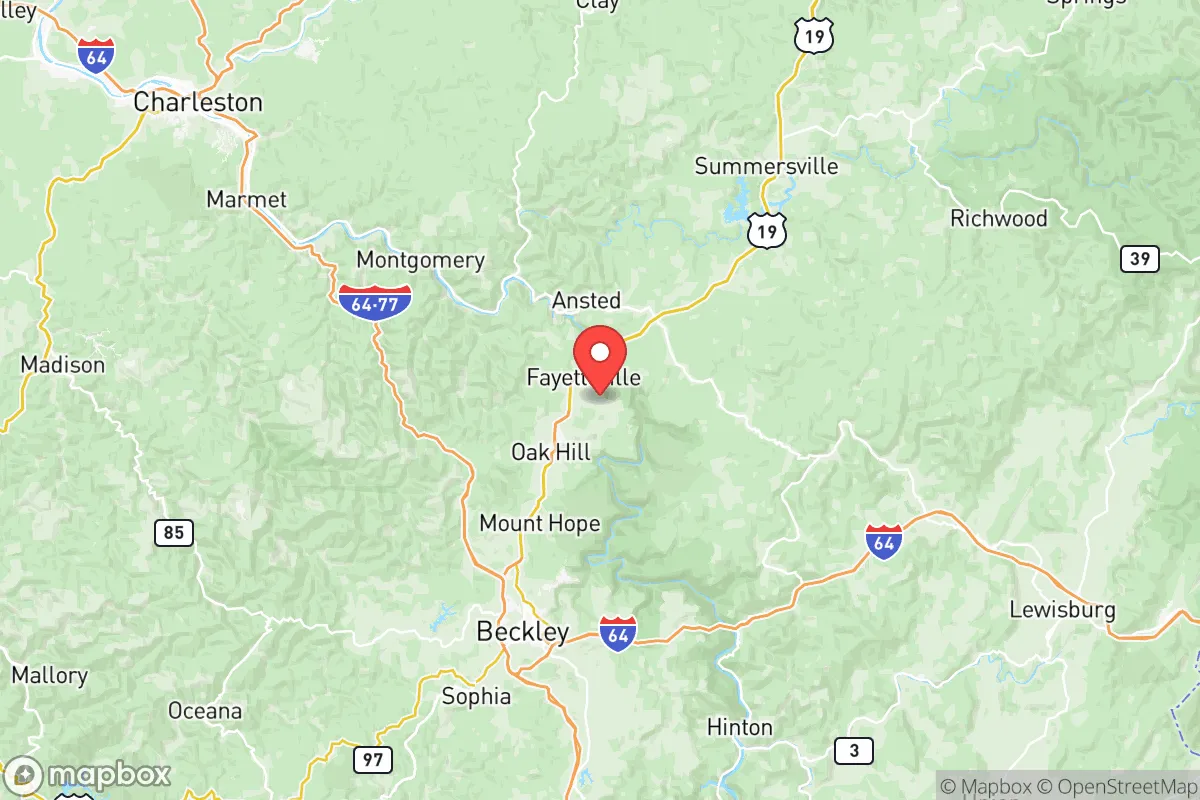
Suburbanization within the county has been limited but real: Oak Hill and Fayetteville have seen modest growth as bedroom communities for workers commuting to Charleston (about 45 minutes west on I-64) and Beckley (30 minutes south). The New River Gorge National Park and Preserve, designated in 2020, has brought a small influx of amenity migrants—retirees, remote workers, and outdoor-recreation entrepreneurs—who tend to settle in Fayetteville and the gorge rim communities.
The future
Fayette County's population is projected to continue a slow decline, with the West Virginia University Bureau of Business and Economic Research forecasting a drop to roughly 37,000 by 2035. The county is becoming slightly less white as the Hispanic share inches upward, but it will remain one of the least diverse counties in America for the foreseeable future. The Black population share is likely to stabilize or decline slightly as older residents pass away and younger Black adults continue to leave for more diverse urban labor markets.
The most significant demographic wild card is the New River Gorge National Park. Since its designation, Fayetteville has seen a surge in short-term rental development and a trickle of new residents from out of state—mostly white, college-educated, and drawn by outdoor recreation. If this amenity-migration trend accelerates, it could modestly increase the county's college-educated share (currently 16.1%, well below the national 33%) and its median income. However, the county lacks the housing stock, broadband infrastructure, and service-sector workforce to absorb rapid growth, so any change will be gradual.
The county's cultural identity is evolving from a purely coal-mining heritage toward a hybrid identity that includes outdoor recreation and tourism. The annual Bridge Day festival at the New River Gorge Bridge draws 80,000 visitors, and the county is marketing itself as "America's Newest National Park" destination. But the underlying demographic reality—an aging, shrinking, and overwhelmingly white population with low educational attainment—will not shift quickly.
For someone moving in now, Fayette County offers a deeply rooted Appalachian community with strong local institutions, very low crime rates, and some of the most spectacular natural scenery in the eastern United States. The trade-off is limited economic opportunity, minimal ethnic diversity, and a population that is more likely to be your grandparents' age than your own. It is a place for those seeking quiet, space, and connection to the land—not for those seeking a dynamic, diverse, or growing community.

* Values derived from national, state, county, city and local statistics and may differ in a specific area. Last updated: 2026-06-15T16:20:23.000Z
Narrative content on this page is AI-generated and may contain mistakes. Verify any details that matter before acting on them.
ReloMaps may earn a commission from affiliate links at no extra cost to you.

