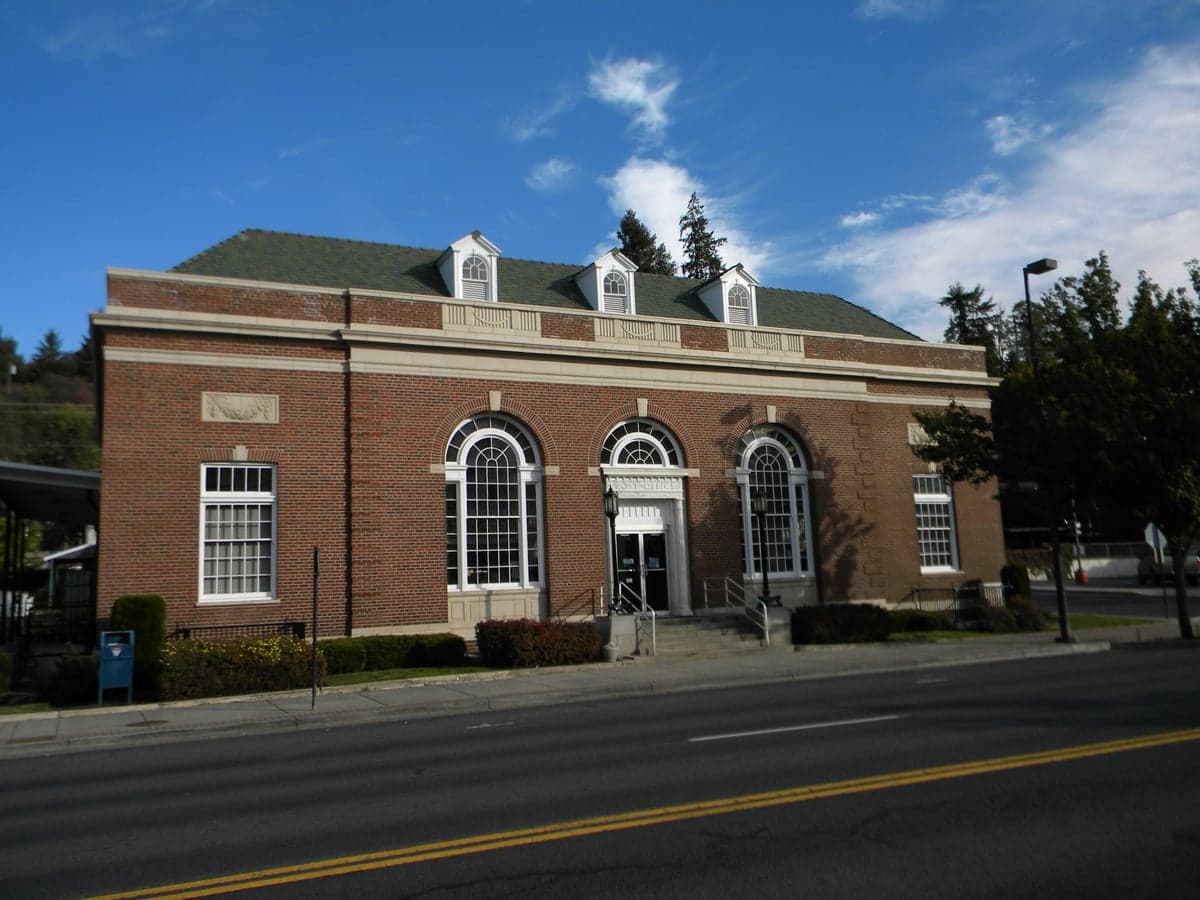
Photo: Wikipedia
Political ClimatePolitical Climate in Whitman County
Showing district-level results — no local-only data available.
Local Political AnalysisPolitical Analysis of Whitman County
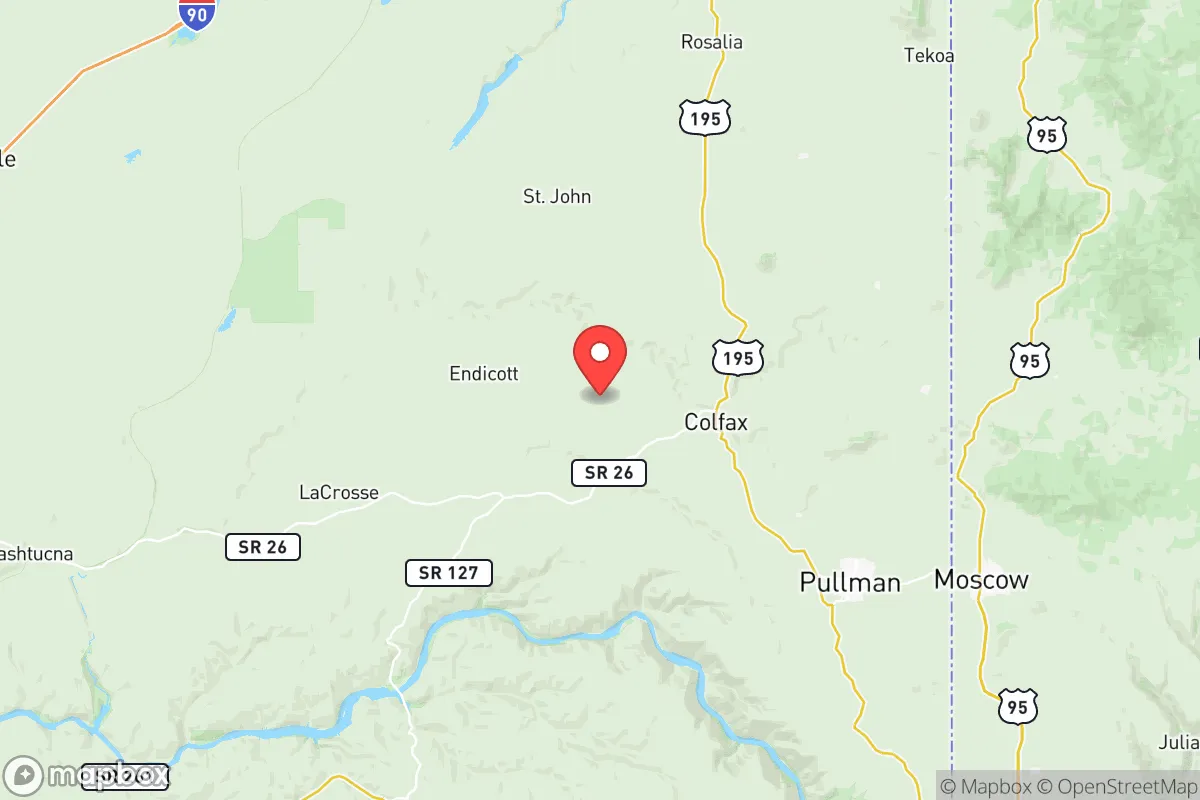
Whitman County, anchored by Pullman and the Washington State University campus, is a classic rural-urban split in miniature, with a Cook PVI of R+5 that masks a deeply divided electorate. The county has voted Republican in every presidential election since 2008, but the margin has narrowed significantly—from a 20-point Romney win in 2012 to a single-digit Trump victory in 2020—as Pullman’s student and faculty population has grown more reliably blue. Meanwhile, the surrounding farm towns like Colfax, Palouse, and Tekoa remain staunchly red, creating a political landscape that feels like two different counties sharing a ZIP code.
How it compares
Compared to Washington state as a whole—which has voted Democratic in every presidential election since 1988 and now leans D+8—Whitman County is a clear outlier. The county’s R+5 rating places it roughly 13 points to the right of the state average, a gap that has widened slightly over the past decade as King County’s Democratic margins have surged. Within Whitman, the contrast is stark: Pullman’s 1st precinct (campus area) went for Biden by 35 points in 2020, while Colfax’s 1st precinct (downtown and surrounding farms) gave Trump a 40-point win. The swing precincts are in the unincorporated areas around Pullman and along the Highway 195 corridor, where independent voters and WSU staff often split tickets—voting for local Republicans but backing Democratic candidates for statewide office like governor or senator. This split-ticket behavior is the county’s defining political trait, and it’s been fading as national polarization seeps into local races.
What this means for residents
For conservative residents, especially in the farming communities, the county’s R+5 lean means local offices—county commission, sheriff, prosecutor—are reliably Republican, and the county’s stance on issues like land use, property taxes, and Second Amendment rights aligns with their values. They can expect a county government that pushes back on state-level mandates from Olympia, particularly around environmental regulations and gun laws. For liberal residents, mostly in Pullman, the reality is more mixed: they have a strong local voice in city council and school board races (Pullman’s city council is majority progressive), but they face an uphill battle on countywide ballot measures and state legislative races, where the district (9th Legislative District) has been held by a Republican since 2010. The practical effect is that Pullman’s progressive policies—like a local minimum wage hike or sanctuary city ordinances—often get preempted or challenged by the county commission, creating a constant low-grade tension that both sides have learned to navigate.
Culturally, the divide shows up in everyday life. In Colfax and Palouse, the county fair, 4-H programs, and church potlucks dominate the social calendar, and political talk is common but civil—people know each other’s families. In Pullman, the WSU campus brings a younger, more transient population that’s less rooted in local traditions, and political conversations are more likely to happen over coffee at The Daily Grind or at a candidate forum in the CUB. The county’s biggest policy distinction from the rest of Washington is its aggressive opposition to the state’s Growth Management Act, which the county commission has repeatedly challenged in court, arguing it infringes on agricultural land rights. That fight, more than any single election, defines Whitman County’s political identity: a place where the rural majority is determined to hold the line against what it sees as urban overreach, even as Pullman’s blue precincts grow a little larger every cycle.

State Political ClimatePolitical Climate in Washington
State Political AnalysisPolitical Environment in the State
Washington State has been a reliably Democratic stronghold for over a decade, but its politics are far more complex than a simple blue label. The state hasn't voted for a Republican presidential candidate since 1984, and Democrats currently hold all statewide executive offices and both U.S. Senate seats. However, the political trajectory over the last 20 years shows a deepening urban-rural chasm, with the Seattle metro area's explosive growth pulling the state leftward while vast swaths of Eastern Washington and the Olympic Peninsula have become increasingly Republican. For a conservative relocator, the reality is that you'll be living in a state where your vote may not matter much in statewide races, but your local community and county government can feel like a completely different country.
Urban vs. rural divide
The political map of Washington is a textbook case of geographic polarization. The entire political gravity of the state is centered on King County, home to Seattle and its booming tech suburbs like Bellevue and Redmond. King County alone casts roughly one-third of all votes in the state and consistently delivers margins of 70% or more for Democratic candidates. This single county effectively decides every statewide election before the rest of the state even finishes counting. The I-5 corridor south to Olympia and north to Everett and Bellingham is similarly blue, creating a solid Democratic bloc from the Canadian border down to the state capital. In contrast, the eastern half of the state—places like Spokane, the Tri-Cities (Kennewick, Pasco, Richland), and Yakima—votes reliably Republican. Spokane County, once a swing area, has trended red over the past decade, though the city of Spokane itself remains a blue island. The most dramatic shift has been in the exurban and rural counties surrounding Puget Sound, like Snohomish and Pierce, which have moved from purple to light blue as Seattle's housing crisis pushes commuters further out. The true red strongholds are the agricultural and timber counties east of the Cascades—Grant, Douglas, Okanogan, and Ferry—where Republican margins often exceed 60%. A conservative moving to Washington should understand that your political experience will be defined almost entirely by which side of the mountains you choose to live on.
Policy environment
Washington's policy environment is defined by a progressive tax structure and aggressive regulatory posture. The state has no personal income tax—a major selling point for conservatives—but makes up for it with the highest state sales tax in the nation (currently 6.5% base, with local add-ons pushing it past 10% in Seattle). Property taxes are moderate, but the state's reliance on sales tax means lower-income residents pay a higher percentage of their income in taxes than the wealthy. The regulatory climate is business-friendly in name only for large tech firms, but small businesses face significant hurdles, particularly in labor and environmental compliance. Education policy is a flashpoint: Washington has a fully funded public school system with above-average per-pupil spending, but school choice is extremely limited, with no voucher program and a weak charter school law that has been repeatedly gutted by the courts. Healthcare is dominated by the state's own exchange, and Washington was an early Medicaid expansion state under the ACA. Election laws are among the most accessible in the country: all elections are conducted by mail, same-day voter registration is available, and ballots are automatically sent to all registered voters. This system has produced high turnout but also persistent concerns from conservatives about ballot security, though no major fraud has been proven.
Recent policy direction
The last five years have seen Washington accelerate in a progressive direction across nearly every policy dimension. On gun and self-defense law, the state passed a ban on high-capacity magazines (over 10 rounds) in 2022, a ban on assault weapons sales in 2023, and a requirement for a 10-day waiting period and safety training for all firearm purchases. These laws are currently being challenged in court but remain in effect. Parental and education rights have been a battleground: the state passed a law requiring schools to notify parents if a student changes their gender identity or pronouns, but this was quickly overturned by a court ruling, and the state now mandates that schools keep such information confidential from parents if the student requests it. On speech and privacy, Washington has some of the strongest privacy laws in the nation, including a comprehensive data privacy act and a ban on facial recognition technology by government agencies without a warrant. Medical and bodily autonomy is fully protected: abortion is legal up to viability with no mandatory waiting period, and the state has a "shield law" protecting providers who perform abortions for out-of-state residents. Property rights are constrained by the state's Growth Management Act, which severely limits rural development and has driven up housing costs. Taxation saw a major shift in 2023 with the introduction of a 7% capital gains tax on profits over $250,000, which the state supreme court upheld as an excise tax rather than an income tax. Voting and ballot access remains the most liberal in the country, with no voter ID requirement beyond a signature match.
Civil unrest & political movements
Washington has a long history of political activism, from the WTO protests in Seattle in 1999 to the CHAZ autonomous zone in 2020. The summer of 2020 saw sustained protests in Seattle, Portland, and Tacoma, with the Seattle Police Department's East Precinct being abandoned for several weeks. This period left a deep scar on the state's politics, with many suburban voters in places like Issaquah and Sammamish shifting toward more moderate Democratic candidates as a reaction. On the right, the Washington State Patriot Network and local 2A groups have been active, particularly in rural counties like Stevens and Pend Oreille, where "constitutional sheriff" movements have gained traction. Immigration politics are a major fault line: Washington is a sanctuary state, with state law prohibiting local law enforcement from cooperating with federal immigiration authorities except in limited circumstances. This has led to tension in agricultural areas like Yakima Valley, where the farm economy depends on immigirant labor but many residents oppose sanctuary policies. Election integrity controversies have been relatively muted compared to other states, but the 2020 and 2022 cycles saw organized efforts to audit ballot drop boxes in conservative counties, and a few county commissions have passed symbolic resolutions calling for hand-counting of ballots. The most visible flashpoint for a new resident would be the constant presence of political signage and the stark difference in political discourse between a coffee shop in Seattle versus a diner in Spokane.
Projection
Over the next 5-10 years, Washington is likely to become even more Democratic at the state level, but with increasing internal friction. The Seattle metro area continues to grow faster than the rest of the state, driven by tech and biotech jobs, which will further concentrate Democratic votes in King County. However, there are signs of a suburban backlash: places like Pierce County and Snohomish County are seeing more competitive local races, and the 2024 election saw some shift toward Republicans in these areas, though not enough to flip them. The real wild card is the housing crisis: if young families continue to be priced out of King County and move to Spokane or the Tri-Cities, those areas could become more competitive over time. A conservative moving to Washington now should expect that state-level politics will remain solidly Democratic for the forseeable future, but that local control in many counties east of the Cascades will remain Republican. The state's tax structure is unlikely to change dramatically, though a state income tax remains a perennial proposal that has always failed. The gun laws are likely to become even more restrictive, and the cultural divide between urban and rural Washington will only deepen.
For a new resident, the bottom line is this: Washington offers a high quality of life with stunning natural beauty and a strong economy, but you must be comfortable living in a state where your political views may be in the minority at the state level. If you choose to live east of the Cascades in places like Spokane or the Tri-Cities, you'll find a community that shares your values on most issues, but you'll still be subject to state laws on guns, taxes, and education that you may disagree with. If you choose to live in the Seattle suburbs, you'll find excellent jobs and schools but a political environment that can feel hostile to conservative viewpoints. The key is to pick your county carefully and understand that in Washington, your vote for president or governor is essentially symbolic, but your vote for county commissioner or school board is where you'll have real impact.
* Values derived from national, state, county, city and local statistics and may differ in a specific area. Last updated: 2026-10-25T16:17:29.000Z
Narrative content on this page is AI-generated and may contain mistakes. Verify any details that matter before acting on them.
ReloMaps may earn a commission from affiliate links at no extra cost to you.

