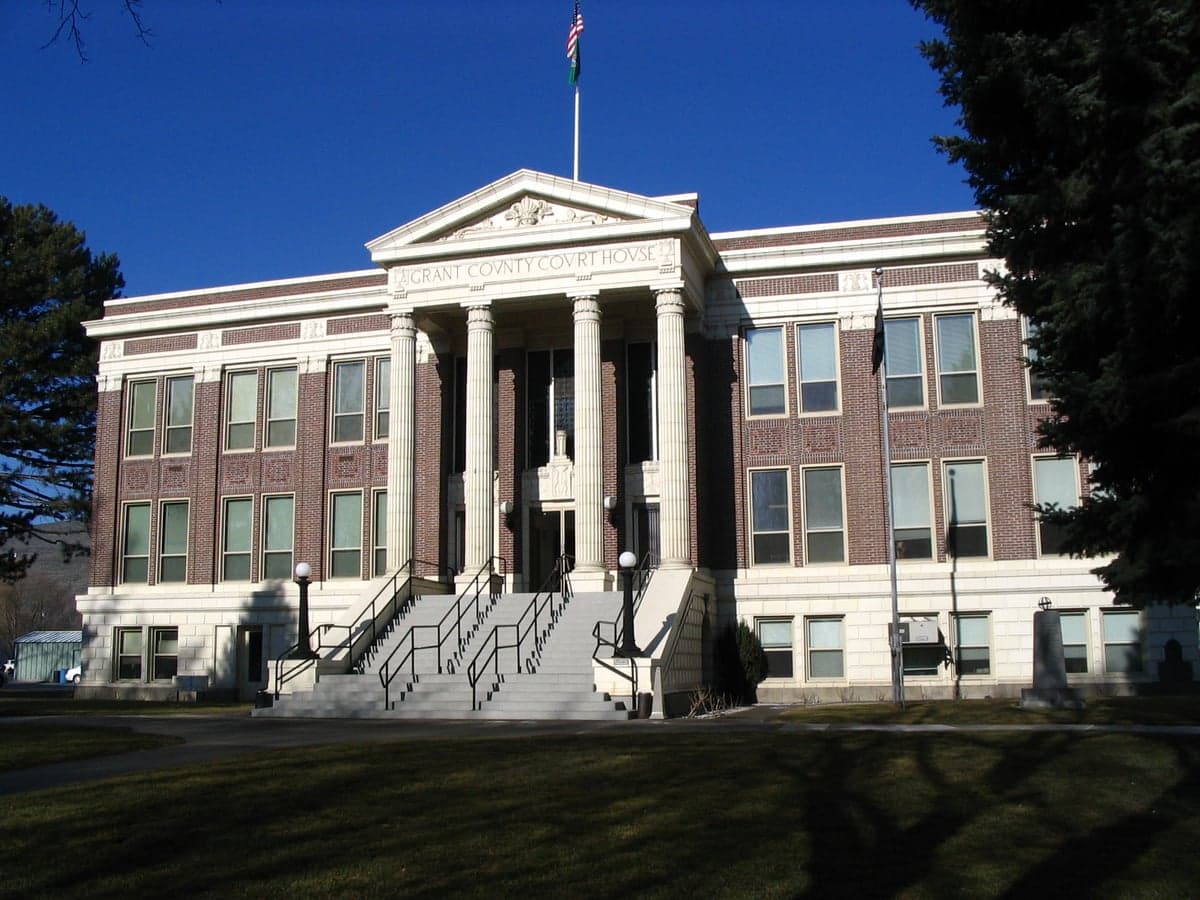
Photo: Wikipedia
Political ClimatePolitical Climate in Grant County
Showing county-level results — no local-only data available.
Lean and PVI are calculated from this county’s 2020 and 2024 presidential results, Cook-style.
Political rankings in Washington
- Most Conservative Cities in Washington
- Most Liberal Cities in Washington
- Best Conservative-Leaning Towns on the West Coast
- Best Conservative-Leaning Towns in the Pacific Northwest
- Most Affordable Liberal-Leaning Small Towns in the U.S.
- Safest Liberal-Leaning Cities in the U.S.
- Most Conservative Counties in Washington
- Most Liberal Counties in Washington
Local Political AnalysisPolitical Analysis of Grant County
Grant County votes reliably Republican, and the numbers back it up: a Cook Partisan Voting Index of R+10 means the county has performed about ten points more Republican than the nation as a whole in recent presidential elections. That lean runs from the Columbia Basin farm towns to the county seat. In 2020, Donald Trump carried Grant County with roughly 63% of the vote, and the county has sent Republicans to the legislature for decades — the 13th District seats around Moses Lake, Ephrata, and Quincy have been GOP-held for a generation. The county's population growth, driven by agricultural work and lower housing costs, has added voters without yet changing the fundamental math.
How it compares to Washington statewide
Here's the contrast that matters: Washington as a whole is one of the bluest states in the country, anchored by King County and the Puget Sound corridor, which is why the state hasn't voted for a Republican presidential candidate since 1984. Grant County is a different political world. A statewide Cook PVI isn't formally assigned, but Washington's recent presidential results put it roughly D+12 to D+15 — meaning the gap between Grant County and the state average is on the order of 22 to 25 points. In practice, that means Grant County voters routinely back candidates and ballot measures that lose statewide by wide margins, from tax-limiting initiatives to Republican legislative slates.
What this means for residents
For conservative residents, the county's lean means local and legislative representation that mirrors their views — county commissioners, sheriffs, and 13th District lawmakers are almost always Republicans, so conservative voters rarely feel outvoted on the local level. The frustration runs the other way: state-level policy on taxes, gun regulation, and land use is set in Olympia by a Democratic majority that Grant County voters overwhelmingly opposed. For liberal residents — and there are pockets of them, particularly in Moses Lake and among the growing Latino community in Quincy and Mattawa — the experience is being a minority in your own county while your state government aligns with you. That's an unusual, sometimes isolating combination, and it shapes how people talk politics at the feed store versus at a city council meeting.
The cultural and policy distinctions are concrete. Grant County is farm country, and water is politics: the Columbia Basin Project, the Odessa Groundwater Replacement Program, and battles over Columbia River water allocations dominate local debate in a way that barely registers in Seattle. The county has pushed back on state COVID-era restrictions, land-use rules, and environmental regulations it sees as written for urban Washington. Meanwhile, the Latino population — now a substantial share of the county, concentrated in Quincy, Mattawa, and Warden — is gradually reshaping local politics, with Latino candidates winning school board and city seats in recent cycles. The trajectory most longtime residents see: Grant County stays solidly red for the foreseeable future, but demographic change and growth from the Tri-Cities and Moses Lake area will soften the margins at the local level long before it changes any statewide map.

State Political ClimatePolitical Climate in Washington
State Political AnalysisPolitical Environment in the State
Washington is a reliably Democratic state in presidential and statewide elections, but its political identity is more fractured than the national map suggests. Democrats have carried the state in every presidential race since 1988, and the 2024 results continued that pattern, with the party's margins concentrated almost entirely in the Puget Sound corridor. The state's dominant coalition is a Seattle-centered alliance of tech workers, organized labor, environmental groups, and progressive urban voters, while the eastern two-thirds of the state — anchored by Spokane, the Tri-Cities, and Yakima — has drifted steadily toward Republicans over the past two decades. The 2016 election was a turning point: Donald Trump narrowly won the 5th Congressional District around Spokane, and Republican strength in eastern Washington has only deepened since.
Urban vs. rural divide
The political map breaks cleanly along the Cascade Range. King County, home to Seattle, Bellevue, and Redmond, delivers roughly a third of the statewide vote and votes Democratic by margins of 40 points or more, single-handedly offsetting the rest of the state. Pierce County (Tacoma) and Snohomish County (Everett) lean Democratic but are more competitive, and Kitsap County across the Sound is a reliable blue collar. East of the mountains, the picture inverts: Spokane County has become solidly Republican, the Tri-Cities (Kennewick, Richland, Pasco) are a conservative stronghold, and Yakima and the surrounding agricultural valleys vote heavily Republican. What surprises newcomers is the political distinctiveness of suburbs like Vancouver, just across the Columbia from Portland, which has grown more Democratic as it absorbs Portland commuters, while exurban communities like Marysville and Monroe remain swingy. The 8th Congressional District, spanning the Cascade foothills east of Seattle, is the state's perennial bellwether and has flipped between parties multiple times since 2000.
Policy environment
Washington has no state income tax, which is a genuine draw for high earners, but it funds government through a 7% state sales tax (among the highest combined rates in the nation once local add-ons are counted) and a relatively heavy property tax burden. In 2021 the legislature enacted a 7% capital gains tax on profits above roughly $270,000, which survived a state Supreme Court challenge in 2023 — a notable shift toward taxing wealth. The state runs one of the nation's most generous paid family and medical leave programs and a public long-term care insurance payroll tax (the WA Cares Fund), both of which add to payroll deductions. Regulatory posture is progressive: aggressive climate legislation including the Climate Commitment Act's cap-and-trade program, strict land-use rules under the Growth Management Act, and a minimum wage indexed well above the federal floor. Education policy leans toward expanded public pre-K and, since 2023, a state law requiring comprehensive sex education in public schools. Election law is vote-by-mail only, with same-day registration and automatic voter registration at the DMV.
Recent policy direction
The last several legislative sessions have moved the state decisively left on social policy. On firearms, Initiative 1639 (2018) raised the purchase age and imposed enhanced background checks, followed by a 2022 ban on magazines over 10 rounds and a 2023 law banning the sale of so-called assault weapons — both facing ongoing litigation. On bodily autonomy, Washington codified abortion protections and passed a shield law protecting providers and patients from out-of-state prosecution. Parental rights became a flashpoint: a 2024 ballot initiative (I-2081) granting parents broader access to school records passed, but Democratic lawmakers have since narrowed its scope, and school districts in places like Bellevue and Issaquah have clashed with parents over curriculum transparency. On speech and privacy, the state passed a My Health My Data law restricting health data sharing, while gun owner registries and red-flag laws expand surveillance of firearms owners. Property rights have been constrained by environmental regulations and tenant-protection laws, including a 2024 cap on rent increases. Voting access is expansive — pre-paid postage, drop boxes, and automatic registration — which critics argue reduces ballot integrity safeguards, though documented fraud remains rare.
Civil unrest & political movements
Seattle's Capitol Hill Occupied Protest (CHOP) in 2020 became a national symbol of the state's activist left, and the city has hosted recurring demonstrations around climate, immigration, and police funding. Organized labor is unusually strong here — the 2024 Boeing machinists' strike and the Seattle minimum wage fights reflect a muscular union culture. On the right, eastern Washington has seen growing "Greater Idaho"-style secession talk (though aimed at joining Idaho, not leaving the Union), county-level nullification resolutions against state gun laws, and a vocal movement questioning election integrity after 2020, particularly in Spokane and rural counties. Immigration politics are visible: Washington is a sanctuary state under a 2019 law limiting local cooperation with federal immigration enforcement, and agricultural communities in the Yakima Valley depend heavily on migrant labor. A new resident will notice the political temperature most in Seattle's protest culture and in eastern Washington's "don't tread on me" yard signs and county sheriff statements refusing to enforce certain state gun laws.
Projection
Demographically, Washington is likely to stay blue statewide for the foreseeable future — King County's growth and the state's high in-migration from California and Asia keep the urban core dominant. But the internal divide will sharpen. Eastern Washington's population is growing more slowly and aging faster, deepening its Republican identity, while the Cascade foothills and southwest Washington suburbs around Vancouver and Camas become the real battlegrounds. Expect continued legislative pushes on climate, housing density (the 2023 middle-housing law allowing duplexes and fourplexes statewide), and gun regulation, with legal challenges working through the courts. If Republicans gain nationally, Washington will likely remain a Democratic firewall on abortion and immigration, while conservative counties test the limits of local resistance. Over the next decade, a mover should expect a state that is socially progressive and fiscally demanding, with a widening cultural gap between the Seattle metro and the rest.
For a conservative family or individual considering Washington, the practical takeaways are concrete: you'll pay no income tax but face high sales and property taxes plus new payroll deductions; your gun rights are among the most restricted on the West Coast; and your vote will matter most in local and county races rather than statewide. For liberal residents, the state delivers on abortion access, climate policy, and labor protections, but the cost of living in the Puget Sound area is steep and the political culture in rural counties can feel unwelcoming. The honest bottom line is that Washington is two states sharing a border — pick your county carefully, because the political reality of Spokane versus Seattle is a different country.
* Values derived from national, state, county, city and local statistics and may differ in a specific area. Last updated: 2026-11-03T09:56:57.000Z
Narrative content on this page is AI-generated and may contain mistakes. Verify any details that matter before acting on them.
ReloMaps may earn a commission from affiliate links at no extra cost to you.

