Photo: Wikipedia
Demographics of Grant County
Affluence Level in Grant County
A middle-class area roughly in line with national averages across income, home values, education, and employment.
People of Grant County
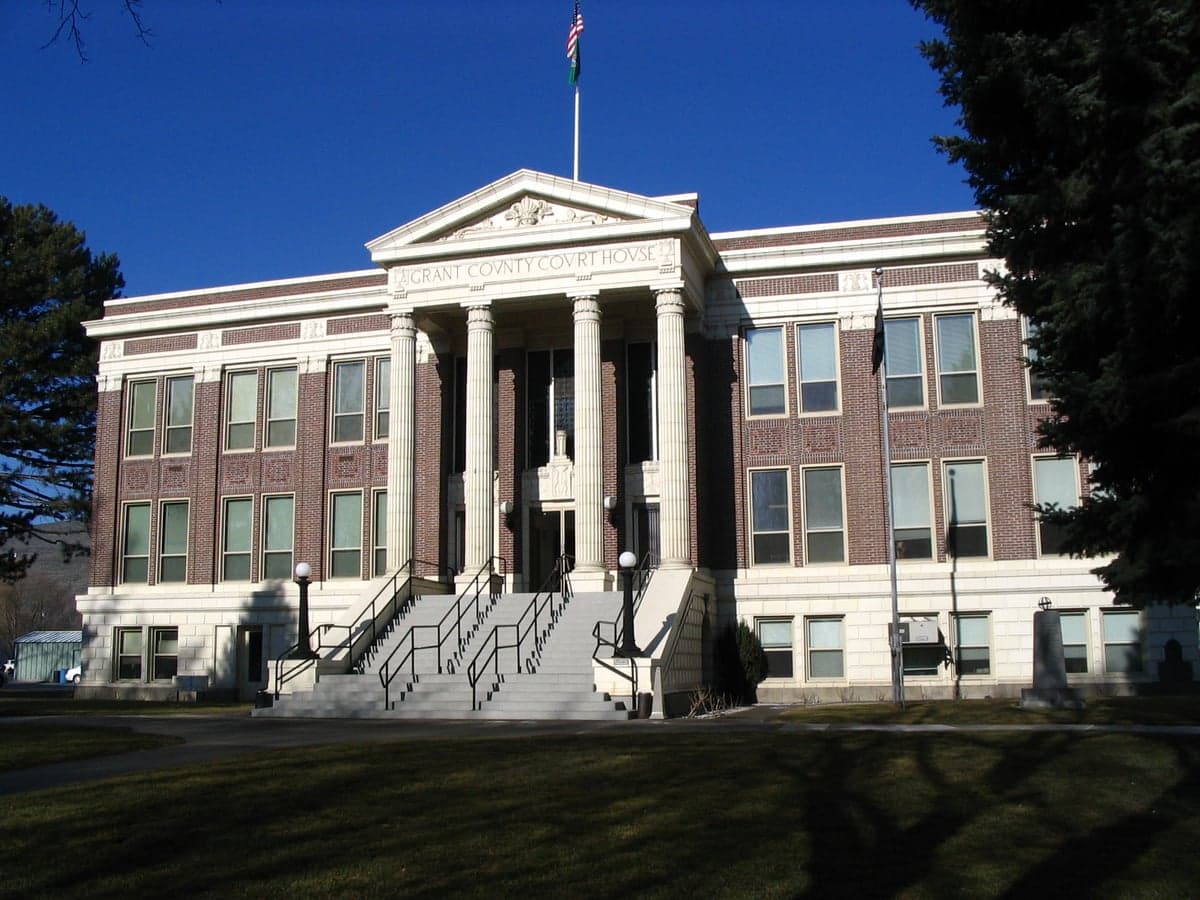
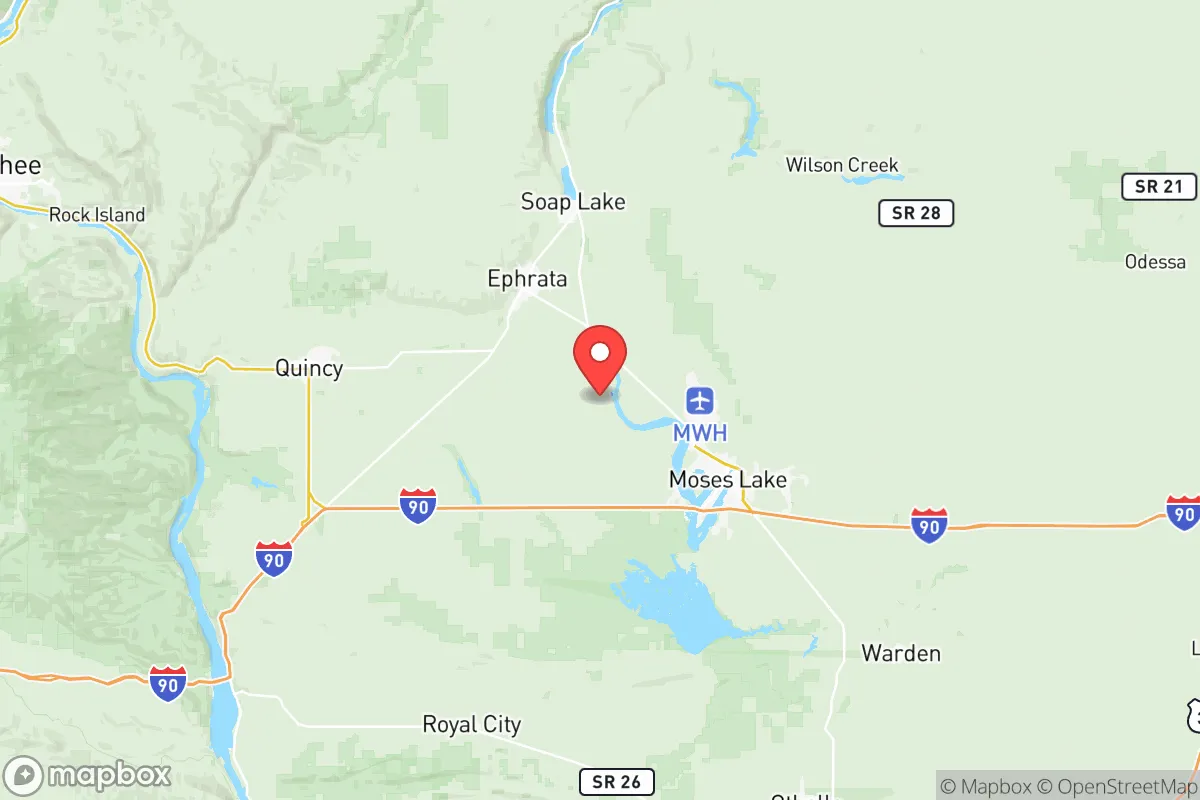
Grant County today is a majority-minority county of 100,428 people spread across 2,700 square miles of Columbia Basin desert, anchored by Moses Lake, Ephrata, and Quincy. Its identity was forged in the 20th century by federal reclamation water, not by colonial settlement: white residents are now 50.0% of the population, Hispanic residents 43.3%, and the foreign-born 12.1%. The county's towns remain sharply distinct — Othello and Quincy are heavily Latino agricultural communities, Moses Lake is the diversified commercial hub, and Ephrata holds the county seat and its government payroll.
Settlement and growth before 1960
Grant County is a post-1900 creation in nearly every meaningful sense. For thousands of years the land was home to Interior Salish-speaking peoples — the Sinkiuse-Columbia (whose leader Chief Moses gave Moses Lake its name), the Wenatchi, and the Okanagan — who moved seasonally across the shrub-steppe to fish the Columbia and hunt. European and American contact arrived late and thinly: fur traders and Catholic missionaries passed through in the 1830s–1840s, but the Columbia Basin remained one of the last unsettled corners of Washington Territory. White ranchers began running cattle along Crab Creek and the coulees in the 1880s, and the Northern Pacific and Great Northern railroads later established sidings that became the towns of Wilson Creek, Hartline, and Coulee City.
The decisive event was the federal Columbia Basin Project. Construction of Grand Coulee Dam began in 1933, and the first irrigation water reached Grant County soils in 1951. Before the water, the county was dryland wheat and cattle country with a few thousand residents; the 1940 census counted roughly 14,000 people. After it, the county's population roughly tripled within two decades. The Bureau of Reclamation's new towns — Moses Lake, Quincy, and Othello — were platted specifically to receive homesteaders on irrigated "farm units," and veterans of World War II and Korea drew priority under the program.
Those homesteaders were overwhelmingly white and largely northern European in origin: Anglo-Americans from the Palouse and the Midwest, plus German-Russian families moving west from the Dakotas and eastern Washington's Adams and Lincoln counties, and a smaller stream of Scandinavian and German settlers. They planted potatoes, alfalfa, sugar beets, and orchards, and built the churches, granges, and co-ops that still define towns like Ephrata, Soap Lake, and Warden. The 1950s also brought the first significant Mexican-American presence: seasonal farmworkers recruited under the Bracero Program (1942–1964) began settling year-round in Quincy and Othello rather than following the harvest circuit.
The modern era since 1965
The Hart-Cellar Act of 1965 reshaped national immigration, but Grant County's demographic transformation came mostly through a different channel: sustained internal migration from Mexico and, later, Central America, driven by agricultural labor demand. By the 1980s and 1990s, Quincy and Othello had become majority-Latino communities, with families from Michoacán, Jalisco, and later Guatemala and El Salvador putting down roots rather than returning south. The 1990s tech-boom orchard and potato-processing economy — including the J.R. Simplot plant in Othello and the Lamb Weston facility in Warden — locked in year-round settlement. Today Hispanic residents make up 43.3% of the county, and in Othello and Quincy they are the clear majority.
Domestic migration since 2000 has been more mixed. Moses Lake attracted retirees, second-home buyers, and remote workers priced out of the Puget Sound region, and its commercial base — including the Moses Lake Business Park and the former Japan Airlines flight-training facility — drew some East/Southeast Asian families, though that community remains small at 0.7% of the county. Indian-subcontinent residents are a still smaller presence at 0.2%, concentrated in Moses Lake and Ephrata's medical and engineering professions. Black residents are 1.2%, with no substantial enclave. The county's college-educated share of 18.2% — well below the state average — reflects an economy built on agriculture, food processing, and the military-adjacent workforce tied to Grant County International Airport and the Port of Moses Lake.
Suburbanization has played out differently here than in metro America: rather than white flight to exurbs, Grant County has seen Latino families move from labor camps and rental housing into homeownership in Quincy, Othello, and Moses Lake's Peninsula and Knolls neighborhoods, while white residents have aged in place in the smaller farm towns like Hartline and Wilson Creek, several of which have lost population since 1980.
Where the population is heading
Grant County is likely to become more Hispanic and more diverse over the next 10–20 years, not less. Hispanic residents are younger on average and have higher birth rates than the county's aging white population, and the trend line points toward Hispanic residents becoming a plurality or majority of the county within a generation. The foreign-born share of 12.1% will probably hold steady or rise modestly as agricultural employers continue to recruit, though federal immigration enforcement and H-2A guest-worker policy will shape how much of that growth is permanent settlement versus temporary labor.
Growth will concentrate in Moses Lake, which has the housing stock, the hospital (Samaritan Healthcare), and the industrial land to absorb newcomers, and in Quincy and Othello along the Highway 28 corridor. The smaller wheat-belt towns — Hartline, Wilson Creek, Coulee City — will likely continue slow decline or hold flat. East/Southeast Asian and Indian-subcontinent communities will remain small and dispersed rather than forming enclaves, and the county's cultural identity will increasingly be defined by a bilingual, Mexican-American agricultural heritage layered over the mid-century reclamation story rather than by either alone.
For someone moving to Grant County now, the bottom line is a place in demographic transition: affordable, agricultural, and increasingly Latino, with a small-town social fabric that is more traditional than Seattle but less homogeneous than its mid-century reputation suggests. Families seeking low-cost housing and outdoor access will find Moses Lake and Ephrata welcoming; those expecting a uniformly white rural county will find Quincy and Othello tell a different story. The county is becoming a working-class, bilingual, Columbia Basin community — and that is the direction it will keep moving.

* Values derived from national, state, county, city and local statistics and may differ in a specific area. Last updated: 2026-11-03T09:56:57.000Z
Narrative content on this page is AI-generated and may contain mistakes. Verify any details that matter before acting on them.
ReloMaps may earn a commission from affiliate links at no extra cost to you.

