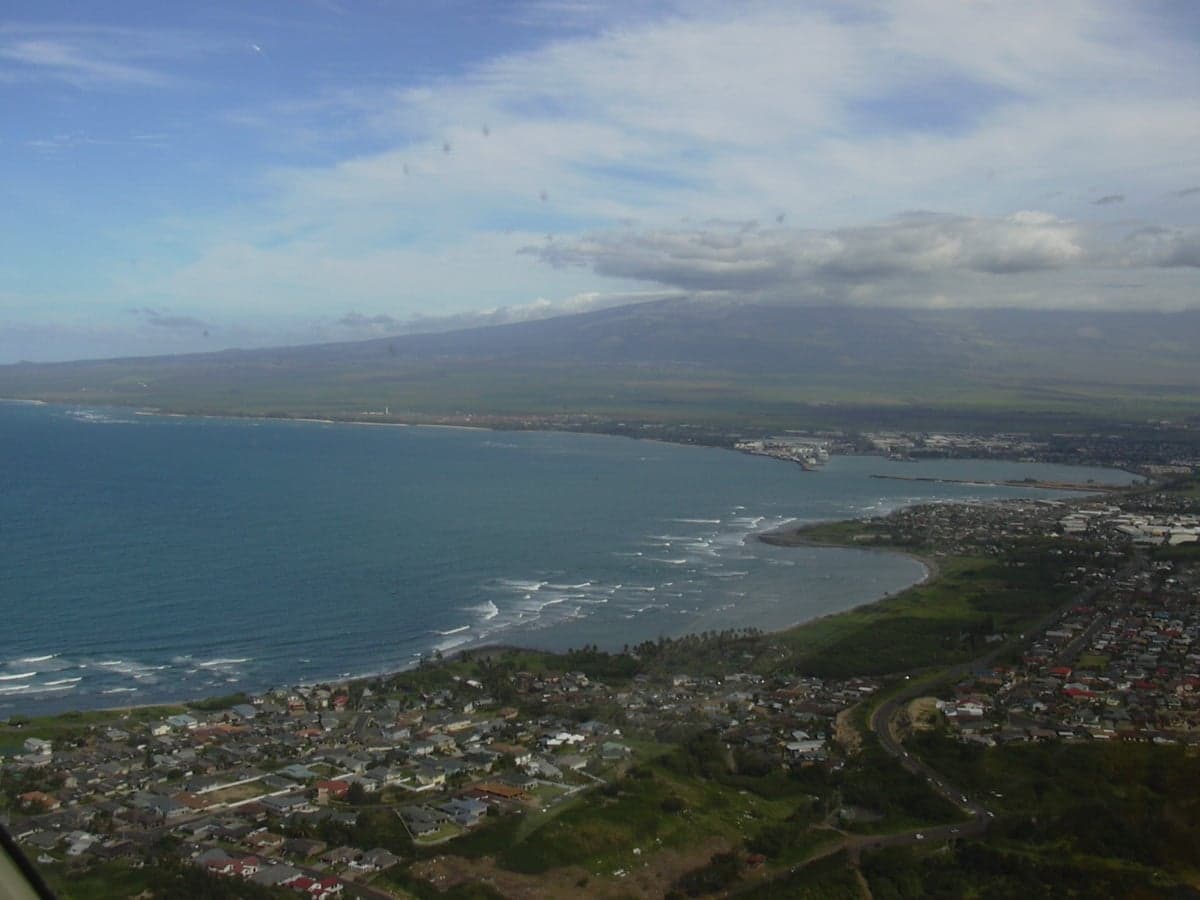
Photo: Wikipedia
Demographics of Waihee, HI
Affluence Level in Waihee, HI
An upper-middle-class area. Household wealth, education levels, and homeownership run ahead of national benchmarks.
People of Waihee, HI
The people of Waihee, Hawaii, today form a community of 11,369 residents defined by a strong East/Southeast Asian majority, a small but established Hispanic presence, and a very low foreign-born rate of just 3.4%. The population is notably less diverse than the state average in several key categories, with a White share of only 6.7% and no measurable Indian subcontinent population. This is a working-class, family-oriented area on Maui’s north shore, where the dominant cultural identity is rooted in the plantation-era labor history of the region. The community is characterized by its tight-knit, multi-generational feel, with many residents tracing their local roots back several generations.
How the city was settled and grew
Waihee’s human history is almost entirely a story of the sugar plantation era. Before the 19th century, the area was a sparsely populated agricultural zone for native Hawaiians, who cultivated taro in the Waihee Stream valley. The modern population began to form after 1860, when the Waihee Sugar Company established its mill and began importing contract laborers. The first major wave brought Japanese and Chinese workers to clear land and plant cane. These laborers settled in what is now known as Lower Waihee, a flat coastal strip where the mill and its associated housing camps were located. The plantation built simple, uniform wooden homes for its workers, and these camps formed the original neighborhoods of the area. A second wave in the 1890s and early 1900s brought Portuguese and Puerto Rican laborers, who were housed in separate camps slightly inland, near the present-day intersection of Kahekili Highway and Waihee Road. These groups established distinct enclaves, with the Portuguese community building a small Catholic church that still serves the area. By the 1920s, the plantation workforce was predominantly Japanese and Filipino, with the latter group arriving in large numbers after 1909. The Filipino laborers settled in camps along the Waihee Stream corridor, an area that remains a core neighborhood for Filipino-descended families today. The plantation system dictated every aspect of life, from housing to schooling, and created a rigid but stable social order that persisted until the mill’s closure in the 1940s.
Modern era (post-1965)
The post-1965 period saw Waihee transition from a plantation camp to a bedroom community for Kahului and Wailuku. The closure of the sugar mill eliminated the area’s single employer, and many families left for Oahu or the mainland. However, the 1970s and 1980s brought a new wave of domestic in-migration from other parts of Maui and from the U.S. mainland, drawn by lower land prices compared to central Maui. These new residents were predominantly White and Hispanic, and they settled in the newer subdivisions built on former cane fields east of the old plantation core. The neighborhood of Waihee Heights, developed in the 1980s, became a concentration for these incoming families, offering larger lots and newer homes. Meanwhile, the original plantation neighborhoods in Lower Waihee and along the stream corridor remained overwhelmingly East/Southeast Asian, particularly Japanese and Filipino. The 1990s and 2000s saw a gradual diversification, with the Hispanic share growing from negligible to 9.2% by the 2020 census, largely through families moving into Waihee Kai, a subdivision built in the late 1990s. The Asian share, now at 38.2%, has remained stable but is aging, as younger Asian-descended residents often move to Kahului or off-island for jobs and education. The college-educated share is just 18.7%, reflecting the area’s working-class character and the limited number of professional jobs available locally.
The future
The population of Waihee is likely to become slightly more diverse over the next 10–20 years, but the pace of change will be slow. The Asian majority is aging in place, and younger Asian families are not replacing them at the same rate, which will gradually reduce the Asian share. The Hispanic population is the fastest-growing segment, driven by families moving into the Waihee Kai and Waihee Ridge subdivisions, where newer housing stock is available. The White share, currently 6.7%, may increase modestly as more mainland retirees and remote workers discover the area’s relative affordability compared to Kihei or Lahaina. However, Waihee lacks the amenities and job base to attract large numbers of newcomers; it will remain a quiet, residential satellite of Wailuku. The foreign-born share, already very low at 3.4%, is unlikely to rise significantly, as the area does not have the immigrant-friendly infrastructure or employment base of larger towns. The cultural identity will remain rooted in its plantation-era heritage, with local festivals and community events still organized around the old ethnic camps.
For someone moving in now, Waihee offers a stable, family-oriented community with deep local roots and a slow pace of change. It is not a place of rapid growth or dramatic demographic shifts, but rather a settled, working-class town where the past remains visible in the neighborhoods and the people. New residents, particularly those moving into the newer subdivisions, will find a welcoming but insular community where multi-generational ties run deep and newcomers are expected to integrate into existing social networks rather than reshape them.

* Values derived from national, state, county, city and local statistics and may differ in a specific area. Last updated: 2026-07-12T14:07:24.000Z
Narrative content on this page is AI-generated and may contain mistakes. Verify any details that matter before acting on them.
ReloMaps may earn a commission from affiliate links at no extra cost to you.

