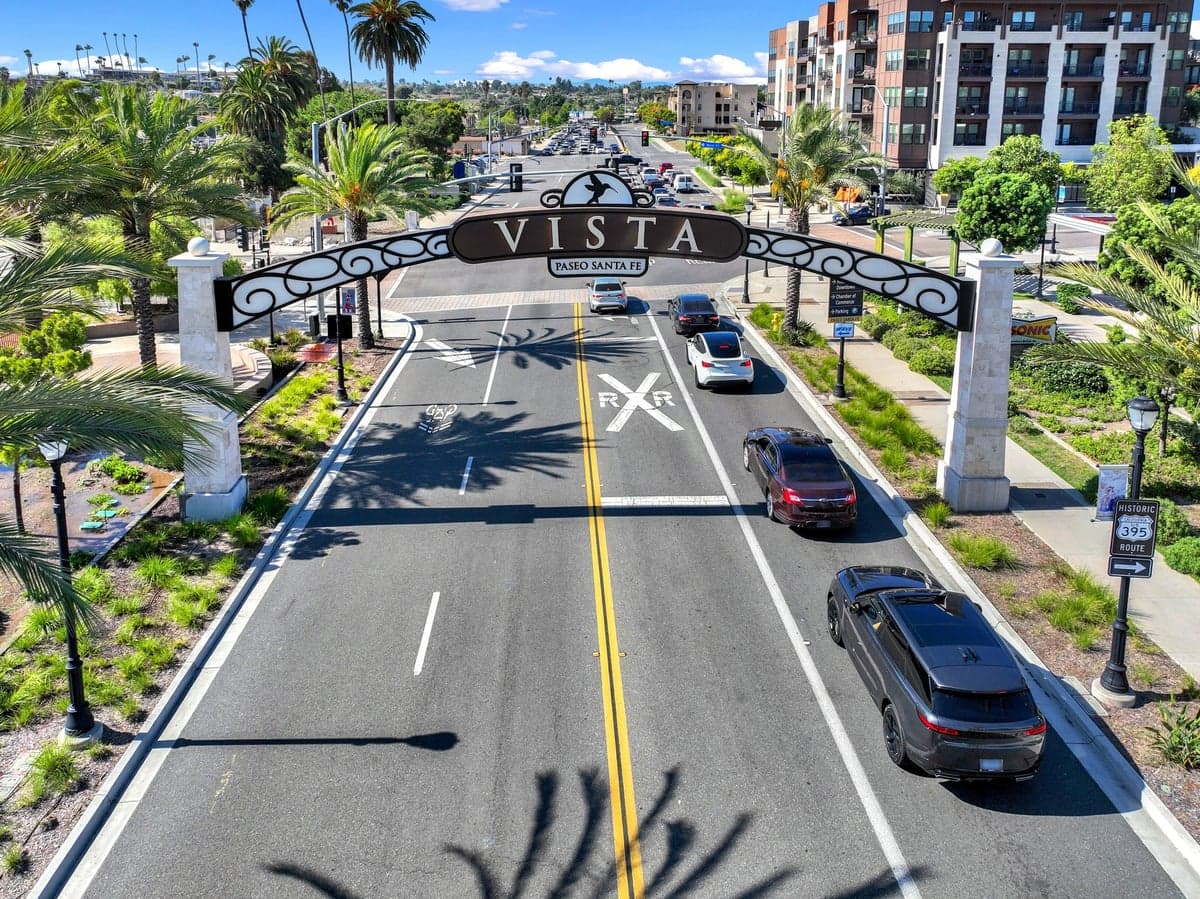
Photo: Wikipedia
Personal Sovereignty in Vista, CA
Moderate friction. Expect trade-offs in some aspect of personal liberty and independence.
What does Personal Sovereignty tell us?
Personal Sovereignty measures your capacity for self-reliance and independence with minimal government friction. Higher scores mean fewer barriers between you and the way you want to live... but it assumes you have the space you need and good neighbors.
What does this tell us?
Personal Sovereignty measures your capacity for self-reliance and independence with minimal government friction. Higher scores mean fewer barriers between you and the way you want to live... but it assumes you have the space you need and good neighbors.
State Policy
Energy independence: Importer (33% of energy produced in-state)
Personal Liberty
Homesteading

Personal Liberty Analysis
Vista, California offers a mixed personal sovereignty environment where state-level regulatory density often overrides local autonomy, but residents still carve out meaningful independence within those constraints. Located in northern San Diego County, Vista sits under California’s comprehensive state framework—one of the nation’s highest tax burdens and most extensive regulatory codes—yet its suburban character and local governance provide pockets of self-determination that a freedom-oriented relocator can work with, if they’re strategic. For a conservative-leaning individual or family, the trade-offs are clear: you gain access to a desirable climate and economic region, but you must navigate a system that prioritizes collective oversight over individual latitude in many domains.
Tax burden and regulatory posture in Vista compared to other California cities
California’s state-level tax burden is among the heaviest in the U.S., and Vista residents feel it directly. The state’s progressive income tax tops out at 13.3% on high earners, and the base sales tax in Vista is 8.75% (2026), composed of the state rate plus local add-ons. Property taxes under Proposition 13 are capped at 1% of assessed value plus voter-approved bonds, but reassessment upon sale can reset that base, meaning newer buyers face higher effective rates than long-term owners. Vista’s regulatory posture mirrors the state’s: building permits, business licensing, and environmental reviews are thorough and often slow. The city’s municipal code runs over 1,000 pages, and zoning is tightly controlled—residential areas are predominantly single-family with strict setback and height limits. For a small business owner or contractor, this means higher compliance costs and longer timelines than in Texas or Arizona. However, Vista is not as aggressive as coastal cities like San Francisco or Los Angeles; its city council leans moderate, and the local Chamber of Commerce actively works to streamline processes for new businesses. The net effect: a high-tax, high-regulation environment that is navigable if you have capital and patience, but a clear deterrent for those seeking minimal government footprint.
Self-defense rights and gun law specifics in Vista, California
California’s firearm laws are among the strictest nationally, and Vista operates entirely within that framework. The state requires a 10-day waiting period and a Firearm Safety Certificate for all purchases, with a background check through the California Department of Justice. Handguns must be on the state’s “roster of certified handguns,” which excludes many popular models. As of 2026, California maintains a may-issue concealed carry (CCW) system, but San Diego County—where Vista is located—has become more permissive after the Supreme Court’s Bruen decision (2022). The Sheriff’s Department now issues CCW permits to applicants who complete a training course and demonstrate “good cause,” which is broadly interpreted. In practice, law-abiding residents in Vista can obtain a CCW, but the process takes 3-6 months and costs several hundred dollars. Magazine capacity is limited to 10 rounds, and “assault weapon” bans restrict certain rifle features. Self-defense in the home is legally protected under the state’s “castle doctrine,” but there is no “stand your ground” law; a duty to retreat applies in public spaces. For a freedom-oriented resident, the gun laws are a significant constraint—you cannot carry the same firearms or configurations as in most of the Mountain West or South. But Vista’s location in a more gun-friendly county than Los Angeles or the Bay Area means local law enforcement is generally reasonable with compliant owners. The trade-off: you can exercise your rights, but with more paperwork, cost, and legal nuance than in less restrictive states.
Self-reliance and homesteading viability in Vista: lot sizes, zoning, and off-grid feasibility
Vista’s suburban-to-semi-rural character offers more homesteading potential than most of coastal Southern California, but state and local regulations still impose clear limits. Typical residential lot sizes in Vista range from 6,000 to 10,000 square feet in standard subdivisions, with some larger parcels—up to 1-2 acres—in the eastern and northern parts of the city near the San Marcos foothills. Zoning in these areas (e.g., “R-A” Residential Agricultural) allows for small-scale animal husbandry: chickens, goats, and even a horse on sufficient acreage, subject to setback and noise ordinances. However, off-grid living is effectively illegal in Vista. The city requires connection to municipal water and sewer for all habitable structures, and solar panels must be grid-tied under California’s net metering rules. Rainwater harvesting is permitted but limited to 200 gallons per property without a permit, and composting toilets are not allowed as primary sanitation. Vegetable gardens and fruit trees are unrestricted, and many residents keep raised beds and small orchards. The climate—average 70°F year-round with 12 inches of annual rainfall—supports drought-tolerant gardening but requires irrigation. For a family wanting to raise some of their own food and reduce reliance on grocery stores, Vista is viable with a larger lot and a willingness to work within the code. For someone seeking true self-sufficiency—off-grid power, well water, septic, and no municipal oversight—Vista is not the place. That lifestyle is more feasible in rural areas of Northern California or the Sierra foothills, where zoning is looser and enforcement less frequent.
Personal liberties in Vista: parental rights, medical autonomy, speech, and property
California’s state preemption shapes personal liberties in Vista more than local ordinances. Parental rights are a contested area: the state mandates comprehensive sex education in public schools (California Healthy Youth Act), and parents cannot opt out of all content—only specific lessons. School boards in Vista have pushed back, with the Vista Unified School District adopting a “parental notification” policy for changes in a student’s gender identity, though this faces legal challenges from the state. In practice, conservative parents often supplement with private or homeschool options; homeschooling is legal with a simple affidavit filed with the state, and co-ops are common in the area. Medical autonomy is limited: California has strict vaccine mandates for school attendance (no personal belief exemptions), and the state’s health insurance exchange (Covered California) operates under tight regulations. Alternative medicine is available but not subsidized. Free speech is robust under the First Amendment, and Vista has not enacted local ordinances restricting political expression beyond standard time/place/manner rules. Property rights are constrained by California’s environmental laws (CEQA), which can delay development and renovations, and by rent control—Vista does not have its own rent control, but state-level AB 1482 caps annual rent increases at 5% plus inflation (or 10%, whichever is lower) for most multifamily units. For a homeowner, this is less relevant; for a landlord, it’s a constraint. Overall, personal liberties in Vista are narrower than in states like Florida or Texas, but the city’s moderate local governance and engaged conservative community provide some buffer against the most progressive state policies.
Compared to other areas in California, Vista ranks as a moderate-to-high sovereignty location—better than the Bay Area or Los Angeles for self-defense and property rights, but behind rural counties like Shasta or Siskiyou for off-grid feasibility and regulatory freedom. For a conservative relocator who values climate, job access, and a like-minded community, Vista offers a workable balance: you can own firearms, raise chickens, and homeschool your kids, but you’ll pay higher taxes and navigate more red tape than in a red state. The key is knowing where to push and where to comply—Vista rewards the informed and prepared, not the defiant.

* Values derived from national, state, county, city and local statistics and may differ in a specific area. Last updated: 2026-10-05T23:57:58.000Z
Narrative content on this page is AI-generated and may contain mistakes. Verify any details that matter before acting on them.
ReloMaps may earn a commission from affiliate links at no extra cost to you.

