Photo: Wikipedia
Demographics of Vista, CA
Affluence Level in Vista, CA
A middle-class area roughly in line with national averages across income, home values, education, and employment.
People of Vista, CA
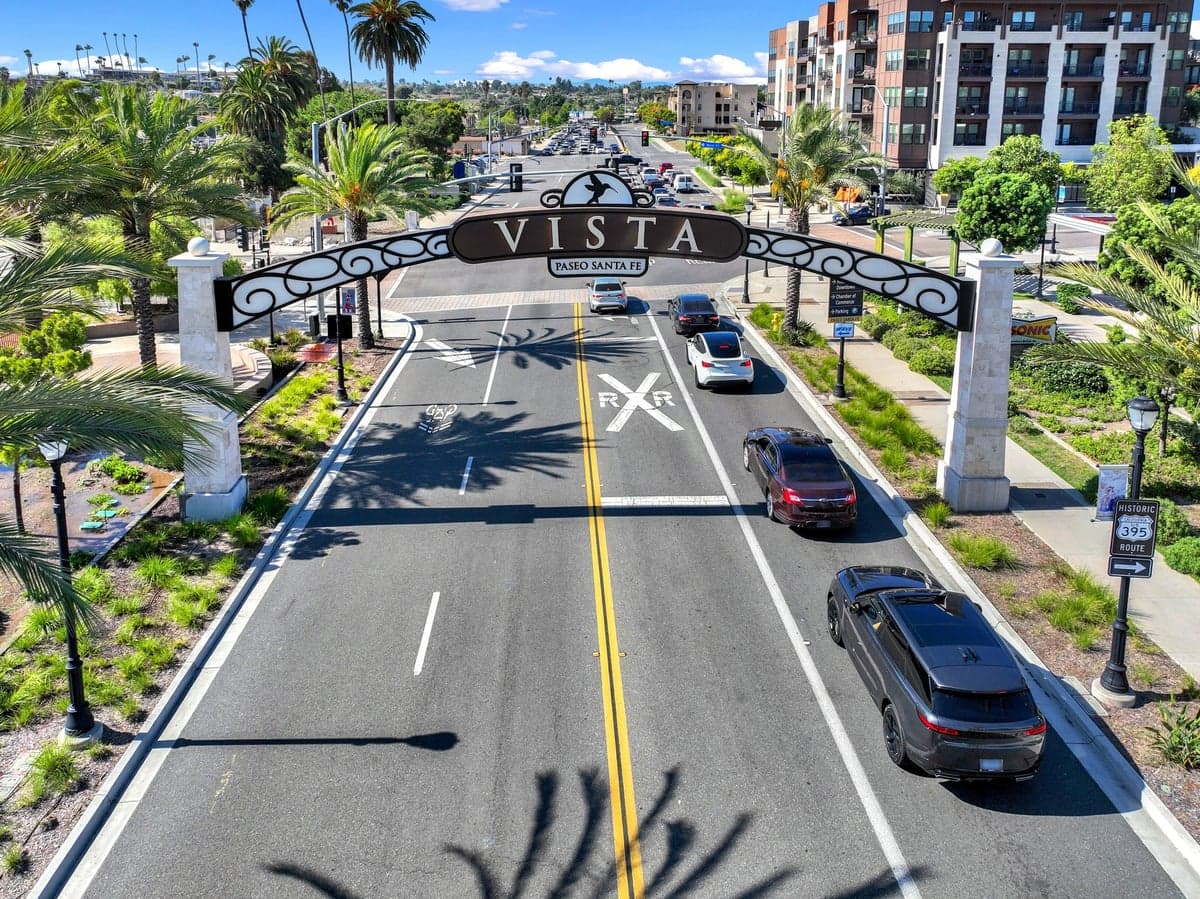
The people of Vista, California today form a predominantly Hispanic and White working- and middle-class community of nearly 99,000 residents, marked by a strong family orientation and a slightly conservative-leaning civic character. With a foreign-born population of 11.5% and a median age around 35, Vista is denser and more ethnically diverse than neighboring Fallbrook but less so than Oceanside. The city’s identity is rooted in its agricultural past and its evolution into a suburban hub for North County San Diego, where single-family homes and small businesses dominate the landscape.
How the city was settled and grew
Vista’s modern population history begins in the late 19th century, not with Spanish or Mexican land grants, but with American homesteaders drawn by the promise of dry-land farming. The area was originally part of the vast Rancho Guajome land grant, but the city itself was formally founded in 1882 when the Santa Fe Railroad extended a line through the valley. Early settlers were predominantly Anglo-American farmers who planted citrus, avocados, and olives. The historic downtown Vista Village area, centered around Main Street and Indiana Avenue, became the commercial and social hub for these early families. By the 1920s, a small but stable community of about 500 people had taken root, with many families living on acreage in what is now the Buena Vista neighborhood, named for the panoramic views of the surrounding hills. The post-World War II era brought a second wave: returning veterans and defense workers from nearby Camp Pendleton and the burgeoning aerospace industry in San Diego. These new residents settled in the Shadowridge area, which saw its first subdivisions built in the 1950s and 1960s, transforming Vista from a farm town into a bedroom community.
Modern era (post-1965)
The 1965 Hart-Cellar Immigration Act fundamentally reshaped Vista’s population. Mexican and Central American immigrants, many with family ties to the region’s agricultural labor force, began arriving in significant numbers. They concentrated in the South Santa Fe Avenue corridor and the Melrose Drive area, where older, more affordable housing stock and proximity to nurseries and packing houses provided a foothold. By 1990, the Hispanic share of the population had risen to roughly 30%, and by 2020 it had become the largest single ethnic group at 49.7%. During the same period, East and Southeast Asian communities—primarily Filipino and Vietnamese—established a presence, settling in the Emerald Drive and Hacienda Drive neighborhoods near the city’s eastern edge. These families were often drawn by jobs in the region’s growing healthcare and technology sectors. The White population, which was over 80% in 1970, has declined to 36.7% today, though many long-time Anglo families remain in the Shadowridge and Buena Vista areas. The Black population (2.7%) and Indian subcontinent population (0.4%) remain small but stable, with no single neighborhood concentration. Vista’s college-educated share (27.2%) is below the San Diego County average, reflecting its blue-collar and service-industry employment base.
The future
Vista’s population is projected to continue its gradual diversification, with the Hispanic share likely exceeding 55% by 2040, driven by natural increase and continued immigration. The White share will continue to decline, while East and Southeast Asian communities are expected to grow modestly, particularly in the Emerald Drive corridor as new townhome developments attract younger professionals. The Indian subcontinent population, while tiny, may see slight growth as tech-adjacent workers seek more affordable housing than coastal cities like Carlsbad. New residential construction is concentrated in the North Vista area near Highway 78, where master-planned communities are attracting a mix of first-time homebuyers and families moving inland from pricier coastal towns. Culturally, Vista is becoming more bilingual and bicultural, with Spanish increasingly heard in public spaces and local businesses. The city’s political leanings, historically moderate-to-conservative, may shift slightly as the electorate becomes younger and more Hispanic, but the area’s strong military and small-business presence will likely keep it to the right of San Diego County as a whole.
For someone moving in now, Vista offers a stable, family-oriented environment with a growing Hispanic cultural influence and a practical, no-frills character. It is not a place of rapid gentrification or dramatic demographic upheaval, but rather a steady, working-class suburb where affordability and community remain the primary draws. The population is becoming more diverse and slightly younger, but the city’s core identity—rooted in agriculture, military service, and small-town values—shows no signs of disappearing.

* Values derived from national, state, county, city and local statistics and may differ in a specific area. Last updated: 2026-10-05T23:57:58.000Z
Narrative content on this page is AI-generated and may contain mistakes. Verify any details that matter before acting on them.
ReloMaps may earn a commission from affiliate links at no extra cost to you.

