
Photo by Library of Congress on Unsplash
Political ClimatePolitical Climate in Winchester City County
Showing state-level results — no local-only data available.
Local Political AnalysisPolitical Analysis of Winchester City County
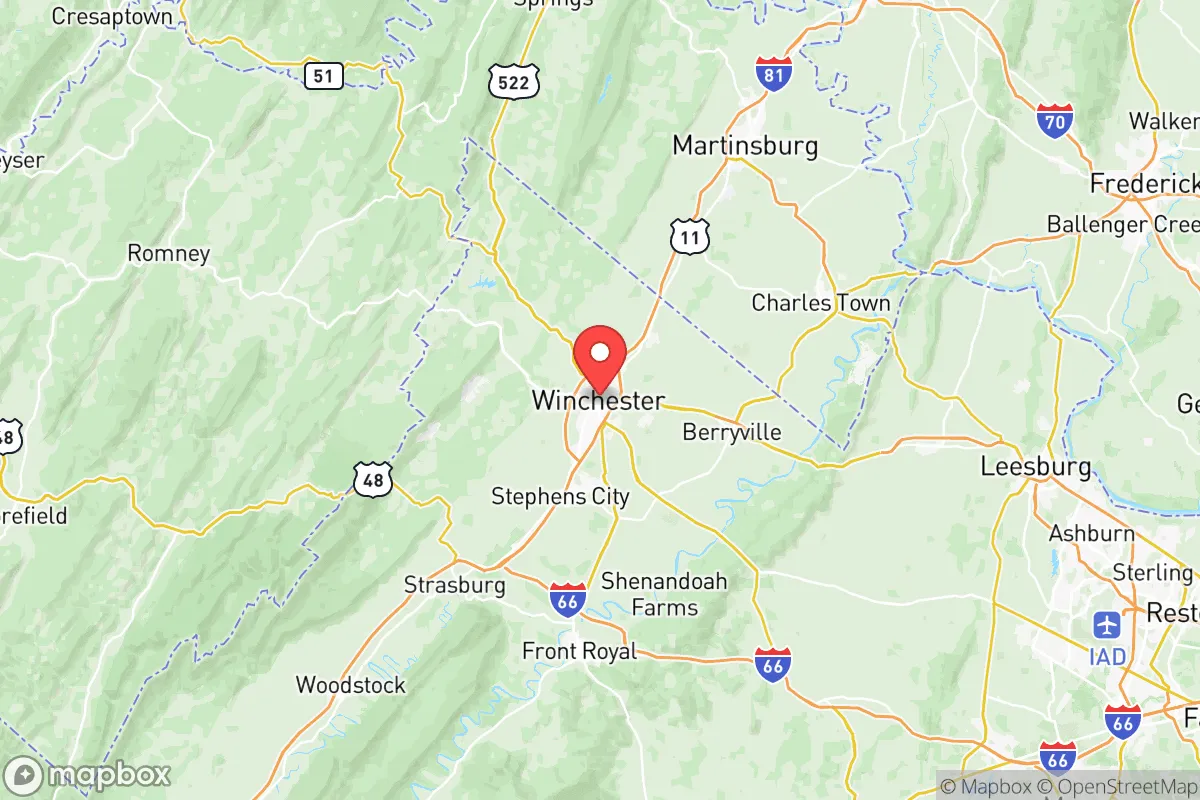
Winchester City County, Virginia, is a reliably conservative area with a Cook PVI of R+12, meaning it votes about 12 points more Republican than the national average. This stands in stark contrast to Virginia as a whole, which has shifted to a D+4 lean in recent years, driven largely by growth in Northern Virginia and the Richmond suburbs. Locally, the city of Winchester itself is a bit of a blue dot in a red sea, with precincts near the downtown core and around Shenandoah University often breaking for Democrats, while the surrounding unincorporated areas of Frederick County—like those near Stephens City and the rural stretches along Route 50—are deeply Republican. The swing precincts tend to be in the newer subdivisions on the city's outskirts, like those off Senseny Road, where transplants from the D.C. metro have brought more moderate or mixed voting patterns.
How it compares
Winchester City County's R+12 rating is a full 16 points to the right of Virginia's statewide D+4, making it one of the most Republican-leaning areas in the northern Shenandoah Valley. For context, neighboring Clarke County is R+14, and Frederick County (which wraps around Winchester City) is R+18, so Winchester City's mix of urban and suburban voters actually moderates the region somewhat. The city itself has voted for Democratic presidential candidates in recent cycles—Biden won it by about 5 points in 2020—but the county as a whole remains solidly red due to the rural and exurban vote. This split mirrors the broader Virginia divide: the state's blue shift is concentrated in the urban crescent from NoVA to Hampton Roads, while the Valley and Southwest stay conservative. Winchester City County's trajectory is stable—it hasn't flipped or trended dramatically in either direction over the past decade, unlike Loudoun County to the east, which swung hard blue.
What this means for residents
For conservative residents, the R+12 lean means local elections are rarely competitive in the county-level races, and Republican primaries often decide the outcome. The Frederick County Board of Supervisors and the Winchester City Council both tend to have Republican majorities, though the city council has seen more competitive races in recent years. For liberal residents, the political reality is that their votes are often in the minority in countywide contests, but they can find community in Winchester's downtown and near the university. Policy-wise, this translates to lower taxes and fewer regulations compared to blue parts of the state—property tax rates in Frederick County are about 20% lower than in Fairfax County—but also less funding for public transit and social services. Gun rights are broadly supported, and the Second Amendment Sanctuary movement had strong local backing in 2020. The area's conservative tilt also means that state-level Democratic policies, like the 2021 marijuana legalization, are implemented with local reluctance—Winchester City opted into retail sales, but Frederick County did not.
Culturally, Winchester City County feels more like a traditional Southern community than the rest of Virginia's urbanized north. The Apple Blossom Festival and the historic walking mall reflect a slower pace, and the local political discourse is less polarized than in the D.C. suburbs—people tend to be civil even when they disagree. That said, the influx of remote workers from NoVA is slowly shifting the demographic, bringing more diversity and progressive leanings to certain neighborhoods. Over the next decade, expect the city of Winchester to become slightly more competitive, while the county remains a Republican stronghold, keeping the area's overall R+12 rating intact for the foreseeable future.

State Political ClimatePolitical Climate in Virginia
State Political AnalysisPolitical Environment in the State
Virginia has shifted from a reliably purple swing state to a solidly Democratic-leaning one, with a Cook PVI of D+4, but that number masks a deeply polarized landscape. Over the past 20 years, the state has moved leftward by roughly 10 points, driven almost entirely by explosive growth in the Washington, D.C. suburbs. While the state voted for Democrats in every presidential election since 2008, Republicans still hold significant power in the legislature and governor’s office, creating a constant tug-of-war that defines daily life for residents.
Urban vs. rural divide
The political map of Virginia is a textbook case of the urban-rural chasm. The Democratic stronghold is the dense, wealthy crescent of Northern Virginia—Arlington, Alexandria, and Fairfax County—where federal workers and tech professionals have turned these areas into some of the most Democratic jurisdictions in the country. Fairfax County alone, with over 1.1 million people, delivers a net Democratic margin larger than the entire state’s population in many rural counties. Richmond, the capital, is another deep blue island, as is Norfolk and the Hampton Roads area, though the military presence there keeps it more competitive. In contrast, rural and exurban Virginia is overwhelmingly Republican. Lynchburg, home to Liberty University, is a conservative anchor, while Roanoke and the Shenandoah Valley counties like Augusta and Rockingham vote reliably red. The real battlegrounds are the fast-growing exurbs like Loudoun County and Prince William County, which flipped from red to blue in the 2010s as D.C. commuters pushed outward. These counties now decide statewide races, and they’ve trended leftward with each cycle.
Policy environment
Virginia’s policy environment is a patchwork because the state operates under a part-time legislature with a powerful governor. Taxes are relatively moderate: the state income tax is a flat 5.75% (with a standard deduction), and the sales tax is 5.3% (higher in Northern Virginia and Hampton Roads for local transportation projects). Property taxes are set locally and vary wildly—Arlington has rates around $1.00 per $100 of assessed value, while rural Giles County is under $0.50. Education policy is a flashpoint: the state has a universal school choice program (the Virginia Education Improvement Scholarship Tax Credit) but also strong public school funding, with per-pupil spending around $14,000. Healthcare is dominated by the expansion of Medicaid under the Affordable Care Act, which Virginia adopted in 2018 under a Democratic governor, covering roughly 400,000 additional adults. Election laws are relatively accessible: no-excuse absentee voting, same-day registration, and early voting are all in place, though voter ID is required. The state has no right-to-work law in its constitution, but it is a right-to-work state by statute, which keeps union influence moderate.
Recent policy direction
The last five years have seen Virginia swing hard in both directions, depending on which party controls the governor’s mansion. Under Governor Glenn Youngkin (R, 2022-2026), the state enacted a series of conservative priorities: a ban on mask mandates in schools, a parental rights law (the “Parents’ Bill of Rights”) that requires schools to notify parents about curriculum changes, and a rollback of some COVID-era emergency powers. On guns, Virginia remains a shall-issue state for concealed carry, but Youngkin signed a law allowing permitless carry in 2024, a major win for Second Amendment advocates. On abortion, the state remains a relative outlier in the South: abortion is legal up to 26 weeks, with no waiting period, and a 2023 law expanded access for out-of-state patients. However, a 2024 ballot measure to enshrine abortion rights in the state constitution failed, leaving it vulnerable to future legislative changes. On property rights, Virginia has a strong “right to farm” law that protects agricultural operations from nuisance lawsuits, but local zoning battles—especially in Loudoun County over data center development—show the tension between growth and rural character. On privacy, the state passed the Virginia Consumer Data Protection Act in 2021, one of the strongest state-level privacy laws in the country, giving residents control over how companies use their personal data. Voting access remains a partisan battleground: Youngkin’s administration tightened voter roll maintenance, removing non-citizens and inactive voters, which Democrats criticized as suppression. The net effect is a state that offers a mix of conservative and liberal policies, depending on the issue.
Civil unrest & political movements
Virginia has been a flashpoint for national political movements. The 2017 “Unite the Right” rally in Charlottesville—which turned violent and left one counter-protester dead—put the state on the map for white nationalist activity and sparked a statewide debate over Confederate monuments. That event led to the removal of the Robert E. Lee statue in Richmond in 2021, but also galvanized conservative backlash. The 2020 protests following George Floyd’s death were particularly intense in Richmond, where protesters clashed with police near the state capitol. On the right, the “Virginia is for Lovers” slogan has been co-opted by the “Virginia is for Gun Lovers” movement, with massive Second Amendment rallies at the capitol in 2020 drawing tens of thousands of armed protesters. Immigration politics are less heated than in border states, but Prince William County has been a battleground over sanctuary policies—it declared itself a “sanctuary city” for immigrants in 2017, then reversed course under local pressure. Election integrity remains a live issue: Youngkin’s 2021 victory was fueled by suburban parents angry over school closures and critical race theory, and his administration has pushed for stricter voter ID and roll maintenance, which Democrats have challenged in court. The state has no serious secession or nullification movement, but the “Virginia Independence” rhetoric from some rural counties is mostly symbolic.
Projection
Over the next 5-10 years, Virginia will continue to drift leftward, but not as fast as some predict. The key driver is Northern Virginia’s growth: the D.C. suburbs are adding population faster than the rest of the state, and those new residents are overwhelmingly Democratic-leaning professionals. However, the exurbs like Stafford and Spotsylvania are growing too, and they are more conservative, which could slow the shift. The rural areas are losing population, which amplifies the urban vote. The state’s political future will hinge on whether Republicans can hold the exurbs and win back some suburban voters—Youngkin’s success in 2021 showed it’s possible, but his 2023 legislative losses (Democrats took full control of the state Senate) suggest the trend is against them. On policy, expect continued fights over education (school choice vs. public funding), abortion (a potential 15-week ban if Republicans win the governorship in 2025), and taxes (a push for a flat income tax rate cut). The state’s economy is strong, driven by defense, tech, and data centers, which will keep in-migration high. A new resident moving in now should expect a state that is politically competitive at the state level but increasingly blue in presidential years, with a policy environment that can swing sharply depending on who wins the governor’s race every four years.
For a conservative relocator, Virginia offers a mixed bag: low taxes and strong gun rights, but a liberal social environment in the cities and a state government that could flip left again. For a liberal relocator, the state provides strong abortion access, privacy protections, and a growing Democratic majority, but with the constant risk of conservative governors rolling back gains. The bottom line is that Virginia is not a place where you can assume your politics will be the norm—it’s a state where you’ll need to engage locally, whether you’re in a deep blue suburb like Arlington or a red stronghold like Lynchburg. The practical takeaway: pick your county carefully, because the political reality changes dramatically within a 30-minute drive.
* Values derived from national, state, county, city and local statistics and may differ in a specific area. Last updated: 2026-07-23T01:01:18.000Z
Narrative content on this page is AI-generated and may contain mistakes. Verify any details that matter before acting on them.
ReloMaps may earn a commission from affiliate links at no extra cost to you.

