
Photo by Library of Congress on Unsplash
Demographics of Winchester City County
Affluence Level in Winchester City County
A middle-class area roughly in line with national averages across income, home values, education, and employment.
People of Winchester City County
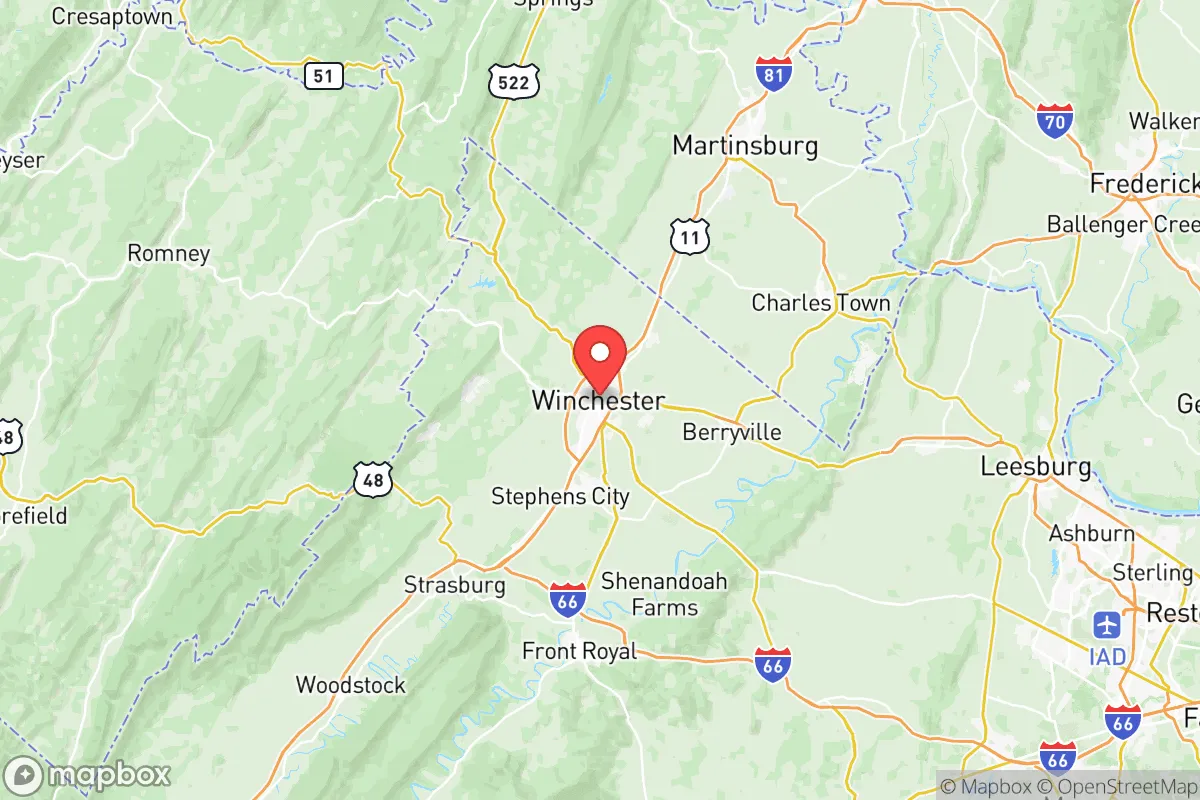
Winchester City County, Virginia, is a small, historically rooted independent city of 27,981 residents, characterized by a predominantly White population (62.7%) with a significant and growing Hispanic community (20.1%) and smaller Black (8.8%) and East/Southeast Asian (1.7%) populations. The city’s identity is shaped by its role as the commercial and cultural hub of the northern Shenandoah Valley, blending a deep colonial and Civil War heritage with a modern, diversifying demographic profile. With a foreign-born population of 9.1% and a college-educated rate of 31.6%, Winchester is a place where traditional Appalachian and Southern influences meet the economic pull of the Washington, D.C., exurbs, creating a distinctive community that is both historic and evolving.
Settlement & growth (pre-1960)
Long before European settlers arrived, the area that is now Winchester City County was part of the homeland of the Shawnee and Iroquoian-speaking peoples, including the Susquehannock, who used the Shenandoah Valley as a hunting ground and travel corridor. The first European incursion came in the early 18th century, when German and Scots-Irish settlers pushed westward from the Tidewater region. By the 1730s, German-speaking immigrants from Pennsylvania began arriving in significant numbers, drawn by the fertile limestone soils of the valley and the promise of land grants under Lord Fairfax’s Northern Neck Proprietary. These settlers founded the core of what became Winchester, naming it after the English city, and established farming communities in the surrounding areas like Kernstown and Stephens City.
The Scots-Irish, who followed closely behind, were predominantly Presbyterian and brought a fiercely independent, frontier-oriented culture. They settled in the northern reaches of the valley, including areas around Brucetown and Gainesboro, and became the backbone of the region’s agricultural economy. By the time of the American Revolution, Winchester was a thriving frontier town and a key military supply depot. The city’s strategic location at the intersection of the Great Wagon Road and the Valley Turnpike made it a crossroads for trade and migration throughout the 19th century.
The Civil War profoundly shaped Winchester’s population. As a border town that changed hands over 70 times, it saw its population fluctuate dramatically. After the war, the region’s economy shifted from tobacco to diversified agriculture, including apple orchards, which became a signature industry. Freed African Americans established communities within the city, particularly in the North End and along Kent Street, forming the basis of Winchester’s Black population, which remained a stable minority through the early 20th century. The early 1900s saw little new immigration; the population remained overwhelmingly native-born White, with a small but established Black community, and the economy centered on apple growing, milling, and rail transport.
Modern era (post-1965)
The 1965 Hart-Cellar Act had a delayed but noticeable effect on Winchester. Unlike larger metropolitan areas, the city did not see a massive wave of new immigrants until the 1990s and 2000s, when the expansion of the Washington, D.C., exurban economy began to pull in new populations. The most significant demographic shift has been the rapid growth of the Hispanic population, which now constitutes 20.1% of the city’s residents. This community is largely composed of immigrants from Mexico and Central America, drawn by jobs in the region’s agricultural sector—particularly apple and peach orchards—as well as construction, landscaping, and food processing. Hispanic enclaves have formed in the South End and along the Valley Avenue corridor, where Spanish-language businesses, churches, and community centers have become prominent.
The East/Southeast Asian population (1.7%) is smaller but visible, with families from Vietnam, Korea, and the Philippines settling in the city, often working in healthcare, hospitality, and small business. The Indian-subcontinent population (0.7%) is a recent addition, with professionals drawn to the region’s growing healthcare and technology sectors, though no single ethnic enclave has formed. The Black population (8.8%) has remained relatively stable, with many families tracing their roots to the post-Civil War era, though some out-migration to larger cities has occurred. Domestic migration from the Rust Belt and the Washington, D.C., suburbs has also reshaped the city. Commuters from the D.C. metro area have increasingly moved to Winchester for its lower cost of living and historic charm, settling in newer subdivisions on the city’s outskirts, such as those near Apple Blossom Mall and along Route 50. This influx has raised the college-educated share to 31.6% and introduced a more politically moderate, professional class to a historically conservative area.
The future
Winchester’s population is projected to continue diversifying, though at a moderate pace. The Hispanic share is expected to grow further, driven by both immigration and higher birth rates, potentially reaching 25-30% within the next decade. This growth will likely concentrate in the southern and eastern parts of the city, where affordable housing and agricultural jobs remain available. The East/Southeast Asian and Indian populations are expected to grow slowly, as the region’s economy attracts more professionals in healthcare and education, but no large enclaves are anticipated. The White population, while still the majority, will continue to decline as a share, reflecting both lower birth rates and out-migration of younger residents to larger cities. The city’s cultural identity is evolving from a predominantly White, Protestant, agricultural community to a more multi-ethnic, suburban-exurban hybrid. Newcomers from the D.C. area are pushing for more amenities, walkable neighborhoods, and cultural diversity, while long-time residents emphasize preservation of the city’s historic character and rural traditions. The next 10-20 years will likely see Winchester become a more diverse, economically dynamic city, but one that retains its small-town feel and deep historical roots.
For someone moving to Winchester now, the city offers a blend of affordability, history, and a growing multicultural fabric. It is becoming a place where the traditional Shenandoah Valley identity is being reshaped by Hispanic vibrancy and exurban ambition, creating a community that is both grounded in its past and open to change. Whether you are drawn by the apple orchards, the Civil War history, or the lower cost of living relative to D.C., Winchester is a city in transition—one where the population is becoming more diverse, more educated, and more connected to the broader Mid-Atlantic economy.

* Values derived from national, state, county, city and local statistics and may differ in a specific area. Last updated: 2026-07-23T01:01:18.000Z
Narrative content on this page is AI-generated and may contain mistakes. Verify any details that matter before acting on them.
ReloMaps may earn a commission from affiliate links at no extra cost to you.

