
Photo by Library of Congress on Unsplash
Personal Sovereignty in Winchester City County
Viable for self-reliance. Generally workable, though some barriers may limit total independence.
What does Personal Sovereignty tell us?
Personal Sovereignty measures your capacity for self-reliance and independence with minimal government friction. Higher scores mean fewer barriers between you and the way you want to live... but it assumes you have the space you need and good neighbors.
What does this tell us?
Personal Sovereignty measures your capacity for self-reliance and independence with minimal government friction. Higher scores mean fewer barriers between you and the way you want to live... but it assumes you have the space you need and good neighbors.
State Policy
Energy independence: Importer (20% of energy produced in-state)
Personal Liberty
Homesteading

Personal Liberty Analysis
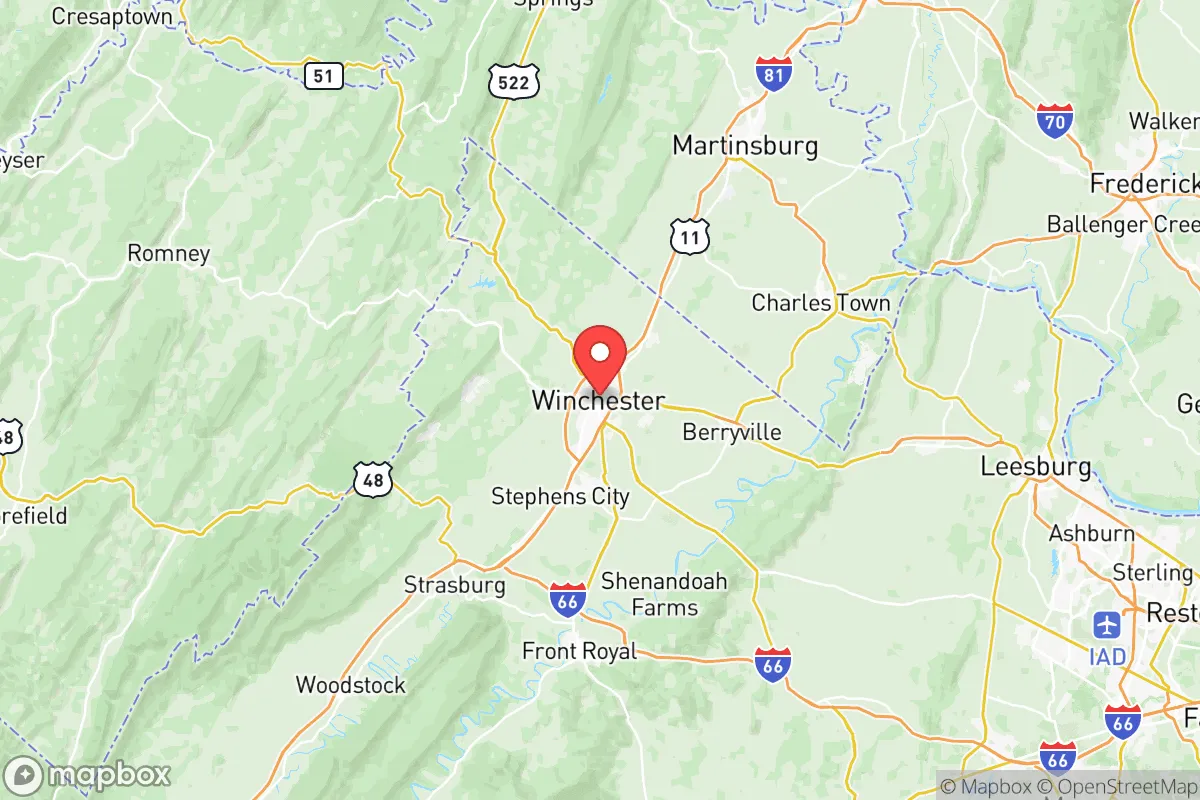
Winchester City, Virginia, presents a nuanced personal sovereignty environment that balances traditional Virginia liberties with the practical constraints of a small, dense urban municipality. As an independent city surrounded by Frederick County, its regulatory posture and cultural leanings differ markedly from the more rural and libertarian-leaning areas just outside its borders. For individuals and families prioritizing autonomy, the key distinction lies not in Winchester City itself, but in the stark contrast between its city limits and the surrounding unincorporated communities of Frederick County, such as Stephens City, Middletown, and Clear Brook.
Tax burden and regulatory posture in Winchester City vs. Frederick County
Winchester City operates under a relatively moderate tax and regulatory framework for a Virginia independent city. The city's real property tax rate is $1.03 per $100 of assessed value (2025), which is higher than Frederick County's rate of approximately $0.57 per $100. This differential is significant for homeowners and reflects the city's need to fund municipal services like police, fire, and schools without a county-level government. The personal property tax on vehicles is also notable: Winchester City levies a rate of $4.50 per $100 of assessed value, compared to Frederick County's $3.50. For a family with two vehicles, this can mean an annual difference of several hundred dollars. The business, professional, and occupational license (BPOL) tax in Winchester City applies to gross receipts, which can be a burden for home-based businesses or sole proprietors. In contrast, Frederick County has a much lighter BPOL footprint, and towns like Stephens City and Middletown have minimal business licensing requirements. The regulatory posture in Winchester City is typical of an urbanized Virginia city—building permits, zoning variances, and business licenses are enforced with moderate rigor. Outside the city, in Frederick County's rural areas like Clear Brook, the regulatory touch is lighter, with fewer inspections and a more permissive attitude toward home occupations and agricultural structures.
Self-defense and gun law specifics in Winchester City and surrounding areas
Virginia is a "shall-issue" state for concealed handgun permits, and Winchester City follows state law without local restrictions that exceed the state baseline. The city does not have its own firearm ordinances that ban open carry or restrict magazine capacity beyond state law. However, the practical environment for gun owners differs by location. Within Winchester City limits, discharging a firearm is prohibited except at approved ranges, which limits opportunities for casual target practice on private property. In contrast, the unincorporated areas of Frederick County—particularly Stephens City and Clear Brook—allow legal discharge of firearms on private property with sufficient acreage and safe backstops, provided local noise ordinances are not violated. The Winchester City Police Department is generally professional and non-confrontational regarding lawful gun ownership, but the city's density means that carrying a firearm in public draws more scrutiny than in rural Frederick County. For self-defense-minded residents, living just outside the city limits in Middletown or Clear Brook provides a more permissive environment for defensive firearm use, target shooting, and storage without city-level interference. Virginia's "stand your ground" law applies statewide, and Winchester City has not enacted any local ordinances that would weaken that right within its jurisdiction.
Self-reliance and homesteading viability: lot sizes, zoning, and off-grid feasibility
Winchester City itself is not conducive to homesteading or off-grid living. The city's minimum lot size for single-family residential is typically 6,000 to 10,000 square feet, and zoning regulations require connection to municipal water and sewer. Keeping chickens is permitted with a permit and specific setback requirements, but larger livestock is prohibited. Rainwater collection for potable use is allowed under Virginia law, but the city's building code requires connection to municipal water, making true off-grid water independence impractical. The situation changes dramatically just outside the city. In Frederick County's rural zoning districts, minimum lot sizes range from 1 to 3 acres, and in some agricultural zones, parcels of 5 acres or more are common. Clear Brook and the area around Stephens City offer properties where residents can install septic systems, drill wells, and keep horses, goats, and poultry without city interference. Solar panel installation is permitted in Frederick County with minimal permitting, and there are no county-level restrictions on battery storage systems for off-grid energy. For those seeking true self-reliance, the Middletown area provides the best balance of proximity to Winchester's amenities and the ability to operate a small homestead. The county's zoning code explicitly allows "agricultural uses" as a by-right activity on parcels of 3 acres or more, which includes raising livestock, growing crops, and selling produce from a roadside stand without a special use permit.
Personal liberties: parental rights, medical autonomy, speech, and property
Winchester City and Frederick County both operate under Virginia state law, which provides a baseline of personal liberties. Parental rights in education are a point of active debate. Virginia law grants parents the right to opt their children out of specific instructional materials that are "sexually explicit," and both Winchester City Public Schools and Frederick County Public Schools have policies that allow parents to review curriculum materials. However, the school boards differ in their responsiveness. The Frederick County School Board has been more receptive to parental input on curriculum transparency and library book content, while the Winchester City School Board has taken a more standard urban-district approach. Medical autonomy in Virginia is moderate: the state does not have a religious or philosophical exemption for vaccine mandates in public schools, but it does allow for medical exemptions. Homeschooling is legal and relatively straightforward in both jurisdictions, with parents required to submit a notice of intent and provide annual evidence of progress. Property rights are stronger in Frederick County, where zoning is less restrictive and the county's comprehensive plan emphasizes preserving rural character. In Winchester City, property owners face more restrictions on short-term rentals, home-based businesses, and exterior modifications. Free speech protections are robust across both jurisdictions, as Virginia has no state-level law that preempts local government criticism, and both cities and counties have public comment periods at board meetings.
Overall, personal sovereignty in Winchester City County is a story of two distinct environments. The city itself offers a moderate, urbanized regulatory framework that respects state-level liberties but imposes meaningful constraints on homesteading, firearm use, and property autonomy. The surrounding Frederick County communities—Stephens City, Middletown, and Clear Brook—provide a significantly lighter regulatory touch, lower taxes, and greater feasibility for self-reliant living. For the autonomy-minded individual or family, the strategic choice is clear: live outside the city limits to maximize personal freedom while still accessing Winchester's employment and services. Compared to Northern Virginia or the Richmond metro area, the Winchester region offers a much more permissive environment for those who value self-defense, homesteading, and minimal government interference, though it falls short of the near-libertarian conditions found in parts of western Virginia or the Shenandoah Valley's more remote counties.

* Values derived from national, state, county, city and local statistics and may differ in a specific area. Last updated: 2026-07-23T01:01:18.000Z
Narrative content on this page is AI-generated and may contain mistakes. Verify any details that matter before acting on them.
ReloMaps may earn a commission from affiliate links at no extra cost to you.

