
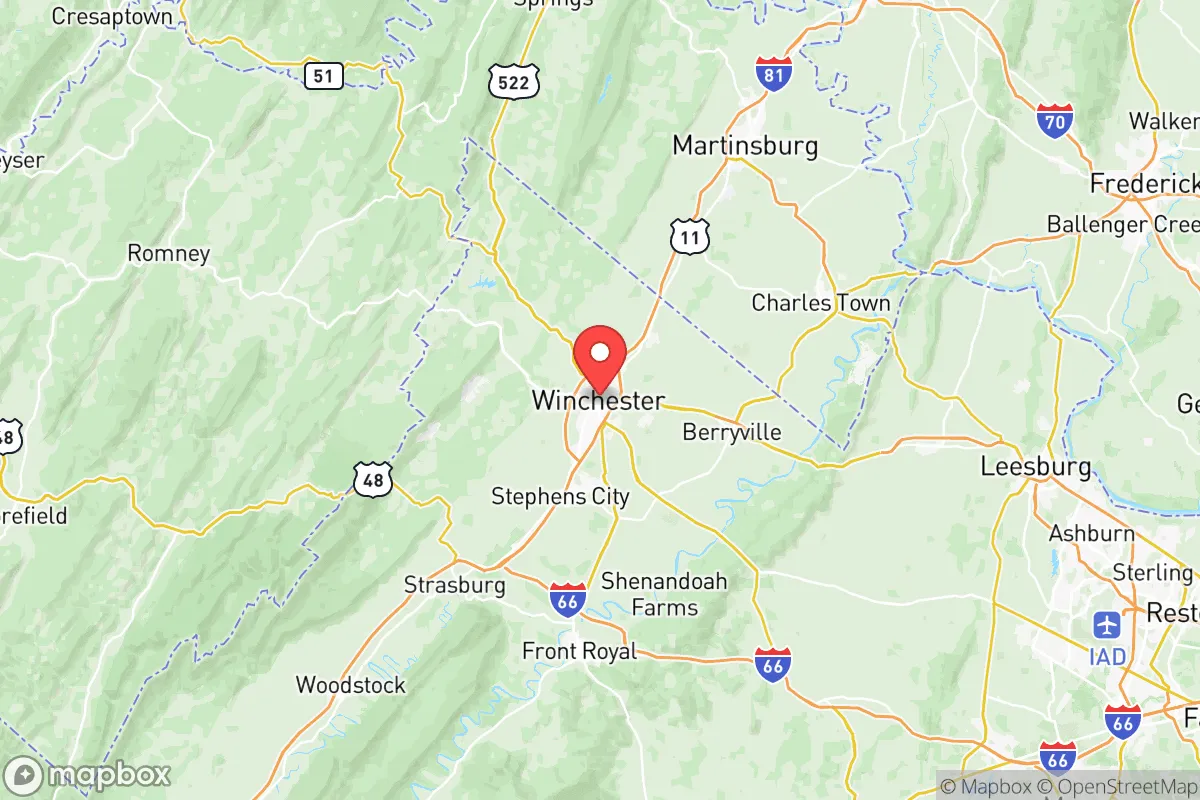
Photo by Library of Congress on Unsplash
Quality of Life in Winchester City County
A livable area that tracks near national norms for affordability, walkability, and neighborhood health.
What does Quality of Life tell us?
Quality of Life measures an area by evaluating factors like cost of living, nearby amenities, country club access, airport proximity, socioeconomic signals and neighborhood character. For large states, this is a general average — quality of life can vary dramatically between metro areas, suburbs, and rural communities within the same state.
What does this tell us?
Quality of Life measures an area by evaluating factors like cost of living, nearby amenities, country club access, airport proximity, socioeconomic signals and neighborhood character. For large states, this is a general average — quality of life can vary dramatically between metro areas, suburbs, and rural communities within the same state.
Cost of Living
13% above national average
69%
The Real Cost of Living in Winchester City County for 2026
| Tier | Individual | Family (4) |
|---|---|---|
| Survival | $21k | $39k |
| Comfortable | $63k | $93k |
| Luxury | $117k+ | $181k+ |
| Elite (Top 5%) | $139k+ | $215k+ |
Quality-of-Life Analysis
Winchester City County, Virginia, is a geographically compact independent city that functions as the urban core of the broader Winchester metropolitan area, offering a quality-of-life spectrum that shifts from a walkable, historic downtown to quiet residential neighborhoods and semi-rural fringe areas. The county draws a mix of professionals commuting to the I-81 corridor, retirees seeking a slower pace, and families attracted to its relatively affordable housing compared to Northern Virginia. While the entire county spans only about 9 square miles, the lived experience varies noticeably between the bustling commercial corridors, the tree-lined historic districts, and the agricultural edges near Frederick County.
Largest town(s) & population centers
The entirety of Winchester City County is the independent city of Winchester, which serves as the county seat and the region's primary population center. Daily life here centers around the historic pedestrian mall on the Loudoun Street Mall, a brick-paved stretch lined with independent boutiques, restaurants, and the Bright Box Theater. The city's compact layout means most errands are a short drive or bike ride away, with major employers like Valley Health's Winchester Medical Center and the corporate headquarters of Trex Company anchoring the local economy. The historic district, particularly around the Old Town Winchester area, offers a dense, walkable lifestyle with 19th-century row houses and condos above storefronts, while the areas near the Winchester Regional Airport and along the Route 37 bypass feature newer subdivisions and big-box retail. The average commute of 20.7 minutes is notably shorter than the national average, reflecting the city's role as a self-contained employment hub where many residents work within the city limits or in adjacent Frederick County.
Smaller towns & rural pockets
Because Winchester City County is an independent city, it does not contain separate incorporated towns or unincorporated communities within its boundaries. However, the county's character includes distinct residential pockets that feel like smaller communities. The Winchester-Frederick County line creates a sharp transition: neighborhoods like the area around Stonewall Elementary School or the Appleland Drive corridor feel suburban and family-oriented, while the southern edge near Abrams Creek and the western boundary along Route 522 quickly give way to the agricultural landscapes of Frederick County. Residents seeking a truly rural lifestyle typically live just outside the city limits in places like Stephens City or Middletown, but the city itself offers a few semi-rural pockets, such as the area around Redbud Road near the city's northern edge, where larger lots and horse properties are interspersed with newer homes.
Cost & lifestyle range
The cost of living in Winchester City County sits at 113 on the index (100 = U.S. average), making it moderately more expensive than the national baseline but significantly cheaper than the Washington, D.C. suburbs 75 miles east. The median home value of $325,900 and median rent of $1,298 place the city in a middle tier for Virginia. The most affordable housing is found in the older neighborhoods near the Winchester Medical Center and along Valley Avenue, where smaller single-family homes and duplexes often list below $250,000. At the higher end, the Kent Street and Braddock Street historic districts feature restored Victorian homes valued above $500,000, while newer subdivisions like Stoneleigh and Apple Valley offer modern townhomes and single-family homes in the $350,000–$450,000 range. Renters find the best deals in older apartment complexes near Millwood Avenue, while newer luxury apartments near the Winchester Town Center command rents above $1,500. The lifestyle range is narrow but real: downtown residents enjoy walkable access to the Winchester Little Theatre and Museum of the Shenandoah Valley, while those on the city's edges trade that convenience for larger yards and quicker access to the George Washington National Forest and Shenandoah River recreation areas.
Winchester City County best suits professionals and families who want a small-city lifestyle with historic character, a reasonable commute, and housing costs that undercut the D.C. metro area by a wide margin. Retirees are drawn to the walkable downtown and the Winchester Medical Center's comprehensive healthcare, while outdoor enthusiasts appreciate the proximity to the Appalachian Trail and Shenandoah National Park. The county's compact size means that even its most affordable and most expensive neighborhoods are rarely more than 15 minutes apart, creating a cohesive community where the quality-of-life differences are more about housing type and lot size than about access to jobs or amenities.

Crime in Winchester City County
Generally safer than 60% of comparable U.S. locations.
Violent CrimeViolent Crime Analysis
Property CrimeProperty Crime Analysis
Crime Analysis
Winchester City, Virginia, an independent city surrounded by Frederick County, reports a violent crime rate of 209.3 per 100,000 residents and a property crime rate of 1,392 per 100,000. These figures place the city in a moderate safety tier relative to the broader Shenandoah Valley region, though specific neighborhood dynamics and the local justice system's approach create meaningful variation in resident experience. The city's status as a small urban core (population roughly 28,000) means crime patterns differ sharply from the surrounding rural and suburban areas of Frederick County and nearby towns like Stephens City and Middletown.
Crime in context
Winchester City's violent crime rate of 209.3 per 100,000 is approximately 43% below the national average of 367 per 100,000 and roughly 30% below the Virginia state average of 299 per 100,000. Property crime, however, tells a different story: the city's rate of 1,392 per 100,000 is about 15% above the national average of 1,210 per 100,000 and significantly higher than the Virginia state average of 1,050 per 100,000. This property crime elevation is concentrated in the city's commercial corridors and older residential neighborhoods near the downtown core. By comparison, the adjacent town of Berryville in Clarke County reports property crime rates roughly half of Winchester's, while the unincorporated areas of Frederick County—including communities like Lake Holiday and Shawnee Land—see rates even lower. The disparity underscores how Winchester City's density and commercial activity drive higher theft and burglary numbers than its rural neighbors.
What residents experience
Residents of Winchester City most commonly encounter property-related offenses—vehicle break-ins, package theft, and burglary—rather than violent confrontations. The violent crimes that do occur are overwhelmingly concentrated in the downtown area near the Loudoun Street Mall and along the Valley Avenue corridor, where transient populations and late-night activity intersect. Neighborhoods west of Interstate 81, including the area around Shenandoah University, and the historic district east of Cameron Street tend to report fewer incidents. A critical factor for public safety is the judicial philosophy of the local courts. Winchester City operates under the 26th Judicial Circuit, and residents should be aware that the city's elected Commonwealth's Attorney and judges have, in recent years, emphasized diversion programs and reduced sentencing for non-violent property offenders. While intended to reduce recidivism, this progressive approach has drawn criticism from community watch groups who argue it leads to repeat offenders cycling through the system without meaningful consequences, particularly for theft and drug-related property crimes. The nearby jurisdictions of Frederick County and Clarke County, by contrast, maintain more traditional sentencing practices, which some residents cite as a reason for their lower property crime rates.
Neighborhood-level variation
Safety in Winchester City is highly neighborhood-dependent. The area around the Winchester Medical Center and the residential streets off Jubal Early Drive are generally considered the safest, with crime rates comparable to the Frederick County suburbs. Conversely, the blocks immediately surrounding the downtown pedestrian mall and the low-income housing complexes along North Kent Street see elevated police activity. The city's proximity to the West Virginia border also means that criminals can quickly cross state lines into Berkeley County, complicating law enforcement coordination. For families and professionals, the safest choice is often the southwestern quadrant near the Frederick County line, where the city's density gives way to suburban subdivisions. Renters and buyers should verify specific block-level data through the Winchester Police Department's online crime map, as a single street can separate a low-crime pocket from a high-theft zone. Overall, while Winchester City is not a high-violence area by national standards, its property crime rate and the local justice system's leniency toward repeat offenders warrant caution, particularly for those considering properties near the commercial core.
* Values derived from national, state, county, city and local statistics and may differ in a specific area. Last updated: 2026-07-23T01:01:18.000Z
Narrative content on this page is AI-generated and may contain mistakes. Verify any details that matter before acting on them.
ReloMaps may earn a commission from affiliate links at no extra cost to you.

