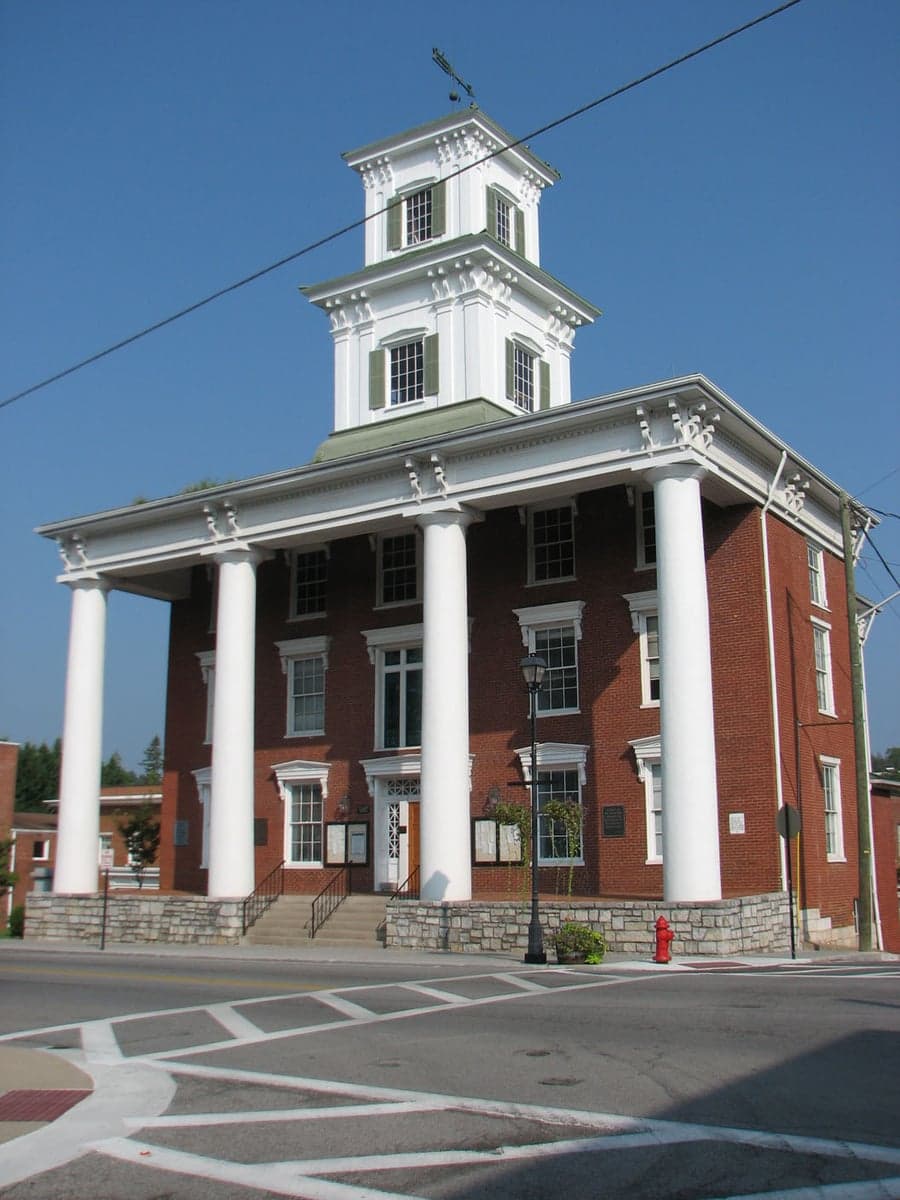
Photo: Wikipedia
Political ClimatePolitical Climate in Washington County
Showing county-level results — no local-only data available.
Lean and PVI are calculated from this county’s 2020 and 2024 presidential results, Cook-style.
Political rankings in Virginia
- Most Conservative Cities in Virginia
- Most Liberal Cities in Virginia
- Best Liberal-Leaning Towns in the South
- Best Liberal-Leaning Towns in Appalachia
- Best Conservative-Leaning Towns in the Mid-Atlantic
- Safest Liberal-Leaning Towns in the South
- Safest Conservative-Leaning Towns in the South
- Safest Conservative-Leaning Towns on the East Coast
- Most Conservative Counties in Virginia
- Most Liberal Counties in Virginia
Local Political AnalysisPolitical Analysis of Washington County
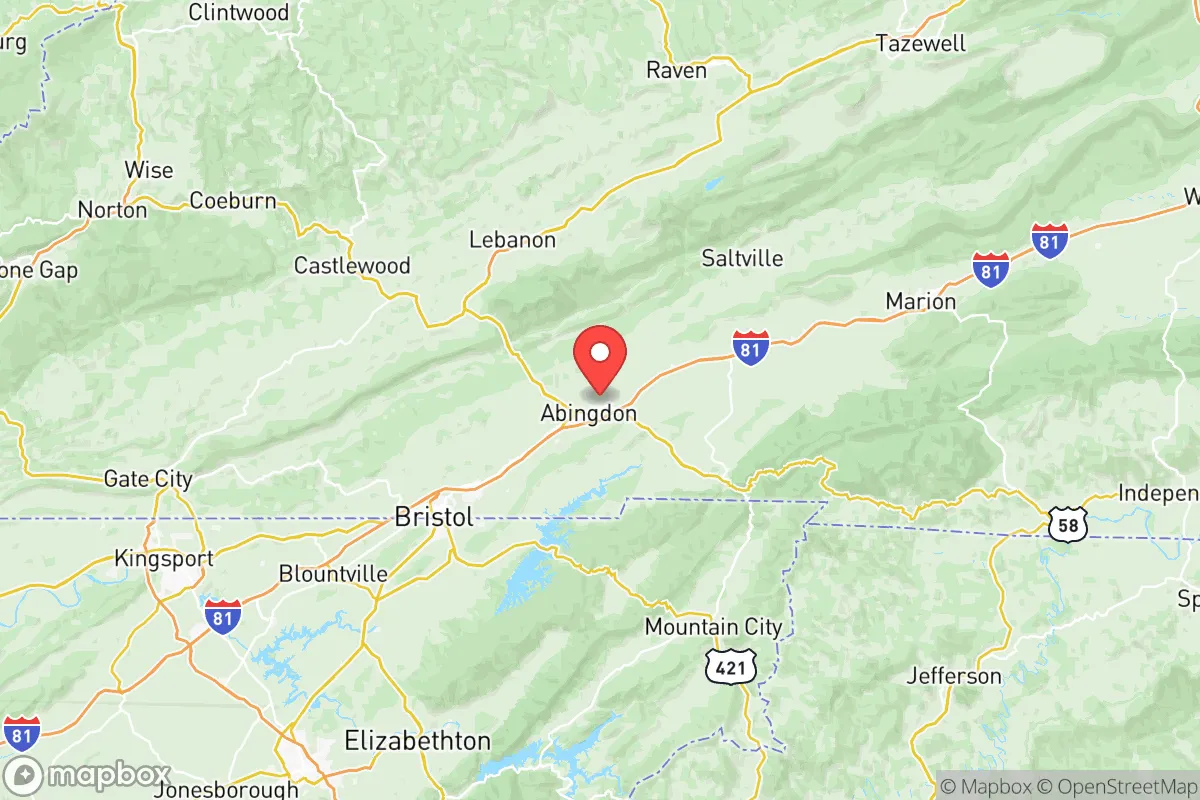
Washington County, Virginia is one of the most reliably Republican corners of the Commonwealth, carrying a Cook Political Report Partisan Voting Index of R+22 — a stark contrast to the state’s overall D+4 lean. That 26-point gap isn't just a statistic; it defines the daily political reality from Abingdon to Damascus. The county hasn't voted for a Democratic presidential nominee since Lyndon Johnson’s 1964 landslide, and the trajectory has only hardened over the last decade as the rural-urban divide in Virginia has widened.
How it compares
To understand Washington County, you have to forget the Virginia you see on a national map. The state’s D+4 PVI is driven almost entirely by the crowded, wealthy suburbs of Northern Virginia (Fairfax, Loudoun, Prince William) and the urban crescent of Richmond, Norfolk, and Virginia Beach. Washington County sits in the far southwestern corner of the state, closer in culture and voting behavior to neighboring Tennessee than to Arlington. In 2020, Donald Trump carried the county with roughly 74% of the vote, and the margins have been creeping upward in every cycle since 2008. The county is part of Virginia’s 9th Congressional District, represented by Republican Morgan Griffith, who routinely wins re-election by 40-point margins. Even in the 2021 gubernatorial race, where Republican Glenn Youngkin won statewide by a narrow two points, Washington County gave him a landslide 78% — a reminder that this is not a purple area but a deep-red anchor in a blue-leaning state.
What this means for residents
For conservative residents, the political climate is comfortable and affirming. The county’s Board of Supervisors is entirely Republican, and the local GOP is well-organized, with active committees in Abingdon, Glade Spring, and Damascus. Conservative voters here rarely feel the need to moderate their views; the primary elections are often the real contests, since the Democratic nominee is a foregone conclusion in November. For liberal residents, the reality is more isolating. Democrats in Washington County are a distinct minority — roughly 20-25% of the electorate — and they tend to cluster in specific precincts: the historic downtown of Abingdon, the Virginia Highlands Community College area, and parts of Emory. These are the only places where a Democratic candidate can crack 40% of the vote. The practical effect is that local Democratic candidates often run unopposed in primaries but face steep, well-funded Republican opposition in the general. There is no Democratic Party office in the county seat, and the local party operates out of a small volunteer network that struggles to compete with the GOP’s fundraising and ground game.
What this means for residents
The cultural and policy distinctions here are tangible. Washington County is one of the few places in Virginia where the Second Amendment sanctuary movement took root early — the Board of Supervisors passed a resolution in 2019 opposing "unconstitutional" gun control measures, a move that drew national attention. The county is also heavily reliant on agriculture, manufacturing (particularly at the Bristol Compressors plant and the Universal Fibers facility), and tourism driven by the Virginia Creeper Trail and the Barter Theatre in Abingdon. These economic realities shape policy priorities: residents here care more about property taxes, right-to-work laws, and broadband access than about the urban transit and housing density debates that dominate Richmond. The county’s school board has also been a flashpoint, with conservative majorities pushing back on state-mandated curriculum changes around LGBTQ topics and critical race theory — a fight that has energized local Republicans even as it has frustrated the minority of progressive parents in Abingdon’s more affluent neighborhoods.
Looking ahead, the political trajectory is unlikely to shift dramatically. The county’s population is aging, and while Abingdon has seen some in-migration of retirees from Northern Virginia and Florida, these newcomers tend to be conservative-leaning themselves. The only wildcard is the growing presence of remote workers drawn to the area’s low cost of living and mountain scenery — a demographic that has, in other Appalachian counties, introduced a small but measurable blue tint. But even in the most optimistic scenario for Democrats, Washington County would move from R+22 to maybe R+15 by 2030. For now, the county remains what it has been for generations: a place where the Republican primary is the election that matters, and where the state’s blue lean is viewed with suspicion rather than celebration.

State Political ClimatePolitical Climate in Virginia
State Political AnalysisPolitical Environment in the State
Virginia has drifted from a reliably purple battleground to a solidly Democratic-leaning state, carrying a Cook PVI of D+4 after a decade of rapid transformation. The shift is driven almost entirely by the explosive growth of the Washington, D.C. suburbs in Northern Virginia, which now dwarf the rest of the state in population and electoral weight. Twenty years ago, George W. Bush won the state by eight points; today, Democrats routinely clear 54-58% of the vote in presidential cycles, and the state legislature has been under Democratic control for most of the last six years.
Urban vs. rural divide
The political map of Virginia is a tale of three distinct regions that often feel like different states. The dominant force is Northern Virginia — specifically the counties of Fairfax, Loudoun, and Prince William, plus the cities of Arlington and Alexandria — which together cast roughly a third of all votes in the state. This is federal contractor country, and the region votes 65-70% Democratic in most cycles. Loudoun County, once a conservative exurb, flipped hard after 2016 and is now one of the most Democratic large counties in the South.
The second region is the Richmond-Hampton Roads corridor, anchored by the state capital and the military-heavy Tidewater area. Richmond's suburbs have trended blue, while the rural counties between them remain deeply red. Virginia Beach and Chesapeake are classic swing areas — military families and defense workers who split tickets but have leaned Democratic in recent statewide races.
Finally, there's rural and western Virginia — the Shenandoah Valley, the Roanoke-Blacksburg area, and the Southside counties along the North Carolina border. These areas vote 70-75% Republican and have only gotten redder as the state's overall complexion has changed. Places like Roanoke County and Augusta County are now solidly GOP, while the cities of Charlottesville and Blacksburg (home to UVA and Virginia Tech) are liberal islands in a conservative sea.
Policy environment
Virginia's policy environment is a study in contrasts. The state is a right-to-work state with a business-friendly regulatory posture, and it consistently ranks in the top tier of CNBC's "Best States for Business" lists. There is no state income tax on military pensions, and the standard deduction was doubled in 2023. However, the tax burden is not uniformly low: the state income tax tops out at 5.75%, and the gas tax was increased in 2020 to fund transportation.
On education, Virginia has a mixed record. The state's public schools are among the best-funded in the South, but the 2020-2021 school closures in Fairfax County and Arlington were among the longest in the nation, sparking a parental rights backlash that helped elect Glenn Youngkin as governor in 2021. Youngkin's administration rolled back mask mandates, expanded charter school options, and pushed through a $1 billion tax cut package. The state also has a "Parents Bill of Rights" that requires schools to notify parents about curriculum changes.
Healthcare is a bright spot for conservatives: Virginia expanded Medicaid under Obamacare in 2018, but it remains one of the few Southern states with strong certificate-of-need laws that limit new hospital construction. Election laws are moderate — no voter ID requirement at the polls, but also no same-day registration. Early voting is widely available, and mail-in voting is no-excuse.
Recent policy direction
The last five years have seen Virginia swing back and forth like a pendulum. Under Governor Ralph Northam (2018-2022), Democrats passed a sweeping gun control package — universal background checks, a "red flag" law, and a one-handgun-per-month limit — plus marijuana legalization and the repeal of the death penalty. Under Youngkin, the state moved the other direction: the gas tax was suspended for three months in 2022, and the governor signed a bill allowing teachers to carry firearms in schools with local approval.
On gun rights specifically, Virginia remains a "shall-issue" state for concealed carry permits, and permitless carry was not enacted — a key difference from neighboring West Virginia and North Carolina. The red flag law is still on the books, and local governments in Northern Virginia have passed their own restrictions on firearms in government buildings. On abortion, Virginia is the last Southern state without a near-total ban — the current law allows the procedure through the second trimester, and Democrats have blocked every attempt to restrict it further.
Property rights are generally strong, with no statewide rent control and a right-to-farm law that protects agricultural operations from nuisance lawsuits. However, the state has aggressive land-use planning in the urban crescent, and the Chesapeake Bay Preservation Act imposes strict buffer requirements on waterfront property. On privacy, Virginia passed the Consumer Data Protection Act in 2021, giving residents the right to access and delete data held by companies — one of the first such laws in the country.
Civil unrest & political movements
Virginia has been a flashpoint for national political movements more than almost any other state. The Unite the Right rally in Charlottesville in 2017 — where a counter-protester was killed — remains a defining scar, and the city has since removed its Confederate statues and become a symbol of the national reckoning over race. The 2020 George Floyd protests in Richmond led to the toppling of Confederate monuments on Monument Avenue, and the state's largest statue of Robert E. Lee was removed in 2021.
On the right, the parental rights movement that emerged from the school closures is now a permanent feature of Virginia politics. The Loudoun County school board became a national symbol of the fight over transgender policies and critical race theory, and the 2021 governor's race was effectively a referendum on those issues. Immigration politics are quieter than in border states, but Prince William County has seen tensions over its growing immigrant population, and the state has no sanctuary city policies — local law enforcement cooperates with ICE detainers.
Election integrity has been a recurring controversy. Virginia uses paper ballots and has post-election audits, but the 2020 election saw lawsuits over the handling of mail-in ballots, and Youngkin's 2021 victory was followed by a purge of voter rolls that removed over 3,000 non-citizens — a move that drew both praise and legal challenges.
Projection
Over the next decade, Virginia's Democratic lean is likely to solidify rather than reverse. The population growth in Northern Virginia shows no signs of slowing — Loudoun County is projected to add another 100,000 residents by 2035, and the federal workforce continues to expand. The state's in-migration is heavily skewed toward college-educated professionals who vote Democratic, while out-migration is concentrated among working-class families leaving the expensive D.C. suburbs for cheaper states like North Carolina and Tennessee.
That said, the Republican Party is not without a path back to competitiveness. The 2021 Youngkin victory showed that a moderate, business-friendly Republican who focuses on education and taxes can win statewide, even in a D+4 environment. The 2025 governor's race will be the next test — if Republicans can hold the governor's mansion and make inroads in the Hampton Roads suburbs, the state could return to battleground status. But the demographic math is unforgiving: every year, the D.C. suburbs add more voters than the rest of the state combined.
For a new resident, the practical takeaway is that Virginia rewards those who pick their county carefully. If you want low taxes, gun-friendly policies, and a conservative community, the Shenandoah Valley or the Southside offers that at a fraction of the cost of Northern Virginia. If you want the opposite — progressive policies, dense urban living, and proximity to federal jobs — the D.C. suburbs deliver. The state's political future is being written in Loudoun County, and whichever party wins there will control Virginia for the next generation.
* Values derived from national, state, county, city and local statistics and may differ in a specific area. Last updated: 2026-11-01T14:23:49.000Z
Narrative content on this page is AI-generated and may contain mistakes. Verify any details that matter before acting on them.
ReloMaps may earn a commission from affiliate links at no extra cost to you.

