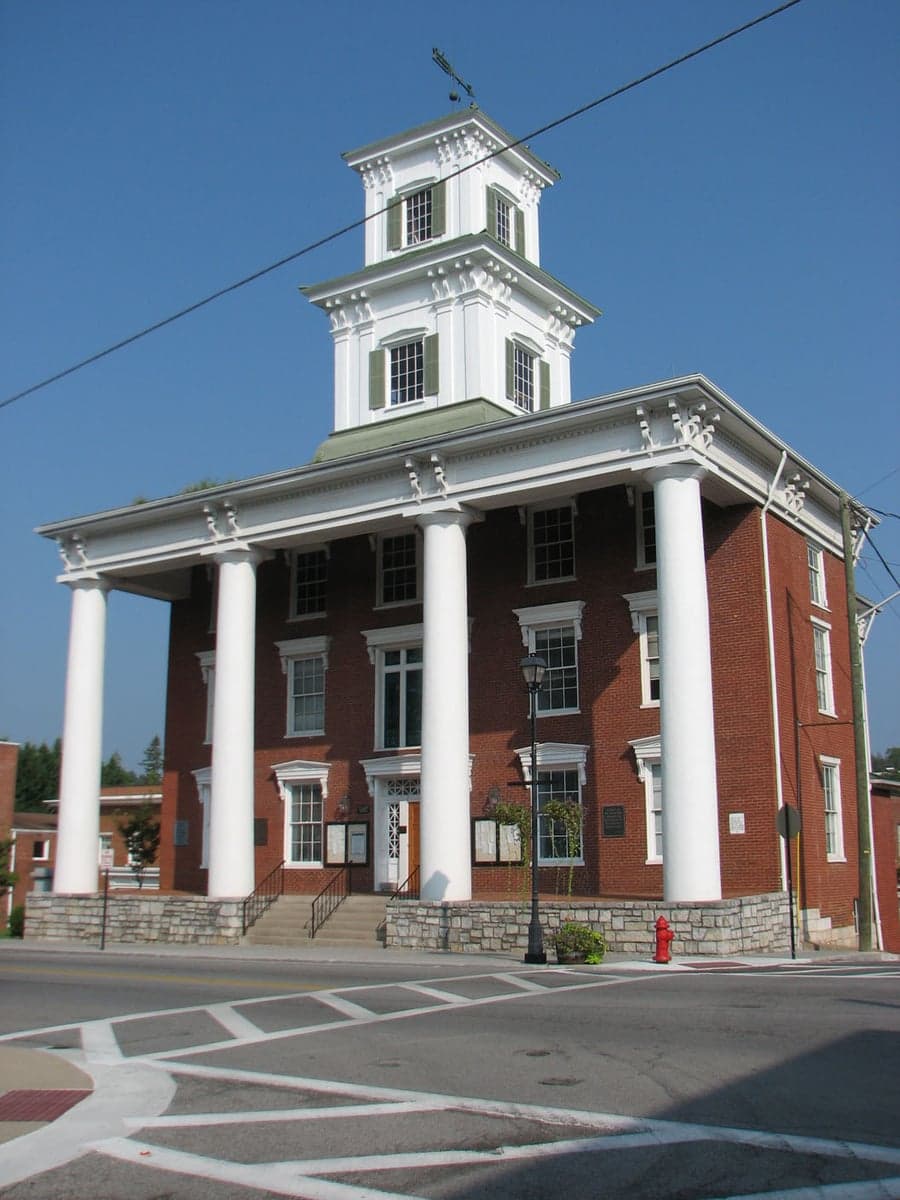
Photo: Wikipedia
Demographics of Washington County
Affluence Level in Washington County
A middle-class area roughly in line with national averages across income, home values, education, and employment.
People of Washington County
Washington County, Virginia, is home to roughly 53,913 residents, a population that remains overwhelmingly white (94.4%) and deeply rooted in the Scots-Irish and English traditions of the Appalachian frontier. With a foreign-born share of just 0.7%, this is one of the least ethnically diverse counties in the commonwealth, yet its identity is far from static—it is a place where a strong Appalachian work ethic meets the modern pressures of exurban growth from the Tri-Cities metro area. The county’s character is defined less by its small minority communities (1.8% Hispanic, 1.7% Black, 0.2% East/Southeast Asian, 0.2% Indian) and more by the enduring cultural imprint of its earliest settlers, whose descendants still anchor the county’s towns and rural districts.
Settlement & growth (pre-1960)
Long before European settlement, the land that is now Washington County was a contested hunting and trading ground for the Cherokee and Shawnee nations, who used the Great Indian Warpath (later the Great Valley Road) that runs through the region. No permanent Native villages existed within the county’s current borders, but the trail system they carved would become the primary artery for white settlement. The first Europeans to pass through were likely French fur traders in the early 1700s, followed by British colonial surveyors, but neither group established a permanent presence.
The real settlement story begins in the 1740s and 1750s, when a wave of Scots-Irish and English settlers pushed south and west from Pennsylvania down the Great Wagon Road. These were not wealthy planters but subsistence farmers, often the second or third sons of Ulster Presbyterian families, drawn by the promise of cheap, fertile land in the Shenandoah Valley’s southern extension. They founded the county’s first permanent settlements, including Abingdon (established 1778, the county seat) and Glade Spring, and they brought with them a fiercely independent, Presbyterian-flavored culture that still shapes local politics and social life. A smaller but significant wave of German-speaking settlers, mostly Lutherans and Mennonites from Pennsylvania, arrived in the same period, concentrating in the Meadowview and Damascus areas, where their stone farmhouses and barn-building traditions remain visible today.
Washington County’s growth through the 19th century was steady but modest, driven by agriculture (tobacco, wheat, and livestock) rather than industry. The arrival of the Virginia & Tennessee Railroad in the 1850s transformed Abingdon into a regional trading hub and brought a small but influential wave of English and Irish merchants and craftsmen. The Civil War devastated the county—it was the site of multiple skirmishes and raids—and the post-war period saw a slow recovery punctuated by out-migration, as young men left for the coal fields of West Virginia or the textile mills of the Piedmont. The county’s Black population, which had been a small but significant enslaved community before the war (roughly 15% of the population in 1860), declined sharply after emancipation as freed families moved to urban centers like Roanoke and Knoxville; today, Black residents make up just 1.7% of the county, a fraction of their pre-war share.
The early 20th century brought modest industrial development—furniture factories in Abingdon, a tannery in Damascus, and the famous "Trail of the Lonesome Pine" railroad line—but no major immigrant wave. Unlike Northern industrial cities, Washington County saw almost no Southern or Eastern European immigration; its foreign-born population in 1920 was under 1%, and it has remained at that level ever since. The Great Depression and World War II accelerated rural out-migration, and the county’s population actually declined between 1940 and 1960, as family farms consolidated and young people left for defense jobs in Norfolk or the shipyards of Newport News.
Modern era (post-1965)
The 1965 Hart-Cellar Act, which abolished national-origin quotas, had virtually no direct impact on Washington County. Unlike the booming suburbs of Northern Virginia or the Research Triangle, this county never became a magnet for post-1965 immigration; its foreign-born share of 0.7% is roughly one-tenth the national average. The small Hispanic population (1.8%) is a recent phenomenon, dating primarily to the 1990s and 2000s, when Latino workers—mostly of Mexican descent—arrived to work in the county’s poultry processing plants and apple orchards. These families have concentrated in Abingdon and Glade Spring, where they form small but visible communities, and they have been joined by a trickle of Guatemalan and Honduran workers in the last decade.
The county’s modern demographic story is not one of immigration but of domestic migration and suburbanization. Since the 1980s, Washington County has functioned as the exurban fringe of the Tri-Cities metro area (Bristol, Kingsport, and Johnson City, Tennessee). The completion of Interstate 81 in the 1970s and the expansion of Interstate 26 in the 1990s turned the county into a commuter shed, and the population has grown steadily—from roughly 44,000 in 1980 to 53,913 today—as retirees and remote workers from Northern Virginia, the Washington D.C. suburbs, and Florida have moved in. This new wave has concentrated almost entirely in the Abingdon and Emory-Meadowview corridor, where new subdivisions and retirement communities have replaced farmland. The county’s college-educated share (26.5%) has risen accordingly, though it still trails the state average, and the local economy has shifted from agriculture and manufacturing toward healthcare (Ballad Health is the largest employer), education (Emory & Henry College), and tourism centered on the Virginia Creeper Trail and the Barter Theatre.
Suburbanization has also reshaped the county’s internal geography. The historic town of Damascus, once a thriving railroad and tannery town, has reinvented itself as a trail-town tourist destination, while Glade Spring and Meadowview have become bedroom communities for Abingdon and Bristol. The county’s Black population, already small, has continued to disperse, with no single concentration remaining; the East/Southeast Asian (0.2%) and Indian (0.2%) populations are tiny and scattered, largely consisting of professionals employed at Emory & Henry College or the Johnston Memorial Hospital in Abingdon.
The future
Washington County is likely to remain one of Virginia’s least diverse counties for the foreseeable future. The foreign-born share is projected to stay below 2% through 2040, and the Hispanic population, while growing, will likely remain a small minority—perhaps reaching 3-4% by 2040—concentrated in the agricultural and food-processing sectors. The county’s growth will continue to be driven by domestic in-migration, particularly from retirees and remote workers seeking lower taxes and mountain scenery, and this will reinforce, rather than dilute, the county’s white, conservative character. The 2024 election results, in which the county voted heavily Republican (roughly 75% for the GOP presidential candidate), suggest that the newcomers are largely aligned with the existing cultural and political ethos.
The most significant demographic shift will be aging. The county’s median age (roughly 46, well above the national average of 38) is rising as retirees move in and young adults continue to leave for college and urban jobs. This will create growing demand for healthcare and senior services, particularly in the Abingdon and Emory areas, and will likely accelerate the conversion of farmland into 55+ communities. The county’s school-age population is projected to decline slightly over the next decade, which may force consolidation of rural elementary schools in Damascus and Glade Spring.
For someone moving to Washington County today, the bottom line is this: you are entering a community that is whiter, older, and more conservative than the national average, but one that is also growing, economically stable, and culturally self-assured. The county’s identity remains firmly rooted in its Scots-Irish and Appalachian heritage, and the newcomers—whether retirees from Florida or remote workers from Northern Virginia—are largely assimilating into that existing culture rather than transforming it. If you are looking for a place where the population is stable, the schools are solid, and the pace of life is unhurried, Washington County offers that in abundance; if you are seeking ethnic diversity or rapid demographic change, you will not find it here.

* Values derived from national, state, county, city and local statistics and may differ in a specific area. Last updated: 2026-11-01T14:23:49.000Z
Narrative content on this page is AI-generated and may contain mistakes. Verify any details that matter before acting on them.
ReloMaps may earn a commission from affiliate links at no extra cost to you.

