
Photo by Matthew Lancaster on Unsplash
Political ClimatePolitical Climate in Staunton City County
Showing state-level results — no local-only data available.
Local Political AnalysisPolitical Analysis of Staunton City County
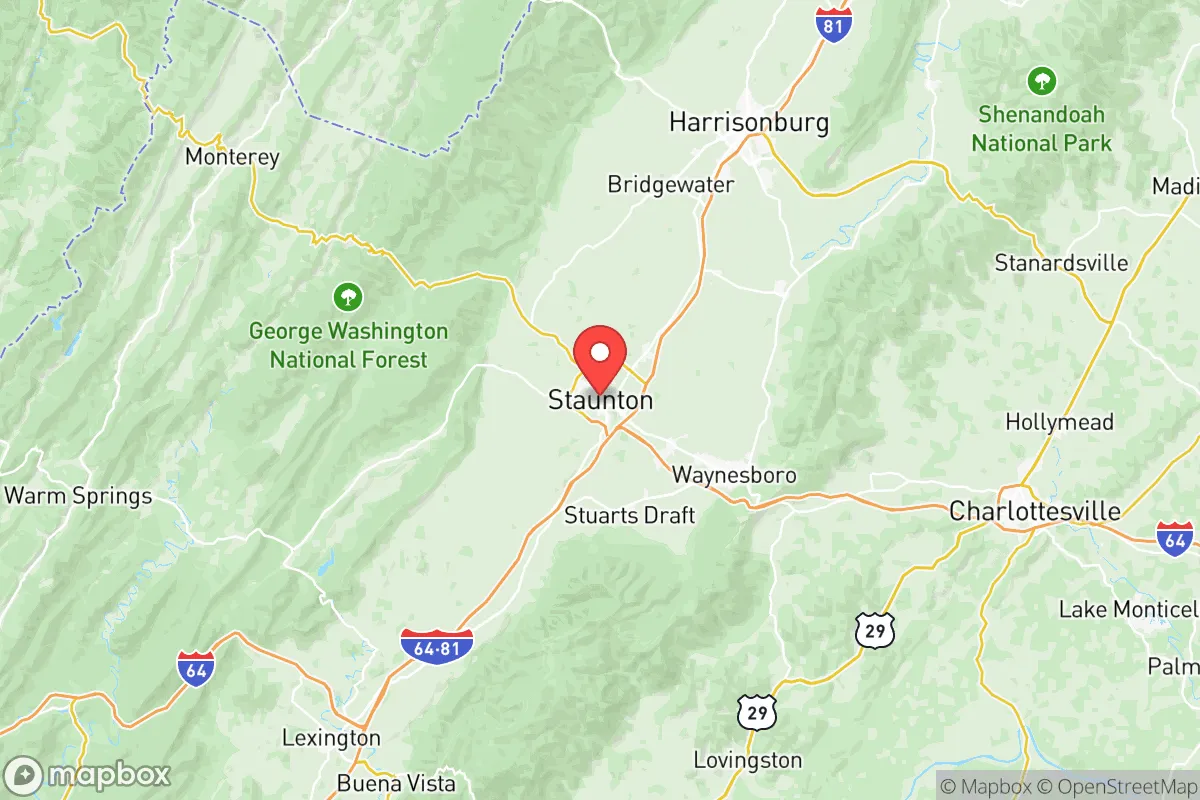
Staunton City County, Virginia, is a politically conservative area with a Cook PVI of R+12, meaning it votes about 12 points more Republican than the national average. This stands in stark contrast to the state of Virginia as a whole, which has a Cook PVI of D+4, reflecting a Democratic lean. Over the past decade, Staunton has held steady as a Republican stronghold, though local precincts show some variation—for instance, the city of Staunton itself (the county's only incorporated city) tends to be more moderate, with some precincts like those around Mary Baldwin University and downtown swinging slightly blue in recent elections, while rural areas like the neighborhoods along Route 250 west of town lean heavily red. The trajectory here is one of stability rather than dramatic shift; the county hasn't flipped in a presidential race since 2008, and even then, it was a narrow margin.
How it compares
Compared to Virginia's D+4 lean, Staunton City County is a political outlier within the state. While Virginia has trended blue in recent cycles—driven by growth in Northern Virginia, Richmond, and Hampton Roads—Staunton remains a reliably conservative pocket. In the 2024 presidential election, the county voted for the Republican candidate by a margin of about 18 points, while the state overall went Democratic by roughly 5 points. This gap of 23 points is significant and reflects the area's rural character and cultural values. Within the county, the city of Staunton (population around 25,000) provides the only real counterweight; its precincts near the historic downtown and the college campus often vote within 5 points of the national average, while the unincorporated areas—like those around the Staunton Mall or the industrial zones near Interstate 81—are solidly red. The contrast is sharp: you can drive 10 minutes from a precinct that voted 60% Republican to one that voted 55% Democratic.
What this means for residents
For conservative residents, Staunton's R+12 lean means their views are well-represented in local governance, from the county board of supervisors to the school board. Policies tend to favor lower taxes, Second Amendment rights, and traditional values, which aligns with the majority's preferences. For liberal residents, the political climate can feel isolating, but the city of Staunton offers a more progressive enclave, with active Democratic clubs and events at places like the Staunton Public Library or the Blackfriars Playhouse. The practical impact is that local elections often see low turnout in rural precincts but higher engagement in the city, meaning a motivated minority can sometimes sway close races—like the 2023 school board election, where a moderate candidate won by 200 votes thanks to city precincts. Both sides should expect a community where political discussions are common but rarely hostile, as the area's small-town feel encourages neighborly civility.
Culturally, Staunton City County distinguishes itself from the rest of Virginia through its strong sense of local identity and slower pace of change. While the state has embraced urban growth and diversity, Staunton retains a more traditional, agrarian character, with events like the Staunton Farmers Market and the annual Augusta County Fair reinforcing community bonds. Policy-wise, the county has resisted some state-level trends, such as stricter gun laws or zoning changes for affordable housing, preferring local control. This creates a unique blend: you get the benefits of Virginia's progressive state policies (like expanded Medicaid) without the cultural friction seen in more polarized areas. For anyone moving here, the key is understanding that the political climate is stable and predictable—a feature, not a bug, for those seeking a conservative-leaning community within a blue state.

State Political ClimatePolitical Climate in Virginia
State Political AnalysisPolitical Environment in the State
Virginia has shifted from a reliably purple swing state to a solidly Democratic-leaning one over the past two decades, carrying a Cook Partisan Voting Index of D+4. The transformation is driven almost entirely by explosive population growth in the Washington, D.C. suburbs, which now overwhelm the conservative lean of the rest of the state. In 2024, Kamala Harris won Virginia by roughly 5 points, a margin that would have been unthinkable in 2004 when George W. Bush came within 6 points of taking the state. For a conservative relocator, the reality is that you are moving into a state where Democrats control the governorship, the state Senate, and the House of Delegates as of 2026, but where your vote still carries real weight in many regions outside the I-95 corridor.
Urban vs. rural divide
The political map of Virginia is a story of three distinct regions. The D.C. suburbs — Fairfax County, Loudoun County, and Prince William County — are the engine of Democratic dominance, delivering margins of 60-70% for Democratic candidates. These counties alone account for over a third of the state's votes. Richmond and Norfolk/Virginia Beach add another layer of blue, though Virginia Beach itself remains a competitive swing area. Meanwhile, the rural south and southwest — places like Roanoke, Lynchburg, and the coal country around Bristol — vote Republican by margins of 30-40 points. The key battlegrounds are the exurban and suburban counties in between: Chesterfield County south of Richmond, Spotsylvania and Stafford south of D.C., and the Fredericksburg area. These places have been trending blue as D.C. commuters push further out, but they still elect Republican local officials and send mixed delegations to the General Assembly.
Policy environment
Virginia's tax structure is moderate by national standards. The state income tax is a flat 5.75% on all income above $17,000, and the sales tax is 5.3% (higher in some localities). Property taxes are set at the local level and vary widely — Loudoun County levies around $1.20 per $100 of assessed value, while Pittsylvania County in the south is under $0.60. There is no state-level property tax. The regulatory posture leans left on environmental issues — Virginia is part of the Regional Greenhouse Gas Initiative (RGGI), though Governor Glenn Youngkin attempted to withdraw the state in 2023, a move that remains tied up in court. Education policy is a flashpoint: the state has seen heated battles over transgender student policies, with the Youngkin administration issuing model policies that require parental notification and restrict bathroom access, while Democratic school boards in Northern Virginia have resisted. Election laws are moderately restrictive: Virginia requires a photo ID to vote, has no-excuse absentee voting, and offers same-day registration during early voting. There is no ballot harvesting, and drop boxes are available but regulated.
Recent policy direction
The last five years have seen Virginia swing back and forth dramatically. Under Governor Ralph Northam (2018-2022), Democrats passed a wave of progressive legislation: abolition of the death penalty, legalization of recreational marijuana (2021), expansion of Medicaid (2019), and a Clean Economy Act mandating 100% carbon-free electricity by 2050. Under Governor Youngkin (2022-2026), the direction reversed on several fronts: he signed a ban on mask mandates in schools, pushed for parental rights in education, and signed a tax cut package reducing the income tax rate from 5.75% to 5.5% (with a trigger for further cuts). On guns, Virginia remains a shall-issue state for concealed carry, but Democrats passed universal background checks and a red flag law in 2020; Youngkin has not been able to repeal them. On abortion, Virginia is an outlier in the South — it remains legal through the second trimester, with no heartbeat ban, making it a destination for women from neighboring states. On property rights, Virginia has no statewide zoning reform, but localities in Northern Virginia have upzoned aggressively for density. The net effect for a relocator: you get a state that is pro-choice, pro-union, and pro-environment at the state level, but with significant local variation — Campbell County and Loudoun County are effectively different countries in terms of school policy, tax rates, and cultural norms.
Civil unrest & political movements
Virginia has been a national flashpoint for political conflict. The 2017 Unite the Right rally in Charlottesville remains the most infamous event, resulting in a death and a lasting scar on the state's reputation. More recently, the 2020 protests in Richmond over the Robert E. Lee statue drew national attention and led to the statue's removal in 2021. The parents' rights movement has been particularly strong in Virginia, with massive school board protests in Loudoun County in 2021 over critical race theory and transgender policies — these protests were a key factor in Youngkin's 2021 victory. On immigration, Virginia has a patchwork of sanctuary policies: Fairfax County and Arlington County limit cooperation with ICE, while Prince William County under Republican control has pushed for stronger enforcement. Election integrity remains a live issue: the 2020 election in Virginia was certified without major controversy, but Republican activists continue to challenge the state's voter roll maintenance and drop box procedures. A new resident will notice that political yard signs, bumper stickers, and local activism are far more visible in Northern Virginia and Richmond than in the rural areas, where politics is quieter but just as deeply felt.
Projection
Over the next 5-10 years, Virginia's Democratic lean will likely deepen, but not uniformly. The D.C. suburbs continue to grow faster than the rest of the state, and the in-migration from other blue states — particularly California and New York — reinforces the trend. The I-81 corridor and Southside Virginia will continue to lose population and political influence. However, there are wild cards: if remote work declines, the premium on D.C.-area housing could ease, slowing suburban growth. The Republican Party could also rebound if it moderates on cultural issues and focuses on the economic populism that appeals to rural and exurban voters. The most likely scenario is that Virginia remains D+4 to D+6 for the next decade, with Democratic control of the governorship and legislature becoming the norm, interrupted only by occasional Republican wins in off-year elections when turnout drops. For a conservative moving in, the practical implication is that you will be living under Democratic state government for the foreseeable future, but your local government — especially if you choose Chesterfield, Spotsylvania, or Rockingham County — can still reflect your values.
For a new resident, the bottom line is that Virginia offers a genuine choice: you can live in a deep-blue suburb with excellent schools and high taxes, a purple exurb with good schools and moderate taxes, or a red rural area with lower costs and fewer services. The state government will lean left, but your day-to-day life will be shaped far more by your county board of supervisors and school board. If you are a conservative who values local control, Virginia still works — just don't expect to win many statewide elections. If you are a liberal, you will find a state that largely aligns with your values, especially in the northern and central regions. Either way, you are moving to a state that is politically engaged, increasingly diverse, and unlikely to swing back to the right anytime soon.
* Values derived from national, state, county, city and local statistics and may differ in a specific area. Last updated: 2026-06-28T20:50:48.000Z
Narrative content on this page is AI-generated and may contain mistakes. Verify any details that matter before acting on them.
ReloMaps may earn a commission from affiliate links at no extra cost to you.

