
Photo by Matthew Lancaster on Unsplash
Demographics of Staunton City County
Affluence Level in Staunton City County
A middle-class area roughly in line with national averages across income, home values, education, and employment.
People of Staunton City County
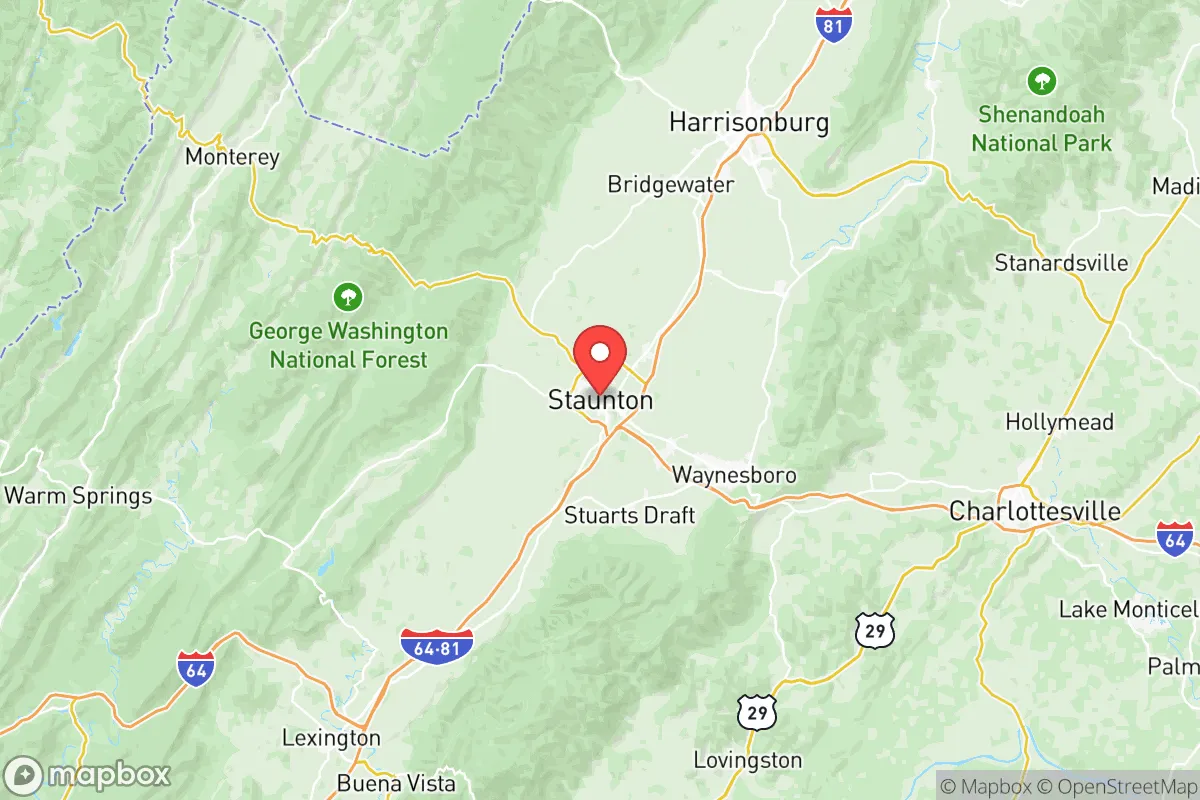
Staunton City County, Virginia, is a historically independent city that functions as a county-equivalent, home to 25,765 residents who form a predominantly White (78.9%) and notably well-educated (35.1% college degree) community. The population is characterized by a strong sense of place rooted in its Shenandoah Valley heritage, with a modest foreign-born share of 2.4% and a Black population of 10.0% reflecting both historic settlement patterns and more recent diversification. The city’s identity blends small-town Southern character with a growing cultural and arts scene, making it a distinctive anchor in the broader Staunton-Waynesboro-Harrisonburg region.
Settlement & growth (pre-1960)
Long before European settlement, the area now known as Staunton was part of the homeland of the Shawnee and Siouan-speaking tribes, including the Monacan people, who used the Shenandoah Valley as hunting grounds and travel corridors. The region saw no permanent Native villages by the time of European contact, as it was a contested borderland between tribes. The first Europeans to arrive were German and Scots-Irish settlers in the 1730s and 1740s, pushing south and west from Pennsylvania along the Great Wagon Road. These groups were drawn by the promise of fertile limestone valley soils and the relative safety of the valley floor compared to the frontier beyond the Blue Ridge.
Staunton was officially founded in 1747 as the county seat of Augusta County, named for Lady Staunton, the wife of Virginia’s colonial governor. The town quickly became a key waypoint on the Great Wagon Road, serving settlers moving further into the Valley of Virginia and beyond. The Scots-Irish, in particular, left a deep cultural imprint, establishing Presbyterian churches and a fiercely independent frontier ethos that persists in local politics and community life. German settlers concentrated in the surrounding farmlands, particularly in areas like Beverley Manor and along the Middle River, where they built stone houses and barns that still dot the landscape.
Through the 19th century, Staunton grew as a commercial and transportation hub. The arrival of the Virginia Central Railroad in the 1850s connected the city to Richmond and the eastern markets, spurring growth in milling, tanning, and ironworking. During the Civil War, Staunton served as a Confederate supply depot and hospital center, and the population remained overwhelmingly native-born White with a significant enslaved Black population. After Emancipation, freedmen and their descendants formed the core of Staunton’s Black community, concentrated in neighborhoods like Newtown and along West Frederick Street, where churches, schools, and small businesses anchored African American life through the Jim Crow era.
The early 20th century brought modest industrial expansion, including the Staunton Military Academy (founded 1884) and the Western State Hospital (1828), a major psychiatric facility that was one of the city’s largest employers for generations. Immigration to Staunton remained minimal through this period; the foreign-born share never exceeded 3% before 1960, with small numbers of German and Irish immigrants joining the existing population. The Great Migration saw some Black residents leave for northern industrial cities, but Staunton’s Black population remained stable at roughly 12-15% through the mid-20th century. The city’s growth was steady but slow, constrained by its landlocked position in the Valley and the lack of major interstate access until the 1960s.
Modern era (post-1965)
The 1965 Hart-Cellar Act had a limited direct impact on Staunton compared to larger metropolitan areas, but the city has experienced gradual demographic shifts nonetheless. The foreign-born population remains low at 2.4%, but this represents a slight increase from near-zero levels in 1970. The most notable change has been the growth of the Hispanic population to 4.4%, driven primarily by domestic migration from other parts of Virginia and the Southeast rather than direct immigration. Hispanic residents have concentrated in the Churchville Avenue corridor and in the Whites Addition neighborhood, working in construction, landscaping, and the poultry processing plants that dot the broader Shenandoah Valley.
The East/Southeast Asian population stands at 1.1%, a small but visible presence centered on the Mary Baldwin University campus and the medical community at Augusta Health, the region’s major hospital. Indian-subcontinent residents make up 0.5%, many of whom are professionals in healthcare and higher education. The Black population has declined slightly from historic levels to 10.0%, reflecting both outmigration of younger residents to larger cities and the aging of the established African American community. New Black residents have arrived from the Washington, D.C., metro area and Northern Virginia, drawn by lower housing costs and a quieter lifestyle, settling in the Stuart Addition and the Sears Hill neighborhoods.
Domestic migration has been the primary driver of population change since 1990. Retirees from Northern Virginia and the D.C. suburbs have moved to Staunton for its lower cost of living, historic architecture, and access to the Blue Ridge Mountains. This influx has raised the college-educated share to 35.1%, well above the Virginia average outside the D.C. suburbs, and has fueled a revival of downtown Staunton’s Beverley Street commercial district with independent shops, restaurants, and the American Shakespeare Center’s Blackfriars Playhouse. The city has also attracted a modest number of remote workers and creative professionals since 2020, though not at the scale seen in Charlottesville or Harrisonburg.
The future
Staunton’s population is projected to remain stable or grow slowly, with the city likely to become slightly more diverse but still predominantly White over the next two decades. The Hispanic share is expected to rise to 6-8% by 2040, driven by both natural increase and continued domestic migration from other parts of Virginia. The East/Southeast Asian and Indian populations will likely grow modestly as Augusta Health and Mary Baldwin University continue to recruit professionals from outside the region. The Black population share is expected to remain near 10%, with some new arrivals from the D.C. area offsetting the aging of the historic community.
The most significant demographic trend is the aging of the population, with the 65+ cohort growing faster than any other age group. This will increase demand for healthcare services, senior housing, and age-restricted communities, particularly in areas like the Gypsy Hill Park neighborhood and new developments along Route 250 west of town. Younger families are more likely to settle in the surrounding Augusta County rather than within Staunton’s city limits, where housing stock is older and school enrollment has been flat. The city’s cultural identity is evolving from a quiet, insular Valley town into a more cosmopolitan small city, though the pace of change is gradual and the core character remains rooted in its Scots-Irish and German heritage.
For someone moving to Staunton now, the city offers a stable, historically grounded community with a growing arts scene and an increasingly educated population, but without the rapid demographic transformation seen in larger Virginia cities. The population is becoming more diverse at a measured pace, and the cultural identity is shifting toward a blend of traditional Valley conservatism and newcomer-driven progressivism. Staunton is becoming a place where historic character and new energy coexist, making it well-suited for those seeking a slower pace of change in a setting that values both heritage and renewal.

* Values derived from national, state, county, city and local statistics and may differ in a specific area. Last updated: 2026-06-28T20:50:48.000Z
Narrative content on this page is AI-generated and may contain mistakes. Verify any details that matter before acting on them.
ReloMaps may earn a commission from affiliate links at no extra cost to you.

