
Photo by Matthew Lancaster on Unsplash
Personal Sovereignty in Staunton City County
Viable for self-reliance. Generally workable, though some barriers may limit total independence.
What does Personal Sovereignty tell us?
Personal Sovereignty measures your capacity for self-reliance and independence with minimal government friction. Higher scores mean fewer barriers between you and the way you want to live... but it assumes you have the space you need and good neighbors.
What does this tell us?
Personal Sovereignty measures your capacity for self-reliance and independence with minimal government friction. Higher scores mean fewer barriers between you and the way you want to live... but it assumes you have the space you need and good neighbors.
State Policy
Energy independence: Importer (20% of energy produced in-state)
Personal Liberty
Homesteading

Personal Liberty Analysis
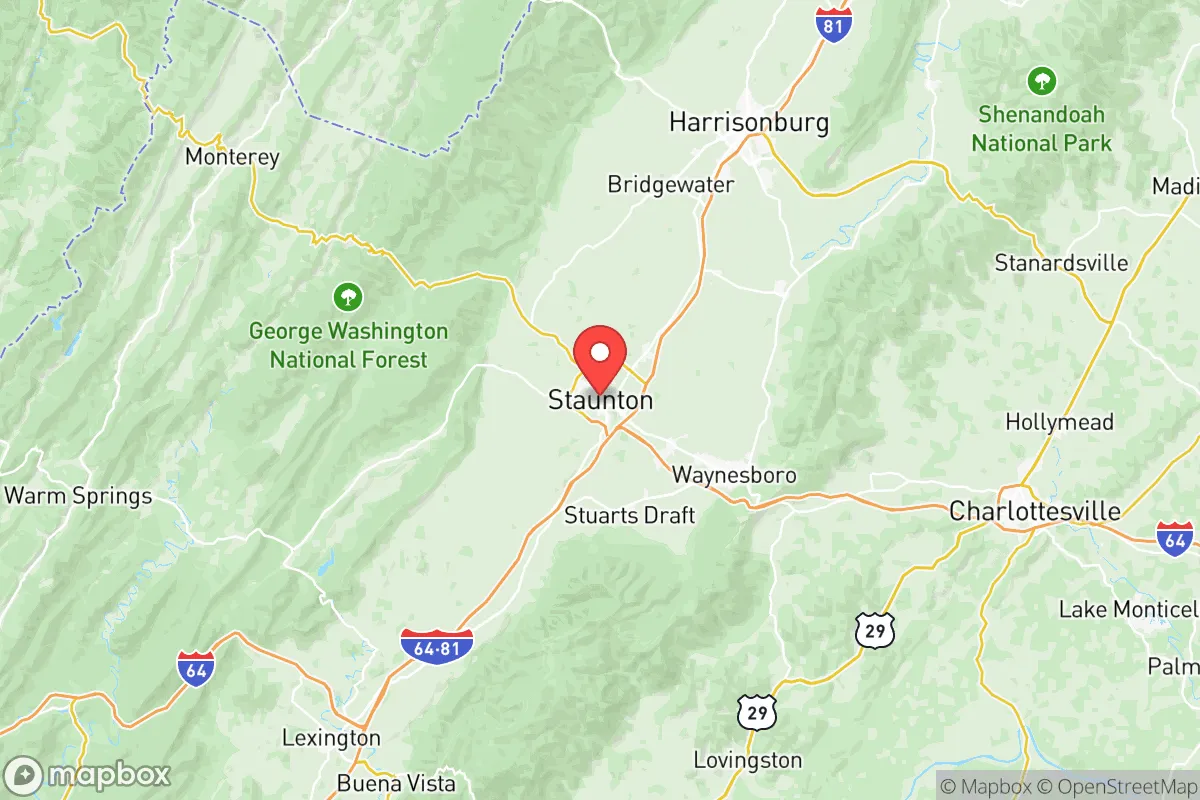
Staunton City County, Virginia, offers a nuanced environment for personal sovereignty, where state-level preemption on key issues like gun rights and zoning provides a baseline of autonomy, but local governance in the city of Staunton itself introduces a more regulatory posture than the surrounding rural areas of Augusta County and the independent cities of Waynesboro and Lexington. For a relocation-minded individual or family prioritizing self-reliance, the key distinction lies not in the county's name—Staunton is an independent city, not a county—but in the contrast between its urban core and the unincorporated communities just beyond its borders. The overall sovereignty picture is one of moderate freedom, with strong protections for self-defense and parental rights, but a tax and regulatory climate that is heavier than the state's rural southwest and lighter than Northern Virginia.
Tax burden and regulatory posture in Staunton compared to surrounding areas
Staunton's tax burden is moderate by Virginia standards, but notably higher than the surrounding Augusta County, where many sovereignty-minded residents choose to live for lower rates. The city levies a real estate tax rate of $1.08 per $100 of assessed value, while Augusta County's rate is approximately $0.56, a nearly 50% difference that directly impacts property owners. Personal property tax on vehicles is also a factor—Staunton's rate is $4.00 per $100, compared to Augusta's $3.50. The regulatory posture in Staunton is more active than in rural areas like Greenville or Craigsville, with a city planning department that enforces zoning codes and building permits more strictly. However, Virginia's Dillon Rule means that localities only have powers explicitly granted by the state, which limits Staunton's ability to impose novel regulations. For a reader comparing to Texas or Florida, the overall regulatory environment is moderate—less burdensome than the D.C. suburbs, but not as light-touch as the Shenandoah Valley's unincorporated areas.
Self-defense and gun law specifics in Staunton City County
Virginia is a shall-issue state for concealed carry permits, and Staunton City County fully respects state preemption on firearms regulation, meaning the city cannot enact its own gun bans or magazine limits. The Staunton Police Department processes concealed handgun permits with a typical turnaround of 45 days, and the city has no local ordinances restricting open carry, which is legal for anyone 18 or older who can legally possess a firearm. The gun culture in Staunton is more subdued than in rural areas like Churchville or Mount Solon, where shooting ranges and hunting are common, but the legal framework is identical. Stand-your-ground laws do not exist in Virginia; the state uses a duty-to-retreat standard in public spaces, though the Castle Doctrine applies inside one's home. For a self-defense-focused reader, the key advantage is that moving to Staunton does not require surrendering any gun rights compared to the rest of Virginia, but the duty-to-retreat rule is a meaningful limitation versus states like Texas or Florida.
Self-reliance and homesteading viability in Staunton and the broader area
Homesteading within Staunton's city limits is constrained by lot sizes and zoning. The typical residential lot in Staunton is 0.1 to 0.25 acres, and city zoning prohibits keeping livestock like chickens or goats in most residential districts, though a permit for up to four hens is possible in some areas. For serious self-reliance, the surrounding Augusta County communities of Fishersville, Stuarts Draft, and Verona offer far more viable options, with zoning that allows for larger lots—often 1 to 5 acres—and livestock as a by-right use. Off-grid feasibility is limited in Staunton itself, where building codes require connection to municipal water and sewer, but in Augusta County, properties with well and septic systems are common, and solar panel installation is permitted without special restrictions. The Staunton area's growing season of about 170 days supports gardening, and the local extension office through Virginia Tech provides resources for small-scale farming. For a family wanting to raise animals and grow food, the practical choice is to live outside Staunton's city limits, where regulatory barriers are minimal.
Personal liberties in Staunton: parental rights, medical autonomy, speech, and property
Virginia law provides strong protections for parental rights, including a statute that affirms parents' fundamental right to make decisions concerning their children's upbringing, education, and healthcare. Staunton City Public Schools have a transparent curriculum review process, and parents can opt their children out of specific instructional materials. Medical autonomy is more restricted than in states like Florida or Texas; Virginia has not passed broad medical freedom legislation, and vaccine mandates for school attendance remain in place. Speech and assembly rights are fully protected under the First Amendment, and Staunton has no local ordinances restricting public protest or expressive activity beyond standard time, place, and manner regulations. Property rights are subject to the city's zoning and historic district regulations—Staunton has a strong historic preservation commission that can delay or deny exterior modifications to properties in designated districts, which is a meaningful constraint for homeowners who value unfettered control over their property. In contrast, property in Waynesboro or rural Augusta County has far fewer aesthetic restrictions.
Overall, Staunton City County offers a moderate level of personal sovereignty that is strongest in self-defense and parental rights, but weaker in tax burden and property autonomy compared to the surrounding rural areas. For a reader who prioritizes maximum freedom, the independent city of Staunton is less attractive than the unincorporated communities of Augusta County, where lower taxes, fewer zoning restrictions, and a more permissive homesteading environment prevail. However, for someone who values the amenities of a small city—walkable downtown, cultural institutions, and a sense of community—while retaining strong gun rights and parental control, Staunton represents a reasonable middle ground. The most sovereignty-focused relocation strategy would be to live in Augusta County's rural areas while commuting to Staunton for work and services, capturing the best of both regulatory environments.

* Values derived from national, state, county, city and local statistics and may differ in a specific area. Last updated: 2026-06-28T20:50:48.000Z
Narrative content on this page is AI-generated and may contain mistakes. Verify any details that matter before acting on them.
ReloMaps may earn a commission from affiliate links at no extra cost to you.

