
Photo by Matthew Lancaster on Unsplash
Strategic Assessment of Staunton City County
Workable tactical position. Some exposure to population density or targets, but generally defensible in a crisis.
What does the Strategic Assessment tell us?
Our Strategic Assessment grades tactical survivability of an area. Major population centers, military targets, fallout zones, natural disasters, and border exposure all drive risk — lower exposure means a more defensible position in a crisis.
This is heavily inspired by Joel Skousen's Strategic Relocation book. Highly recommended you checkout the book ($)What does this tell us?
Our Strategic Assessment grades tactical survivability of an area. Major population centers, military targets, fallout zones, natural disasters, and border exposure all drive risk — lower exposure means a more defensible position in a crisis.
This is heavily inspired by Joel Skousen's Strategic Relocation book. Highly recommended you checkout the book ($)Strategic Pillars

Key Distances
Strategic Assessment Analysis
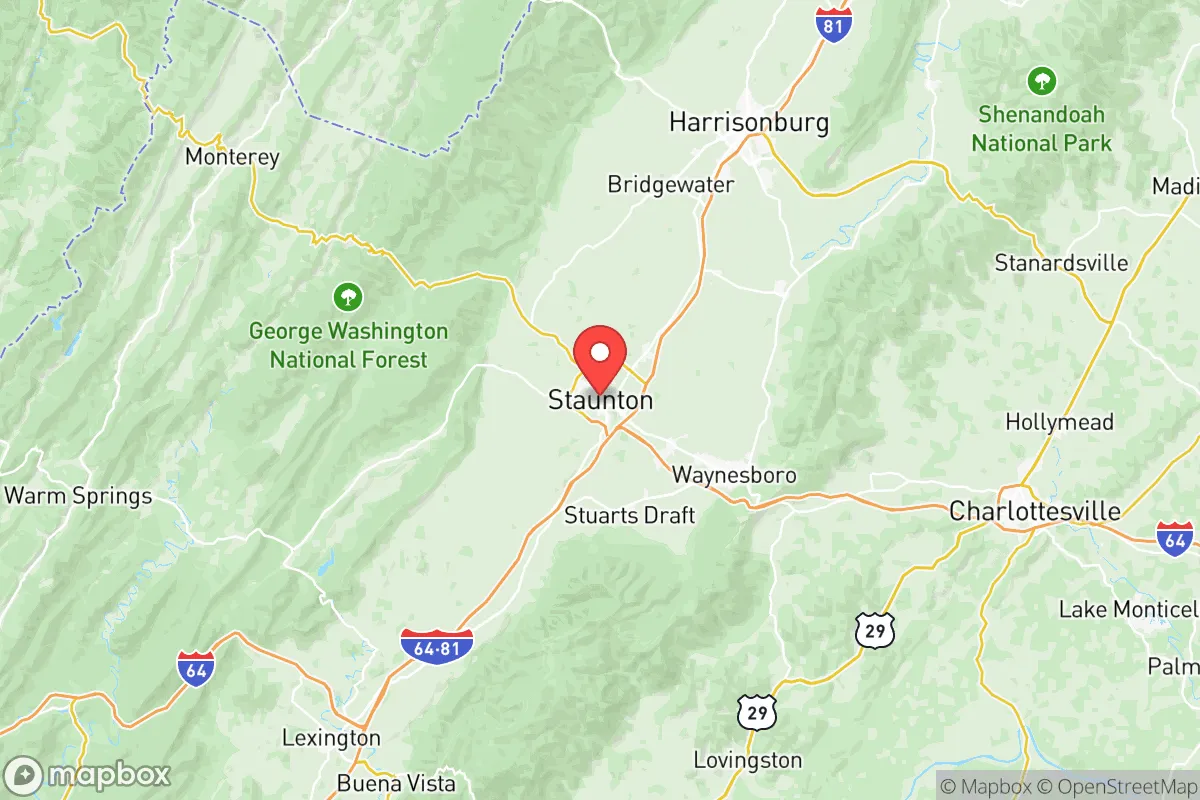
Staunton City County, Virginia, offers a compelling strategic position for relocation-minded individuals and families who prioritize disaster readiness and self-sufficiency. Nestled in the Shenandoah Valley, this independent city of roughly 25,000 residents sits at the intersection of Interstates 81 and 64, providing both accessibility and a degree of natural insulation from the denser, more vulnerable corridors of the Eastern Seaboard. Its location—roughly 150 miles west of Washington, D.C., and 100 miles northwest of Richmond—places it outside the immediate blast and fallout zones of major metropolitan targets, while still offering reasonable proximity to supply chains and medical infrastructure in cities like Harrisonburg (25 miles north) and Charlottesville (40 miles east).
Geographic position and natural advantages for long-term security
Staunton’s primary strategic asset is its position within the Shenandoah Valley, a natural trough flanked by the Blue Ridge Mountains to the east and the Allegheny Mountains to the west. This topography provides a dual benefit: it creates a natural barrier that can mitigate the spread of airborne contaminants from coastal or inland targets, and it offers multiple egress routes via secondary roads (such as US-250 and VA-254) if interstates become compromised. The valley’s agricultural capacity is significant—Augusta County, which surrounds Staunton, is one of Virginia’s top agricultural producers, with over 1,200 farms generating $200 million annually in crops like poultry, cattle, and apples. For a relocator, this means local food sources are not hypothetical; they are operational and within a 20-minute drive of downtown Staunton. The city itself sits at an elevation of 1,400 feet, reducing flood risk compared to low-lying valley towns, and its water supply comes from the Staunton River and several protected reservoirs, including the 1.5-billion-gallon Sherando Lake system in the George Washington National Forest, 25 miles west.
Risk exposure, fallout proximity, and man-made threat assessment
While Staunton avoids the highest-risk zones, it is not immune to man-made threats. The most significant nearby target is the Blue Ridge Arsenal in Waynesboro (12 miles southeast), a U.S. Army depot that stores conventional munitions and small arms. A strike or accident there could generate localized fragmentation hazards, but the depot is not a nuclear or chemical weapons facility, so fallout risk is limited. More concerning is Staunton’s position along the I-81 corridor, which carries heavy truck traffic, including hazardous materials. A derailment or truck accident involving chemicals—like the 2023 Norfolk Southern derailment in East Palestine, Ohio—could disrupt water or air quality for days. The city’s water intake on the Staunton River is upstream of most industrial sites, but a spill upstream in the George Washington National Forest (e.g., from a logging or mining operation) could still pose a risk. For nuclear fallout, Staunton’s distance from major targets is a clear positive: the nearest Tier-1 target is the Pentagon and D.C. metro area (150 miles east), while the Surry Nuclear Power Plant (120 miles southeast) and North Anna Nuclear Station (90 miles east) are the closest nuclear facilities. Prevailing winds in the valley run southwest to northeast, meaning fallout from a D.C. strike would likely blow toward the Atlantic, not up the valley toward Staunton. However, a strike on the Norfolk Naval Shipyard (200 miles southeast) or the Newport News shipbuilding complex (170 miles southeast) could push fallout inland if winds shift, though the Blue Ridge would provide partial shielding.
Practical resilience for a relocator: food, water, energy, and defensibility
For someone serious about self-sufficiency, Staunton’s practical resilience is strong but requires preparation. Food security is excellent: the city hosts a year-round farmers’ market (the Staunton Farmers’ Market, operating since 1973), and within a 30-minute drive, you can access dozens of u-pick orchards, CSA farms, and bulk food suppliers like the Mennonite-run Countryside Market in Dayton (15 miles north). The Shenandoah Valley is also a hub for livestock and poultry, so protein sources are local. Water security is solid: the city’s municipal water comes from the Staunton River and is treated at the Staunton Water Treatment Plant (capacity 8 million gallons per day), but a well on private property is feasible in the surrounding county, with average well depths of 150-300 feet and good aquifer yields. For those relying on municipal water, a backup plan like a 500-gallon cistern or Berkey filter is wise, as the treatment plant is a single point of failure. Energy resilience is mixed: Dominion Energy provides grid power, but outages from winter storms (ice storms are common every 2-3 years) or summer thunderstorms can last 24-48 hours. Solar is viable—the region averages 200 sunny days per year—and net metering is available, though installation costs run $15,000-$25,000 for a whole-home system. Wood heat is a practical backup, with firewood readily available from national forest permits ($20 per cord) or local suppliers. Defensibility is moderate: Staunton’s layout as a compact historic city (grid streets, narrow alleys) makes it harder to secure than a rural homestead, but the surrounding county offers numerous properties with good sightlines, natural barriers (creeks, ridges), and low population density (Augusta County averages 80 people per square mile). The nearest military installation is Fort Barfoot (formerly Fort Pickett, 90 miles southeast), a Virginia Army National Guard base that could become a staging area in a crisis, but it’s far enough to avoid drawing attention to Staunton.
Overall, Staunton City County presents a balanced strategic picture for the disaster-conscious relocator. Its geographic insulation from major targets, robust local agriculture, and defensible terrain make it a strong candidate for those seeking a base that is neither too remote (which complicates supply runs and medical access) nor too exposed. The primary weaknesses—grid dependency, a single water treatment plant, and proximity to the I-81 chemical transport corridor—are manageable with modest preparation: a backup power source, a water filtration system, and a route plan for avoiding a hazmat incident. For a family or individual willing to invest in those basics, Staunton offers a rare combination of natural security and practical livability that few mid-Atlantic locations can match.

* Values derived from national, state, county, city and local statistics and may differ in a specific area. Last updated: 2026-06-28T20:50:48.000Z
Narrative content on this page is AI-generated and may contain mistakes. Verify any details that matter before acting on them.
ReloMaps may earn a commission from affiliate links at no extra cost to you.

