
Photo by Chandler Cruttenden on Unsplash
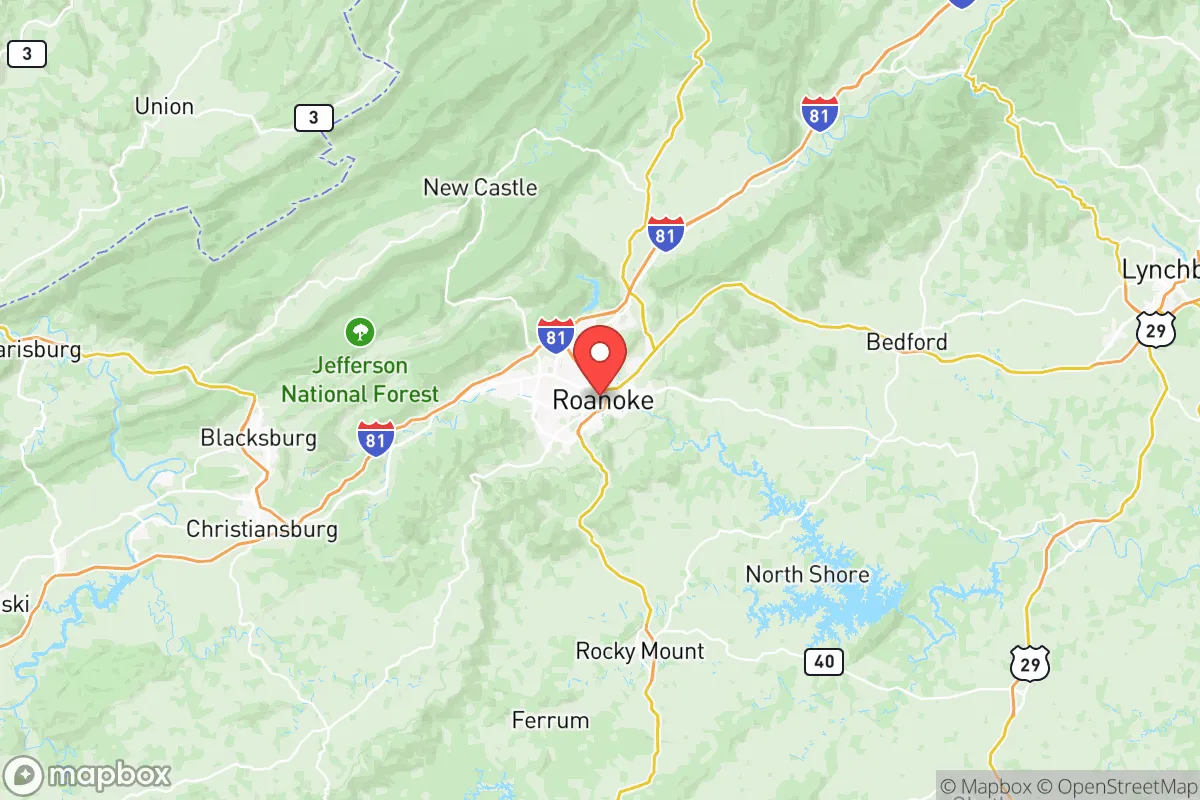
Personal Sovereignty in Roanoke City County
Viable for self-reliance. Generally workable, though some barriers may limit total independence.
What does Personal Sovereignty tell us?
Personal Sovereignty measures your capacity for self-reliance and independence with minimal government friction. Higher scores mean fewer barriers between you and the way you want to live... but it assumes you have the space you need and good neighbors.
What does this tell us?
Personal Sovereignty measures your capacity for self-reliance and independence with minimal government friction. Higher scores mean fewer barriers between you and the way you want to live... but it assumes you have the space you need and good neighbors.
State Policy
Energy independence: Importer (20% of energy produced in-state)
Personal Liberty
Homesteading

Personal Liberty Analysis
Roanoke City County, Virginia, presents a nuanced environment for personal sovereignty, where a relatively light-touch state-level framework on gun rights and parental autonomy meets a more structured municipal regulatory landscape. The city of Roanoke itself operates under a council-manager government with a progressive tilt, while the surrounding county areas, including Vinton, Cave Spring, and the rural stretches near Bent Mountain, often experience a more permissive, hands-off approach to daily life. For the relocation researcher prioritizing independence, the key distinction is not just between city and county lines, but between the specific zoning and enforcement cultures of individual communities within the region.
Tax burden and regulatory posture in Roanoke City County
Virginia is a Dillon's Rule state, meaning localities only have powers expressly granted by the state legislature, which generally creates a more uniform regulatory baseline than in home-rule states like Colorado or Texas. Roanoke City's combined real estate tax rate sits at approximately $1.21 per $100 of assessed value, while Roanoke County's rate is lower, around $0.99 per $100. This difference is meaningful for a family budgeting for long-term property ownership. The state income tax is a flat 5.75%, and while there is no local income tax in Roanoke City or County, the personal property tax on vehicles—assessed at 100% of value with a rate of roughly $3.50 per $100 in the city—is a recurring cost that surprises many newcomers from states without such taxes. Business regulation is moderate; the city has a more active code enforcement division, particularly in historic districts like Old Southwest and Wasena, where exterior paint colors and fence heights can trigger review. In contrast, the county's regulatory posture in areas like Glenvar or the Hollins precinct is notably more relaxed, with fewer inspections and a faster permitting process for accessory structures.
Self-defense and gun law specifics in the Roanoke Valley
Virginia is a "shall-issue" state for concealed handgun permits, and Roanoke City County generally respects that framework. The county sheriff's office processes permits efficiently, with turnaround times typically under 45 days. Open carry is legal without a permit for anyone 18 or older who can legally possess a firearm, and this is a common sight in rural parts of the county, particularly around Bent Mountain and Back Creek. However, the city of Roanoke has a more restrictive culture; while open carry is technically legal, it draws police attention and public scrutiny, especially in dense areas like the Market Square district or along the Roanoke River Greenway. Virginia law preempts local governments from passing their own gun ordinances, so the city cannot ban carry in parks or public buildings beyond state mandates, but the practical social friction is higher inside the city limits. For the self-defense-minded individual, living in the county—especially in the southern precincts near Boones Mill or the northern reaches near Daleville—offers a more seamless integration of gun culture into daily life, with fewer questions from neighbors or law enforcement.
Self-reliance and homesteading viability across the region
The viability of a self-reliant lifestyle varies dramatically within Roanoke City County. Inside the city, lot sizes average less than a quarter-acre, and zoning prohibits keeping livestock—chickens are allowed only with a special permit in limited districts, and goats or pigs are effectively banned. The city's code enforcement actively pursues complaints about unkempt lots, outdoor storage, and non-permitted structures, making off-grid living or extensive homesteading impractical. Cross the line into the county, however, and the picture shifts. In the Cave Spring area, zoning allows for horses on lots of two acres or more, and in the Bent Mountain and Back Creek precincts, five-acre minimum lot sizes are common, with no restrictions on livestock, beekeeping, or non-commercial farming. Off-grid feasibility is highest in these rural pockets; while the county requires a building permit for any permanent structure, there is no active enforcement against solar panel installation or rainwater catchment systems. The Glenvar area, with its mix of agricultural and residential zoning, offers a middle ground where a family can keep a substantial garden and a few animals without the regulatory friction found in the city. For the serious homesteader, the county's lack of a county-wide noise ordinance and its permissive stance on non-commercial food processing (such as selling raw milk through herd-share agreements) are significant advantages over the city's more restrictive posture.
Personal liberties in education, medicine, and property rights
Parental rights in education are a strong point for the region. Virginia law grants parents broad authority to opt their children out of specific instructional content, and both Roanoke City and County public schools have transparent policies on this. The county, in particular, has a robust homeschool community, with the Roanoke County School Board maintaining a hands-off approach to homeschool oversight—parents simply file a notice of intent and provide annual assessment evidence, with minimal bureaucratic friction. Medical autonomy is more constrained by state-level mandates; Virginia has not passed broad medical freedom legislation akin to what exists in Idaho or Montana. Vaccine mandates for school attendance remain in effect, though exemptions are available. Property rights are generally well-respected in the county, where zoning is less prescriptive. In the city, however, the Historic Preservation Board has authority over exterior changes in designated districts, which can feel intrusive to a property owner who values absolute control over their home's appearance. Free speech is protected under standard First Amendment jurisprudence, and the region's political diversity—with a mix of libertarian-leaning independents in the county and progressive voices in the city—means that public discourse is robust but rarely suppressed.
Overall, personal sovereignty in Roanoke City County is best understood as a trade-off between proximity to urban amenities and the regulatory freedom of rural living. The city of Roanoke offers walkability and cultural density but imposes a tighter regulatory grip on property use and daily activities. The county, particularly in the Bent Mountain, Back Creek, and Glenvar communities, provides a far more permissive environment for self-reliance, gun ownership, and homesteading. Compared to the heavily regulated environments of Northern Virginia or the progressive enclaves of the Blue Ridge, Roanoke County stands out as a relatively high-sovereignty area within the Commonwealth, especially for those who choose their specific community wisely.

* Values derived from national, state, county, city and local statistics and may differ in a specific area. Last updated: 2026-07-08T07:06:00.000Z
Narrative content on this page is AI-generated and may contain mistakes. Verify any details that matter before acting on them.
ReloMaps may earn a commission from affiliate links at no extra cost to you.

