
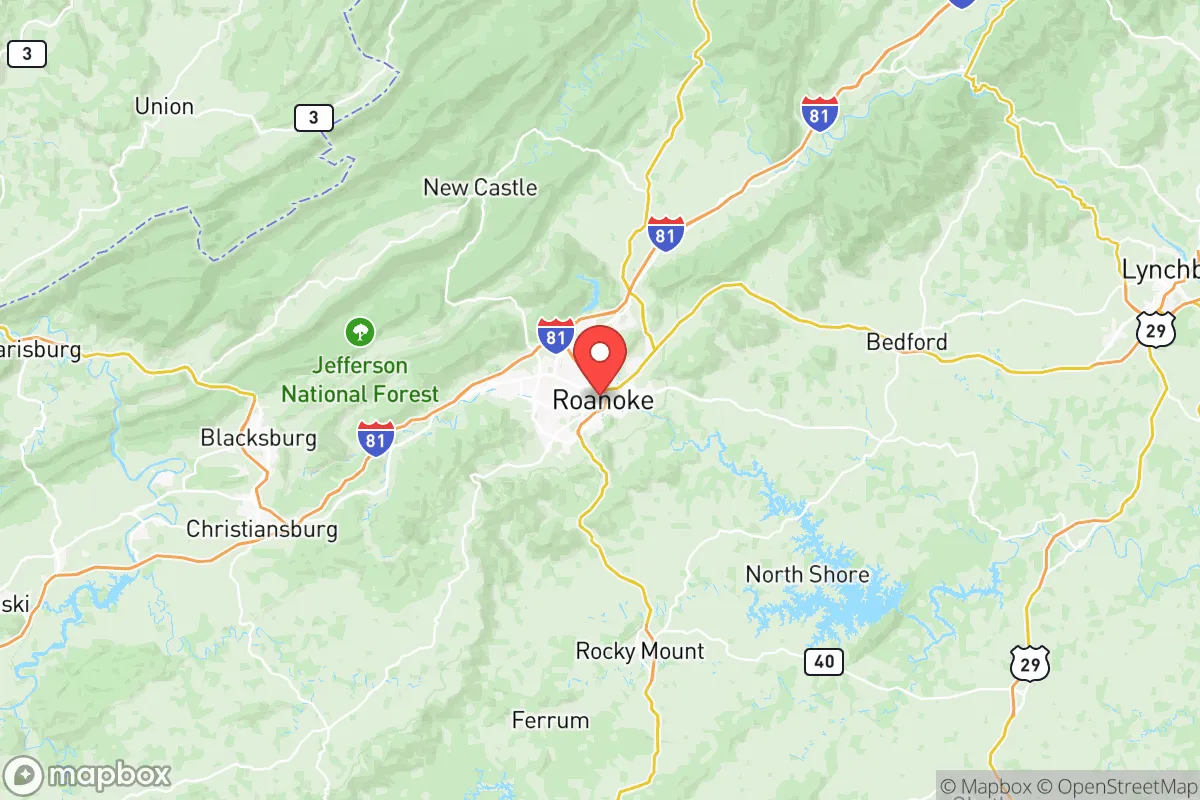
Photo by Chandler Cruttenden on Unsplash
Demographics of Roanoke City County
Affluence Level in Roanoke City County
A below-average socioeconomic profile. Incomes, home values, and educational attainment trail the U.S., with higher poverty and unemployment.
People of Roanoke City County
Roanoke City County, Virginia, is a compact, densely populated urban core of roughly 98,700 residents, defined by its Blue Ridge Mountain setting and a population that is majority-white but significantly Black, with a small but growing Hispanic and Asian presence. The city’s identity is rooted in its history as a railroad and industrial hub, giving it a working-class character that leans moderate to conservative, with a strong sense of local place and a slower pace of life than the state’s northern suburbs. Today, its people are a mix of long-standing Appalachian families, descendants of African American migrants who came for industrial jobs, and a modest influx of newcomers drawn to lower costs and mountain scenery. The foreign-born share sits at just 4.8%, well below the national average, making Roanoke one of the less diverse mid-sized cities in Virginia, though its demographic composition is slowly shifting.
Settlement & growth (pre-1960)
Long before European settlers arrived, the region around present-day Roanoke was part of the homeland of the Siouan-speaking Tutelo and Saponi peoples, who lived in villages along the Roanoke River. By the early 1700s, pressure from Iroquois raiding parties and encroaching English colonists pushed these groups southward, and the area was largely depopulated of Native inhabitants by the time of the American Revolution. The first permanent European settlers were Scots-Irish and German migrants moving down the Great Wagon Road from Pennsylvania in the 1740s and 1750s, who established small farms in the Roanoke Valley. These early families—names like Preston, Trout, and Persinger—settled in what are now the neighborhoods of Old Southwest and along the Roanoke River near present-day Wasena, laying the foundation for a rural, agrarian society that would persist for over a century.
The city’s explosive growth began with the arrival of the railroad. In 1852, the Virginia and Tennessee Railroad reached the area, and the small settlement of Big Lick—named for a salt lick used by wildlife—was chosen as a junction point. The railroad brought Irish laborers, many of whom settled in the Gainsboro neighborhood, and later, German and Italian craftsmen who worked on the tracks and in the machine shops. After the Civil War, the city was officially renamed Roanoke in 1882 and incorporated in 1884, and the Norfolk and Western Railway (N&W) established its headquarters and massive Shops complex there. This industrial boom pulled in thousands of workers: Appalachian whites from surrounding counties, African Americans from rural Virginia and North Carolina during the Great Migration (roughly 1910–1940), and a smaller number of Eastern European immigrants—Poles, Slovaks, and Hungarians—who found work in the rail yards and foundries. By 1920, Roanoke’s Black population had grown to about 25%, concentrated in the Gainsboro and Northeast Roanoke neighborhoods, which became vibrant commercial and cultural centers despite Jim Crow segregation. The Great Depression slowed growth, but World War II brought a new wave of domestic migrants—men and women from the surrounding countryside—who filled defense-related manufacturing jobs at the N&W Shops and the new General Electric plant in Salem, just west of the city limits.
Modern era (post-1965)
The 1965 Hart-Cellar Act had a modest effect on Roanoke compared to coastal cities, but it did open the door for a small but steady stream of immigrants. The most notable post-1965 group has been Vietnamese refugees, who began arriving after the fall of Saigon in 1975, sponsored by local churches and resettlement agencies. They concentrated in the South Roanoke and Raleigh Court neighborhoods, where a handful of Vietnamese restaurants and markets now operate, though no formal ethnic enclave emerged. More recently, a small Indian-subcontinent community (0.9% of the population) has grown, largely professionals in healthcare and engineering at Carilion Clinic and Virginia Tech Carilion School of Medicine, settling in Cave Spring and South Roanoke. The Hispanic population (8.6%) has grown steadily since the 1990s, driven by Mexican and Central American immigrants working in construction, landscaping, and food processing, with a visible concentration along Melrose Avenue in Northwest Roanoke and in the Hollins area just north of the city.
Domestic migration has been the larger force reshaping Roanoke since the 1970s. The decline of the railroad industry—N&W merged with Southern Railway in 1982 and moved its headquarters to Norfolk—led to a population peak of about 100,000 in 1980, followed by a slow decline to roughly 97,000 by 2010. Many white working-class families left for surrounding counties like Botetourt and Franklin, seeking newer housing and lower taxes, a pattern of suburbanization that continues today. At the same time, Roanoke has attracted a modest influx of retirees and remote workers from the Northeast and Mid-Atlantic, drawn by lower home prices and the Blue Ridge Parkway. The city’s Black population, which peaked at around 30% in the 1990s, has held relatively steady at 28.5%, though many younger Black families have moved to the suburbs of Vinton and Salem. The college-educated share (28.9%) has risen in the past decade, driven by the expansion of Virginia Tech Carilion and Jefferson College of Health Sciences, but remains below the national average, reflecting the city’s still-industrial economic base.
The future
Roanoke’s population is projected to remain stable or grow very slowly over the next decade, with the city likely staying in the 98,000–102,000 range. The Hispanic share is expected to continue rising, potentially reaching 12–14% by 2035, as younger families settle in the Northwest and Hollins corridors, while the East/Southeast Asian and Indian communities will grow modestly as healthcare and tech jobs expand. The white population will continue to shrink as a share, but will remain the majority, and the Black population is likely to hold steady or decline slightly as outmigration to suburbs continues. The city is becoming slightly more diverse, but not dramatically so—Roanoke will remain a predominantly white and Black city with a small but visible Hispanic minority, far less diverse than Northern Virginia or Richmond. New residents are most likely to be domestic migrants from higher-cost states, particularly Florida, New York, and California, seeking affordability and mountain recreation, and they will tend to settle in the Grandin Court and South Roanoke neighborhoods, where walkable streets and older homes appeal to newcomers.
For someone moving to Roanoke now, the city offers a stable, modestly diverse community with a strong sense of local history and a slower pace of change. The population is aging slightly, but the presence of two major medical centers and a growing remote-work cohort is bringing in younger professionals. The cultural identity remains rooted in Appalachian and railroad heritage, with a conservative-leaning but not insular character—a place where newcomers are welcomed but expected to adapt to local rhythms. Roanoke is not becoming a melting pot, but it is becoming a more varied version of itself, and for those seeking a mid-sized city with genuine character and manageable costs, that evolution is likely to continue on its current steady course.

* Values derived from national, state, county, city and local statistics and may differ in a specific area. Last updated: 2026-07-08T07:06:00.000Z
Narrative content on this page is AI-generated and may contain mistakes. Verify any details that matter before acting on them.
ReloMaps may earn a commission from affiliate links at no extra cost to you.

