
Photo by Anthony Chiado on Unsplash
Political ClimatePolitical Climate in Harrisonburg City County
Showing state-level results — no local-only data available.
Local Political AnalysisPolitical Analysis of Harrisonburg City County
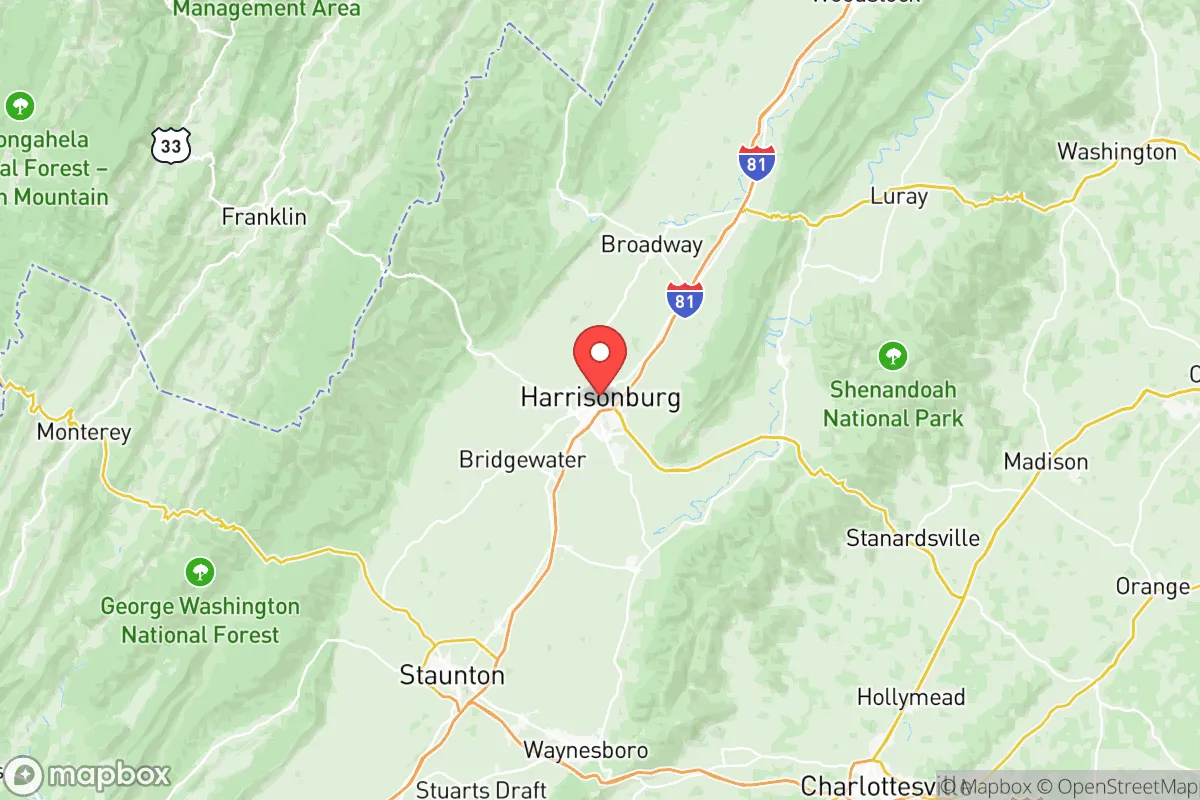
Harrisonburg City County is a fascinating political outlier in Virginia, a deep blue island in a sea of red. While the surrounding state of Virginia as a whole has a Cook PVI of D+4, Harrisonburg City County itself carries a Cook PVI of R+12, making it one of the most reliably Republican jurisdictions in the commonwealth. This isn't a recent shift; it's a long-standing reality rooted in the city's unique demographics and economic base. The city itself is a mix of a large university (James Madison University) and a significant Mennonite and conservative Christian population, creating a political tension that doesn't exist in most of Virginia's other urban centers.
How it compares
The contrast between Harrisonburg and the rest of Virginia is stark. The state's D+4 lean is driven by the massive Democratic margins in Northern Virginia (Arlington, Fairfax, Loudoun) and the Richmond metro area. Harrisonburg, by contrast, votes more like a rural county in Southwest Virginia than a college town. Within the city limits, the political geography is surprisingly granular. The precincts around James Madison University, like the JMU campus precinct, reliably vote blue by 15-20 points, driven by students and faculty. Meanwhile, the precincts in the southeastern part of the city, near the Rockingham County line, and the northwestern neighborhoods around the city's historic Mennonite settlements, vote red by 30-40 points. The swing precincts are the central city wards around the downtown area, where a mix of young professionals, long-time residents, and service workers create a more competitive environment. In 2024, the city's overall R+12 result was a product of these two very different worlds colliding, with the red precincts turning out in higher numbers than the blue ones.
What this means for residents
For a conservative resident, Harrisonburg is a comfortable place to live politically. The city council and school board are reliably conservative, and local policies tend to reflect a pro-business, low-tax, and limited-government philosophy. You'll find that the local Republican Party is well-organized and active, and conservative candidates often win citywide races without much trouble. For a liberal resident, the reality is more challenging. While you have a strong community around JMU and in the downtown arts scene, you are a clear minority in local elections. Your vote matters most in the Democratic primary, but in the general election, your candidate often loses. The practical effect is that progressive policies on housing, zoning, and social issues are difficult to advance. The city's recent debates over affordable housing and short-term rentals have been heavily influenced by the conservative majority's preference for market-based solutions over government intervention.
Looking ahead, the trajectory is interesting. The student population at JMU is growing, and younger voters are trending more liberal nationally. However, the city's older, more conservative base is also growing, particularly in the suburban-style developments on the city's outskirts. The near-term future likely sees the R+12 lean holding steady, as the two forces balance each other out. The long-term future is more uncertain. If the city's economy continues to diversify beyond agriculture and education, and if more young professionals move in, the blue precincts could grow. But if the city's conservative base continues to turn out at high rates, the red lean will persist. For now, Harrisonburg remains a place where the national political divide is lived out in miniature, with each side having its own clear territory and its own clear sense of what the city should be.

State Political ClimatePolitical Climate in Virginia
State Political AnalysisPolitical Environment in the State
Virginia has shifted from a reliably conservative Southern state to a competitive, D+4 lean-blue state over the past two decades, driven by explosive growth in the Washington, D.C. suburbs. The Democratic coalition is anchored in Northern Virginia and the increasingly blue Richmond metro, while the rest of the state—from the Shenandoah Valley to Southside and Southwest Virginia—has become deeply Republican. The result is a state that votes blue in statewide races but remains deeply divided, with a Republican governor (Glenn Youngkin, elected in 2021) and a Democratic-controlled Senate, creating a constant tug-of-war over policy.
Urban vs. rural divide
The political map of Virginia is a tale of two commonwealths. The Democratic stronghold is Northern Virginia, specifically the counties of Fairfax, Loudoun, Prince William, and Arlington, plus the cities of Alexandria and Falls Church. These areas, home to federal workers, tech professionals, and a diverse population, deliver massive Democratic margins—often 60-70% of the vote. The Richmond metro, including Henrico County and the city of Richmond itself, has also trended blue, now reliably Democratic. On the other side, Southwest Virginia (places like Bristol, Abingdon, and Wise County) and Southside (Danville, Martinsville) are deeply red, often voting 70-80% Republican. The Shenandoah Valley (Harrisonburg, Staunton, Winchester) is a mixed bag—the cities lean blue, but the surrounding rural counties are solidly red. The Hampton Roads area (Virginia Beach, Norfolk, Chesapeake) is a true swing region, with Virginia Beach itself often deciding statewide races. The key dynamic: the urban crescent from NoVA through Richmond to Hampton Roads now outweighs the rest of the state, but the rural areas are so overwhelmingly Republican that they keep every election close.
Policy environment
Virginia’s policy environment is a patchwork reflecting its divided government. The state has a flat income tax rate of 5.75%, with a standard deduction that has been increased under Youngkin. Sales tax is 5.3% (higher in some localities), and property taxes are set locally, averaging around 0.8% of assessed value. The state is a Dillon’s Rule state, meaning localities only have powers explicitly granted by the state—so state-level policy changes directly affect your daily life. On education, Virginia has seen a fierce battle over parental rights, with Youngkin’s executive orders on “parental notification” regarding sexually explicit materials in schools and the creation of a “tip line” for reporting divisive teaching. The state’s election laws are moderately restrictive: voter ID is required, but no-excuse absentee voting and same-day registration are available. Virginia is also a right-to-work state, which limits union power. On healthcare, the state expanded Medicaid under the Affordable Care Act in 2019, a move that was deeply controversial among conservatives.
Recent policy direction
The last five years have seen Virginia swing back and forth on key issues. Under Governor Youngkin, the state has moved right on gun rights: in 2024, he signed a law allowing permitless concealed carry, reversing a 2020 Democratic law that required a permit. On parental rights and education, Youngkin’s administration has pushed for “cellphone-free” schools and banned “divisive concepts” in state training materials, though a broader ban on critical race theory in classrooms failed. On abortion, Virginia remains a relative outlier in the South: abortion is legal up to 26 weeks, with a 24-hour waiting period and parental consent for minors. Youngkin has pushed for a 15-week ban, but the Democratic Senate has blocked it. On voting and ballot access, the state has moved toward convenience: no-excuse absentee voting, early voting starting 45 days before an election, and same-day voter registration are all in place. On property rights, Virginia has seen fights over data center development in Loudoun County and solar farm siting in rural areas, with local control often clashing with state-level renewable energy mandates. On privacy and surveillance, the state passed a comprehensive consumer data privacy law in 2021, but police use of facial recognition remains largely unregulated.
Civil unrest & political movements
Virginia has been a flashpoint for national political movements. The 2017 Unite the Right rally in Charlottesville, which turned violent, put the state on the map for white nationalist activity and sparked a statewide debate over Confederate monuments. The 2020 protests over George Floyd’s murder were particularly intense in Richmond, where protesters toppled a statue of Jefferson Davis on Monument Avenue. On the right, the “parents’ rights” movement exploded in Loudoun County in 2021-2022, driven by controversies over school mask mandates, transgender policies, and sexually explicit books in libraries. This movement was a key factor in Youngkin’s 2021 victory. Immigration politics are less visible than in border states, but Northern Virginia has a large immigrant population, and some localities (like Alexandria) have declared themselves “sanctuary cities,” though state law prohibits such designations. Election integrity remains a live issue: after the 2020 election, Virginia’s Republican-controlled House of Delegates launched a review of the state’s voting machines, but found no evidence of widespread fraud. The Second Amendment Sanctuary movement saw over 100 counties pass resolutions in 2019-2020 opposing new gun restrictions, a powerful display of rural political power.
Projection
Over the next 5-10 years, Virginia is likely to continue its slow drift leftward, but not as fast as some predict. The key driver is Northern Virginia’s growth: Loudoun County alone added over 100,000 residents between 2010 and 2020, and these new arrivals are overwhelmingly Democratic-leaning professionals. The Richmond metro is also growing and diversifying, further solidifying the blue base. However, the rural exodus is real—Southwest Virginia is losing population, which actually concentrates Democratic power in the urban areas. The wild card is Hampton Roads: if the military-heavy population there continues to trend Republican, it could keep the state competitive. Expect continued fights over school funding (rural schools are underfunded compared to NoVA), gun laws (a Democratic trifecta would likely reinstate permit requirements), and abortion (a 15-week ban is likely if Republicans ever win the Senate). The state’s tax structure is unlikely to change dramatically, but a future Democratic governor could push for a higher income tax on the wealthy. For a conservative relocator, the bottom line is that Virginia will remain a purple state, but the center of gravity is shifting left—you’ll find your political home in the rural counties and exurbs, but you’ll be living in a state where the cities and suburbs set the cultural and policy tone.
Bottom line for a new resident: If you’re a conservative moving to Virginia, you’ll find a strong community in the Shenandoah Valley, Southside, or Southwest Virginia, but you’ll be living under a state government that is often at odds with your values. If you’re a liberal, you’ll find a welcoming environment in Northern Virginia or Richmond, but you’ll face constant political battles over education, guns, and abortion. The state’s divided government means that policy can swing wildly from election to election, so be prepared for a dynamic, often contentious, political environment. Your vote will genuinely matter here—Virginia is one of the few states where a single election can flip the entire policy direction.
* Values derived from national, state, county, city and local statistics and may differ in a specific area. Last updated: 2026-07-03T01:40:26.000Z
Narrative content on this page is AI-generated and may contain mistakes. Verify any details that matter before acting on them.
ReloMaps may earn a commission from affiliate links at no extra cost to you.

