
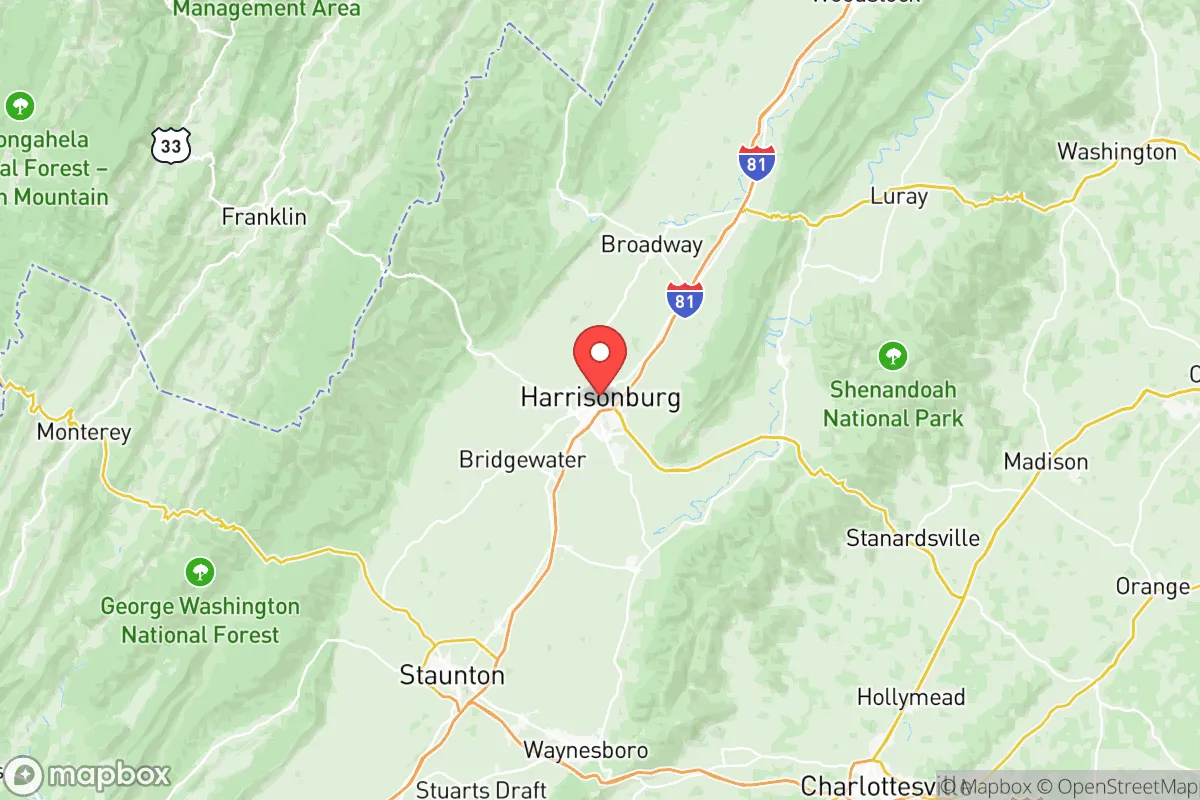
Photo by Anthony Chiado on Unsplash
Demographics of Harrisonburg City County
Affluence Level in Harrisonburg City County
A middle-class area roughly in line with national averages across income, home values, education, and employment.
People of Harrisonburg City County
Harrisonburg City County is a small, dense urban enclave of just over 51,000 residents, distinguished by its role as a regional trade and education hub. The city is notably diverse for inland Virginia, with a white population of 61.4%, a substantial Hispanic community of 23.1%, a Black population of 7.0%, and an East/Southeast Asian share of 2.4%, alongside a smaller Indian subcontinent community of 0.8%. Its character is shaped by a mix of longstanding Shenandoah Valley families, a large refugee and immigrant workforce tied to the poultry industry, and a transient student population drawn by James Madison University, giving the city a youthful, working-class, and distinctly multicultural feel.
Settlement & growth (pre-1960)
The region now known as Harrisonburg City County was originally inhabited by the Siouan-speaking Manahoac people, who were largely displaced or decimated by the Iroquoian-speaking Seneca and other groups during the Beaver Wars before European contact became sustained. By the early 1700s, the valley was a heavily contested hunting ground, and few Native settlements remained by the time German and Scotch-Irish settlers arrived. The first major European wave came in the 1730s and 1740s, when Scots-Irish Presbyterians moved south from Pennsylvania along the Great Wagon Road, drawn by fertile limestone soil and cheap land grants. They founded the original settlement of Harrisonburg itself in 1779, naming it after founder Thomas Harrison. A second early wave came with German-speaking Lutherans and Mennonites—often called "Pennsylvania Dutch"—who settled in the surrounding rural areas like Dayton and Bridgewater, establishing a tradition of small-scale agriculture and religious non-conformity that persists today. During the 19th century, enslaved African Americans made up roughly 20-25% of Rockingham County's population, working on grain and livestock farms, and after emancipation, many became sharecroppers or moved to Harrisonburg's emerging Black neighborhoods like the Northeast Neighborhood (near what is now Smithland Road). The post-Civil War era saw little new immigration, but the arrival of the Shenandoah Valley Railroad in the 1870s transformed Harrisonburg into a market and processing center for apples, poultry, and dairy, pulling in a small wave of Italian and Irish laborers who settled in working-class blocks near the rail yards. By the 1950s, Harrisonburg's population was overwhelmingly native-born white, with around 10-12% Black residents and only trace numbers of other groups, and the economy remained anchored in agriculture and the newly established James Madison University (then a teachers' college).
Modern era (post-1965)
The 1965 Hart-Cellar Act and subsequent refugee resettlement policies fundamentally reshaped Harrisonburg's demographics. The single largest modern wave began in the 1970s and accelerated through the 1990s, when the region's poultry industry—led by companies like Pilgrim's Pride and Cargill—actively recruited immigrant and refugee labor. The East/Southeast Asian community, now at 2.4% of the population, was among the first new groups, initially arriving as Vietnamese refugees after 1975, followed by Laotian and Hmong families in the 1980s, many settling in the Northwest Harrisonburg corridor near poultry plants. The Hispanic community, now the largest minority group at 23.1%, exploded from near zero in 1980 to a major presence by 2000, driven by Mexican and Central American migrants (primarily from Guatemala and El Salvador) seeking work in poultry processing, construction, and agriculture. These families concentrated heavily in the Lincoln Avenue area (often called "the Block") and the East Side neighborhoods around Vine Street and Cantrell Avenue, where Spanish-language churches, tiendas, and soccer leagues anchor daily life. The Indian subcontinent community, at just 0.8%, is smaller and more dispersed, largely composed of professionals and graduate students connected to James Madison University or Eastern Mennonite University, living in graduate housing or newer subdivisions near Port Republic Road. A smaller but notable population of Arab refugees (primarily Iraqi and Syrian families) arrived in the 2010s through resettlement programs. Meanwhile, domestic migration has been modest compared to Northern Virginia; Harrisonburg draws a steady stream of retirees from rural Virginia and lower-income families from the Shenandoah Valley, but has not experienced the explosive suburban growth seen in places like Chesterfield or Loudoun. Notably, the Black population declined from roughly 12% in 1970 to 7.0% today, as many families left for larger cities with more job opportunities or were displaced from longtime neighborhoods by rising rents and university expansion.
The future
Harrisonburg's population trajectory suggests continued diversification, driven primarily by the Hispanic community's higher birth rates and continued refugee and immigrant arrivals rather than by domestic in-migration. The Hispanic share, currently 23.1%, is projected to approach 30-35% by 2040, with the community increasingly dispersing from traditional enclaves like Lincoln Avenue into Dale Enterprise and Pleasant Hill areas as families seek larger homes and better schools. The East/Southeast Asian population is likely to grow slowly through secondary migration and JMU's modest international recruitment, while the Indian subcontinent population may expand as healthcare and tech-adjacent jobs increase, but both groups will remain comparatively small. The white population, now 61.4%, will slowly decline in share but remain the city's largest group, especially as the university maintains its majority-white student body. The more consequential shift may be economic: Harrisonburg is becoming more bifurcated between a college-educated professional class (36.7% hold a bachelor's degree or higher) and a largely immigrant working class, with less of the middle-income native-born base that characterized the mid-20th century. New affordable housing developments near Massanutten Avenue and the Enderly Heritage Area are beginning to scatter immigrant families across the city, reducing the concentration of traditional enclaves. For a family or individual moving in now, Harrisonburg offers a genuine multicultural small city that is far more diverse than most of rural Virginia, but one where economic integration lags behind demographic mixing.

* Values derived from national, state, county, city and local statistics and may differ in a specific area. Last updated: 2026-07-03T01:40:26.000Z
Narrative content on this page is AI-generated and may contain mistakes. Verify any details that matter before acting on them.
ReloMaps may earn a commission from affiliate links at no extra cost to you.

