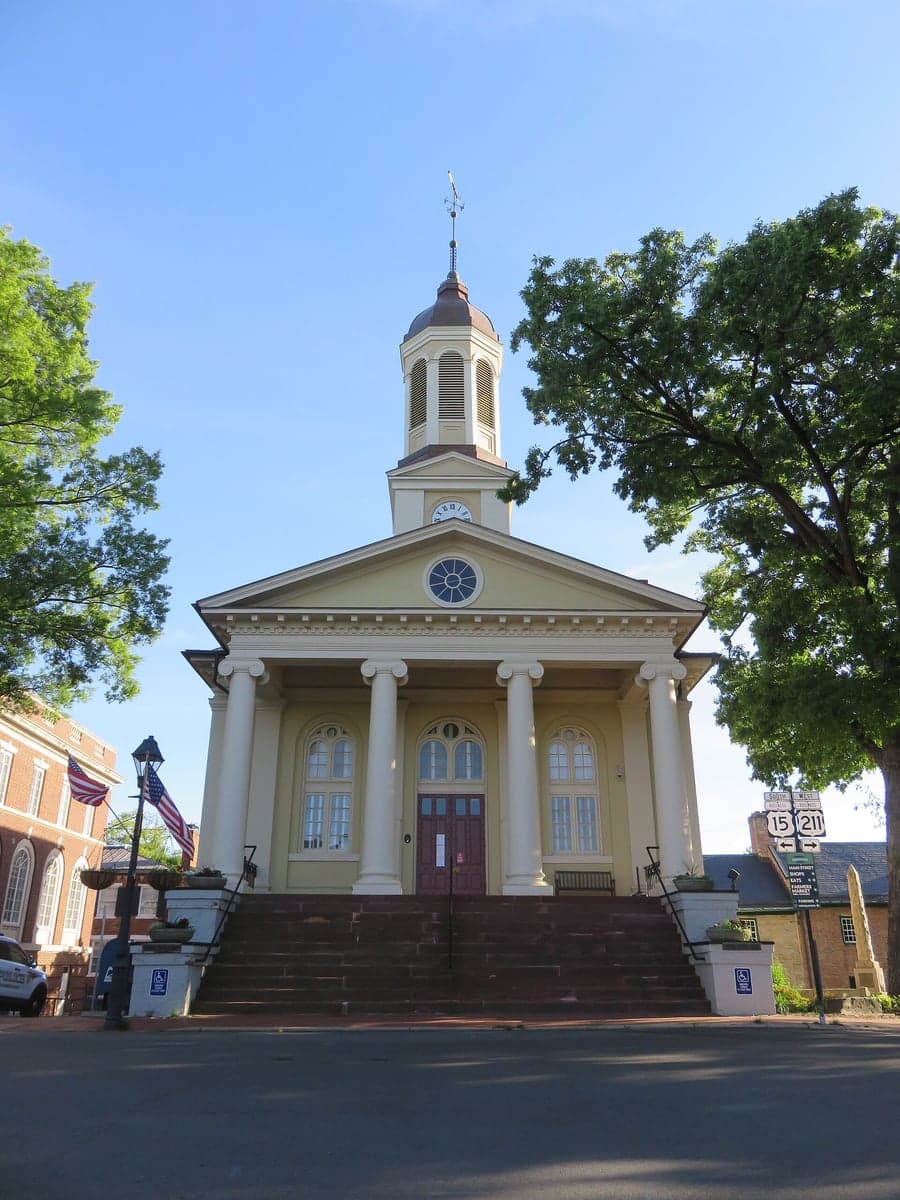
Photo: Wikipedia
Political ClimatePolitical Climate in Fauquier County
Showing district-level results — no local-only data available.
Local Political AnalysisPolitical Analysis of Fauquier County
Fauquier County has been shifting left in recent cycles, but it's still a place where the political temperature varies dramatically depending on which part of the county you're standing in. The county as a whole now carries a Cook PVI of D+6, meaning it leans six points more Democratic than the national average — a notable shift from its reliably red past. That puts it just a shade to the left of Virginia as a whole, which sits at D+4, but the county's politics are far from uniform. You'll find deep-red precincts in the rural western end and increasingly blue pockets in the eastern towns closer to the D.C. exurbs, making Fauquier a genuine bellwether for the broader Northern Virginia suburbanization trend.
How it compares
Fauquier's D+6 PVI is two points more Democratic than Virginia's statewide D+4, which might surprise people who remember when the county was a Republican stronghold. The difference is driven almost entirely by the eastern edge of the county, particularly around Warrenton and Bealeton, where new subdivisions have brought in younger families and telecommuters from D.C. who tend to vote blue. In the 2024 presidential race, Warrenton precincts like Lee District and Cedar Run swung Democratic by double digits, while western towns like Marshall and Upperville stayed solidly red. The county's trajectory mirrors what's happened in Loudoun and Prince William counties over the past two decades — just a phase behind. Virginia's statewide D+4 reflects the combined weight of deep-blue Northern Virginia, competitive Richmond suburbs, and redder rural areas like Southwest Virginia. Fauquier sits right in the middle of that tension, with its own internal divide between the exurban east and the agricultural west.
What this means for residents
For conservative residents, the shift means that local races are no longer automatic wins. School board and board of supervisors elections in districts covering Warrenton and Bealeton are now genuinely competitive, and Republican candidates have to work harder in the eastern precincts. For liberal residents, the change means they're no longer a fringe voice — there are active Democratic committees in Warrenton and a growing network of progressive neighbors, especially in the New Baltimore and Vint Hill areas. But the western part of the county, around Rectortown and Paris, remains deeply conservative, and the county's overall character still leans toward rural independence and limited government. The practical effect is that Fauquier has become a place where both sides have to show up and make their case, rather than assuming the outcome.
Culturally, the divide shows up in zoning debates, school funding votes, and land-use decisions. The eastern towns push for more housing and transit connections to Northern Virginia, while western residents fight to preserve agricultural easements and keep development at bay. The county's gun culture is still strong — open carry is common at the Fauquier County Fair and local gun shows — but Warrenton's town council has become more cautious about public safety ordinances. The bottom line: Fauquier is no longer a safe bet for either party, and that uncertainty is what makes it one of the more interesting political landscapes in Virginia right now.

State Political ClimatePolitical Climate in Virginia
State Political AnalysisPolitical Environment in the State
Virginia has shifted from a reliably purple swing state to a solidly Democratic-leaning one, carrying a Cook PVI of D+4. Over the past 20 years, the state has moved decisively leftward, driven primarily by the explosive growth of the Washington, D.C. suburbs in Northern Virginia. While the state still elects Republican governors in off-years (Glenn Youngkin in 2021), its presidential and U.S. Senate votes have gone Democratic in every cycle since 2008. The practical reality for a conservative relocating here is that you'll be living in a state where Democrats control the governorship, the state Senate, and the House of Delegates as of 2026, but where significant pockets of deep red territory and a strong rural conservative culture still exist.
Urban vs. rural divide
The political map of Virginia is a textbook study in urban-rural polarization. The entire Democratic majority is generated by three major population centers: Northern Virginia (Arlington, Alexandria, Fairfax, Loudoun, Prince William counties), the Richmond metro, and Hampton Roads (Virginia Beach, Norfolk, Chesapeake). These three regions alone account for over two-thirds of the state's population. Northern Virginia, in particular, is the engine of the state's leftward shift — it's a dense, highly educated, and increasingly diverse region where federal workers, tech professionals, and immigrants have created a deep-blue voting bloc. In contrast, Southwest Virginia (places like Bristol, Abingdon, and Wise County) and Southside Virginia (Danville, Martinsville) are deeply conservative, often voting 70-80% Republican. The Shenandoah Valley (Harrisonburg, Staunton, Winchester) is a mixed bag — the rural parts are red, but the college towns and growing suburbs are trending purple. The Richmond suburbs (Henrico, Chesterfield) have been steadily flipping blue, while the city itself is solidly Democratic. The key takeaway: where you live in Virginia determines your political experience more than almost any other state.
Policy environment
Virginia's tax structure is moderate compared to its neighbors. The state income tax is a flat rate of 5.75% (as of 2026), with a standard deduction of $8,000 for single filers. Sales tax is 5.3% statewide, but localities can add up to 1% more. Property taxes are set at the local level and vary widely — Loudoun County has some of the highest rates in the state, while Pittsylvania County is much lower. The regulatory posture is mixed: Virginia is a "Dillon Rule" state, meaning localities only have powers explicitly granted by the state legislature, which keeps local policy relatively uniform. Education policy has been a major flashpoint. Governor Youngkin pushed for expanded school choice and "parents' rights" in education, but the Democratic legislature has blocked most of his agenda. The state still has some of the strongest teacher unions in the South and has increased education funding significantly since 2020. Healthcare policy is similarly divided: Virginia expanded Medicaid under the Affordable Care Act in 2018, and the state has some of the strongest insurance regulations in the region. Election laws are moderately restrictive: Virginia has voter ID requirements (though a photo ID is not strictly required — a utility bill or bank statement works), no-excuse absentee voting, and same-day voter registration. The state does not have a "stand your ground" law, but it does have a "castle doctrine" and a shall-issue concealed carry permit system.
Recent policy direction
The last five years have seen Virginia swing back and forth on several key issues. On gun and self-defense law, the Democratic-controlled legislature passed a package of gun control measures in 2020, including universal background checks, a "red flag" law (extreme risk protection orders), and a one-handgun-per-month purchase limit. These remain in effect, though enforcement varies by locality. On parental and education rights, the Youngkin administration issued executive orders on "parents' rights" and critical race theory, but the Democratic legislature has blocked most legislative action. The state's public schools remain among the highest-rated in the South, but also among the most politically contested. On speech and privacy, Virginia passed the Consumer Data Protection Act in 2021, one of the strongest state-level privacy laws in the country. There is no state-level law protecting or restricting social media speech. On medical and bodily autonomy, Virginia has become a haven for abortion access in the region — the state has no gestational limit on abortion, and it passed a law in 2020 requiring insurance plans to cover abortion. This is a major draw for liberal relocators and a significant concern for conservatives. On property rights, Virginia is generally favorable to landowners, with strong protections against eminent domain abuse and a robust right-to-farm law. On taxation, the trend has been toward modest cuts — the flat income tax rate was reduced from 5.75% to 5.5% in 2023, though it reverted back to 5.75% in 2025 after a sunset provision. On voting and ballot access, Virginia has expanded early voting and no-excuse absentee voting, but has not gone as far as states like Oregon or Colorado. The overall direction is a state that is slowly but steadily moving left on social and cultural issues, while remaining relatively moderate on economic and property rights issues.
Civil unrest & political movements
Virginia has been a flashpoint for political conflict in recent years. The 2017 Unite the Right rally in Charlottesville remains the most infamous event, a violent white nationalist gathering that resulted in the death of counter-protester Heather Heyer. That event reshaped Virginia politics, galvanizing Democratic turnout and leading to the removal of Confederate monuments across the state. The 2020 protests over George Floyd's murder were particularly intense in Richmond, where protesters toppled statues on Monument Avenue and clashed with police. On the right, the 2021 "parents' rights" movement was born in Virginia, with Loudoun County becoming a national symbol of school board conflicts over critical race theory, transgender policies, and COVID-19 restrictions. That movement propelled Glenn Youngkin to the governorship. Immigration politics are less heated than in border states, but Northern Virginia's sanctuary city policies (Fairfax County, Arlington, Alexandria) have been a point of contention. Election integrity controversies have been relatively muted compared to other swing states — Virginia's 2020 election was widely seen as well-administered, and there have been no major fraud allegations that gained traction. The state's secession or nullification rhetoric is minimal, though there is a small but vocal movement in Southwest Virginia to join West Virginia, which has gone nowhere. A new resident would notice the political polarization most acutely in the suburbs — yard signs, bumper stickers, and local news coverage are heavily partisan, and it's common to see both "Let's Go Brandon" and "In This House We Believe" signs within the same neighborhood in places like Chesterfield County or Spotsylvania County.
Projection
Over the next 5-10 years, Virginia will continue to trend Democratic, but the pace may slow. The key demographic driver is Northern Virginia, which is growing faster than the rest of the state and is becoming more diverse and more liberal with each cycle. The Richmond suburbs are also flipping blue, and Hampton Roads is becoming more competitive as military families and defense contractors shift toward the center. However, there are countervailing trends. The exurban counties like Loudoun and Prince William are seeing an influx of conservative-leaning families priced out of the inner suburbs, which could create a more competitive environment in the long run. The Shenandoah Valley is growing as a destination for remote workers and retirees, which could shift its politics toward the center. The biggest wild card is the 2025 gubernatorial election — if a Republican wins, it would signal that the state is still competitive at the state level. But the structural trend is clear: Virginia is becoming a safe Democratic state for federal elections, with a competitive but left-leaning state government. A conservative moving in now should expect to live in a state where Democratic policies on abortion, gun control, and education are the norm, but where local control in rural areas still allows for a conservative lifestyle. A liberal moving in will find a state that is increasingly aligned with their values, especially in the urban centers.
For a new resident, the bottom line is this: Virginia is a state of stark political contrasts. Your day-to-day experience will depend almost entirely on which county you choose. If you're a conservative looking for a place where your values are reflected in local government, look at Southwest Virginia, the Shenandoah Valley, or the exurban counties like Hanover or Stafford. If you're a liberal, Northern Virginia, Richmond city, or Charlottesville will feel like home. The state's tax burden is moderate, its schools are excellent, and its economy is strong — but the political climate is increasingly polarized, and that polarization is only going to deepen. Choose your locality carefully, and you'll find a community that fits. Choose blindly, and you may find yourself in a political environment that feels foreign.
* Values derived from national, state, county, city and local statistics and may differ in a specific area. Last updated: 2026-07-26T14:59:00.000Z
Narrative content on this page is AI-generated and may contain mistakes. Verify any details that matter before acting on them.
ReloMaps may earn a commission from affiliate links at no extra cost to you.

