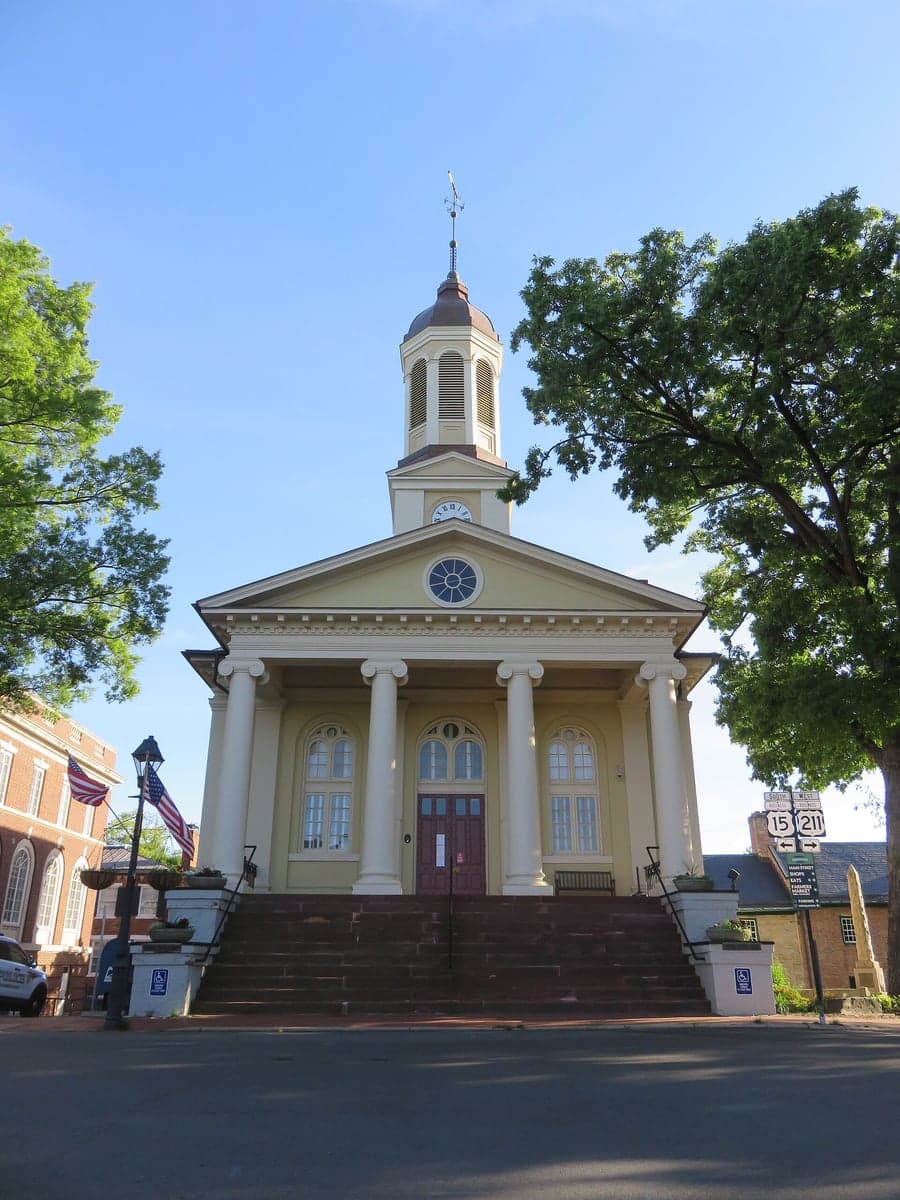
Photo: Wikipedia
Demographics of Fauquier County
Affluence Level in Fauquier County
An upper-middle-class area. Household wealth, education levels, and homeownership run ahead of national benchmarks.
People of Fauquier County
Today, Fauquier County is home to 73,935 residents who live across a landscape of historic towns, horse farms, and expanding subdivisions. The county retains a distinctly rural and conservative character, with a population that is 75.7% white and 11.7% Hispanic, while 39.7% of adults hold a college degree. Its identity is shaped by a deep equestrian tradition, a working agricultural base, and a growing commuter population drawn to towns like Warrenton, The Plains, and Marshall. The foreign-born share stands at just 4.1%, well below the national average, reflecting a population that has been shaped more by domestic migration than by international immigration.
Settlement & growth (pre-1960)
Long before European settlers arrived, the area now known as Fauquier County was the homeland of the Siouan-speaking Manahoac people, who lived along the Rappahannock River and its tributaries. By the early 1700s, the Manahoac had been largely displaced by disease and conflict, and English colonists from Virginia's Tidewater region began pushing westward into the Piedmont. The Virginia General Assembly created Fauquier County in 1759 from a portion of Prince William County, naming it after Francis Fauquier, the colony's lieutenant governor. The earliest European settlers were primarily of English ancestry, taking up land grants in the fertile valleys around what would become Warrenton, the county seat established in 1790.
Through the 18th and early 19th centuries, the population grew slowly as English and Scots-Irish farmers established plantations and small farms. The county's location along the Rappahannock River and key stagecoach routes made towns like Warrenton, Remington, and The Plains natural centers for trade and agriculture. By 1850, enslaved African Americans made up roughly 40% of the county's population, working on tobacco and grain plantations. After the Civil War, many freedmen remained in the county, forming communities in areas like the Black Hill neighborhood of Warrenton and in the rural crossroads of Hume and Orlean. The post-Reconstruction period saw little new immigration; Fauquier remained an overwhelmingly native-born, white and Black agricultural county through the early 1900s.
The arrival of the railroad in the late 19th century spurred modest growth in towns like Marshall and Remington, but the county's population remained stable through the Great Depression and World War II. The mid-20th century brought the first significant wave of domestic in-migration: Washington, D.C., professionals and military families began purchasing farm estates and weekend homes in the rolling hills around Warrenton and Upperville. The county's horse country reputation, anchored by the Upperville Colt & Horse Show (founded 1853), attracted wealthy buyers from the Northeast. By 1960, the population had reached roughly 24,000, still overwhelmingly white and native-born, with a small but established Black population concentrated in historic settlements.
Modern era (post-1965)
The 1965 Hart-Cellar Act had a limited direct effect on Fauquier County, as the region never became a primary destination for post-1965 immigrant groups. Unlike Northern Virginia's closer-in suburbs, Fauquier remained largely untouched by the waves of Vietnamese, Korean, and Indian immigration that reshaped Fairfax and Loudoun counties. Instead, the county's modern demographic story is one of domestic migration: from the 1970s onward, families and retirees from the Washington, D.C., metro area moved outward in search of larger lots, lower taxes, and a rural lifestyle. This exurban growth concentrated most heavily in Warrenton, which grew from a small county seat into a commuter hub, and along the Interstate 66 corridor through Marshall and The Plains.
Hispanic population growth began in the 1990s and accelerated through the 2000s, driven primarily by Mexican and Central American immigrants who came for work in the county's construction, landscaping, and equestrian industries. Today, Hispanic residents make up 11.7% of the population, the largest minority group, with concentrations in Warrenton and in the more rural areas around Remington and Bealeton. The Black population, which stood at roughly 15% in 1970, has declined to 6.2% as younger Black residents moved toward urban job centers in Northern Virginia and beyond. East and Southeast Asian residents account for 1.1% of the population, and Indian-subcontinent residents 0.6%, both groups small and dispersed rather than concentrated in ethnic enclaves. The foreign-born share of 4.1% is roughly one-third the national average, underscoring the county's limited role as an immigrant destination.
Suburbanization reshaped the county's built environment and social character. The development of planned communities like the Vint Hill area, a former Army intelligence base converted into a mixed-use community after 1997, brought new families and a slightly more diverse population to eastern Fauquier. Bealeton and New Baltimore have seen the most rapid residential growth, with new subdivisions attracting commuters willing to trade a longer drive to D.C. for more affordable housing. The county's political character has remained reliably conservative, with Republican candidates consistently winning local and national elections, though the growing exurban population has introduced a more moderate, fiscally conservative strain to local politics.
The future
Fauquier County's population is projected to continue growing slowly, driven primarily by domestic migration from the Washington, D.C., region rather than by international immigration. The county's Hispanic share is likely to increase gradually, as younger Hispanic families have higher birth rates and as the construction and service sectors continue to attract workers. The white share, while still dominant, will edge downward as the county diversifies, though Fauquier will remain far less diverse than neighboring Prince William or Loudoun counties. The Black population share is expected to remain stable or decline slightly, as the county does not have the urban job base or cultural institutions that attract Black in-migrants to other parts of Virginia.
New residential development will concentrate in the eastern end of the county, particularly around Bealeton, Vint Hill, and New Baltimore, where land is cheaper and commuter access to Interstate 66 is strongest. The western horse country around Upperville, Middleburg, and The Plains will remain protected by large-lot zoning and conservation easements, limiting population growth and preserving the county's rural character. The cultural identity of Fauquier is likely to become a blend of its traditional agricultural and equestrian roots with the suburban sensibilities of incoming exurbanites, a tension visible in local debates over development, school funding, and land use. For someone moving in now, Fauquier offers a conservative, rural-leaning lifestyle within commuting distance of Washington, D.C., with a population that is slowly diversifying but remains overwhelmingly native-born and English-speaking.

* Values derived from national, state, county, city and local statistics and may differ in a specific area. Last updated: 2026-07-26T14:59:00.000Z
Narrative content on this page is AI-generated and may contain mistakes. Verify any details that matter before acting on them.
ReloMaps may earn a commission from affiliate links at no extra cost to you.

