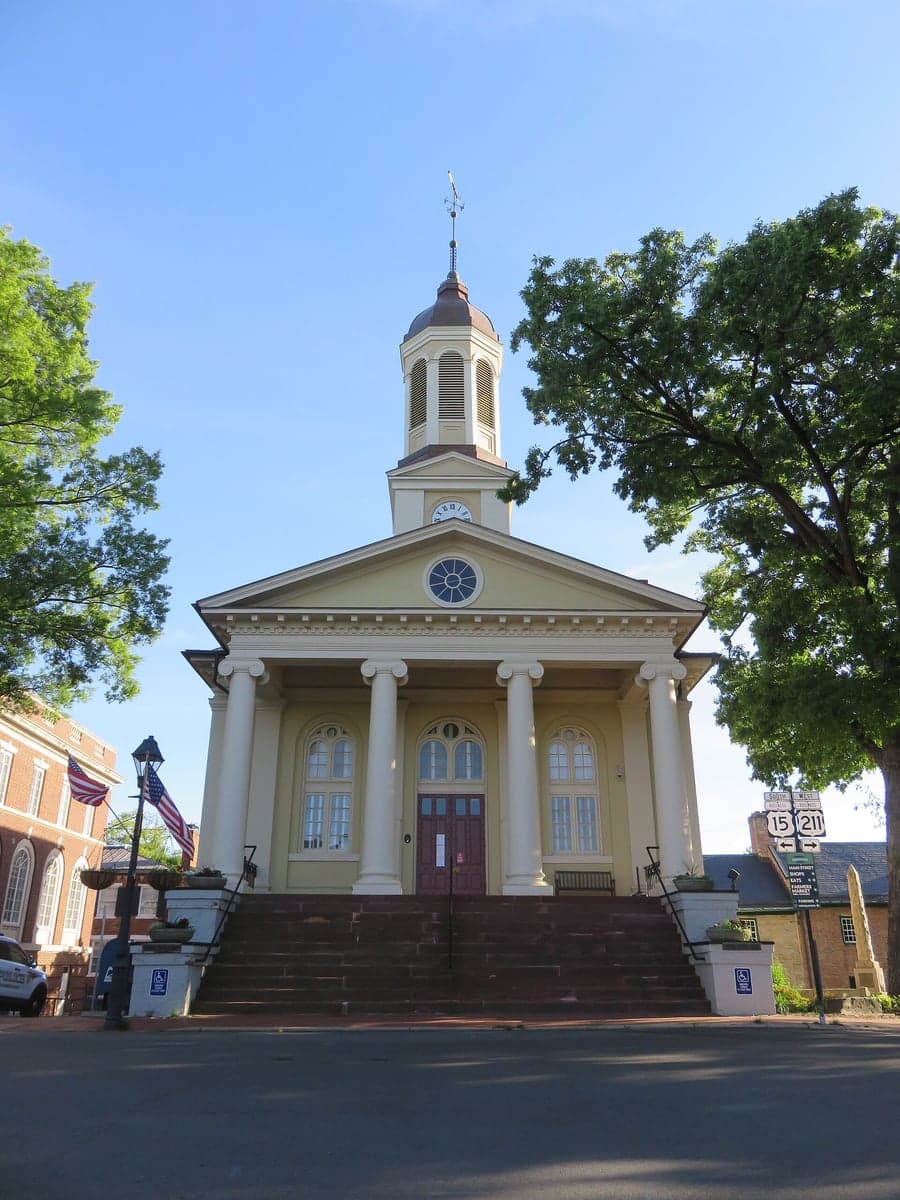
Photo: Wikipedia
Personal Sovereignty in Fauquier County
Viable for self-reliance. Generally workable, though some barriers may limit total independence.
What does Personal Sovereignty tell us?
Personal Sovereignty measures your capacity for self-reliance and independence with minimal government friction. Higher scores mean fewer barriers between you and the way you want to live... but it assumes you have the space you need and good neighbors.
What does this tell us?
Personal Sovereignty measures your capacity for self-reliance and independence with minimal government friction. Higher scores mean fewer barriers between you and the way you want to live... but it assumes you have the space you need and good neighbors.
State Policy
Energy independence: Importer (20% of energy produced in-state)
Personal Liberty
Homesteading

Personal Liberty Analysis
Fauquier County, Virginia, offers a notably high degree of personal sovereignty relative to the densely regulated urban corridors of Northern Virginia, striking a balance between rural independence and proximity to federal power. The county’s regulatory environment, tax structure, and cultural norms around self-defense and self-reliance create a landscape where individuals and families can exercise significant autonomy over their daily lives. While not a libertarian free-for-all, Fauquier consistently ranks as one of the more freedom-oriented counties in the Commonwealth, particularly when compared to neighboring Prince William or Loudoun counties.
Tax burden and regulatory posture in Fauquier County
Fauquier County maintains a relatively light tax burden compared to its Northern Virginia neighbors, with a real property tax rate of approximately $0.52 per $100 of assessed value as of 2025, significantly lower than Loudoun County’s $0.87 or Prince William’s $0.96. The county operates under Virginia’s Dillon Rule, meaning local governments only exercise powers expressly granted by the state, which limits the ability of county supervisors to impose novel regulations or taxes without General Assembly approval. This creates a more predictable regulatory environment for homeowners and small business owners. The county’s comprehensive plan emphasizes preserving agricultural and rural character, which translates to fewer zoning overrides and less aggressive code enforcement in unincorporated areas like Marshall, Rectortown, and Upperville. Business licensing requirements are straightforward, with no county-level business license tax for most small operations, and the county does not impose a meals tax or a personal property tax on household goods, unlike many incorporated towns in the region.
Self-defense and gun law specifics in Fauquier County
Virginia is a shall-issue state for concealed handgun permits, and Fauquier County’s circuit court processes applications efficiently, typically within 45 days. The county is home to several active gun clubs and shooting ranges, including the Fauquier County Shooting Range near Warrenton and the Blue Ridge Hunt Club near Paris, reflecting a deeply ingrained firearms culture. Open carry is legal without a permit for anyone 18 or older who can legally possess a firearm, and the county sheriff’s office is publicly supportive of Second Amendment rights. Fauquier does not impose any county-specific restrictions on magazine capacity, firearm types, or storage requirements beyond state law. The towns of Warrenton, Remington, and The Plains have no local ordinances restricting firearms in public spaces, though carrying in government buildings is prohibited by state statute. Stand-your-ground laws apply statewide, and Fauquier juries have historically been sympathetic to self-defense claims, with no notable cases of prosecutorial overreach in justified shootings in recent years.
Self-reliance and homesteading viability in Fauquier County
Fauquier County’s zoning code strongly supports agricultural and rural land uses, making it one of the more homestead-friendly jurisdictions in Northern Virginia. Minimum lot sizes in the Agricultural (A-1) district are 10 acres, with many parcels in the western part of the county, around Orlean and Hume, exceeding 20 acres. Raising livestock, keeping chickens, beekeeping, and operating small-scale farms are permitted by right in agricultural zones without special use permits. Off-grid living is feasible but requires adherence to state building codes; the county does not mandate connection to municipal water or sewer in rural areas, and private wells and septic systems are standard. Solar panels are allowed by right on residential properties, though the county’s historic preservation overlay districts in areas like Middleburg (which straddles Fauquier and Loudoun) impose aesthetic restrictions. Rainwater collection is legal without a permit for non-potable uses. The county’s extension office offers robust support for small-scale agriculture, including soil testing, livestock management workshops, and farm business planning resources.
Personal liberties in Fauquier County: parental rights, medical autonomy, speech, and property
Fauquier County Public Schools operate under a school board that has consistently emphasized parental involvement and transparency, with policies allowing parents to opt their children out of specific instructional materials and health curricula without penalty. The county does not have any local ordinances restricting medical freedom beyond state licensure requirements, and several integrative health practitioners operate in Warrenton and Catlett. Free speech is protected under standard First Amendment jurisprudence, and the county has not enacted any local hate speech or public assembly restrictions beyond state law. Property rights are robust, with the county’s zoning administrator generally deferring to landowners’ reasonable use of their property, and the board of supervisors has a track record of opposing state-level land use preemptions. The county’s comprehensive plan explicitly states that “private property rights shall be respected and protected,” and eminent domain is rarely exercised outside of utility easements. Home-based businesses are permitted by right in most residential zones, provided they do not generate excessive traffic or noise, which supports entrepreneurial independence.
Overall, Fauquier County offers a level of personal sovereignty that is increasingly rare in the Washington, D.C., metropolitan area. For individuals and families who prioritize self-reliance, firearm rights, and minimal government interference in daily life, the county presents a compelling option that balances rural freedom with reasonable access to urban employment centers. While not as permissive as some western states or deep-rural Virginia counties like Highland or Bath, Fauquier’s combination of low taxes, pro-Second Amendment culture, homestead-friendly zoning, and respect for parental and property rights places it among the top tier of freedom-oriented jurisdictions within a two-hour drive of the nation’s capital.

* Values derived from national, state, county, city and local statistics and may differ in a specific area. Last updated: 2026-07-26T14:59:00.000Z
Narrative content on this page is AI-generated and may contain mistakes. Verify any details that matter before acting on them.
ReloMaps may earn a commission from affiliate links at no extra cost to you.

