Photo: Wikipedia
Quality of Life in Fairfax County
A livable area that tracks near national norms for affordability, walkability, and neighborhood health.
What does Quality of Life tell us?
Quality of Life measures an area by evaluating factors like cost of living, nearby amenities, country club access, airport proximity, socioeconomic signals and neighborhood character. For large states, this is a general average — quality of life can vary dramatically between metro areas, suburbs, and rural communities within the same state.
What does this tell us?
Quality of Life measures an area by evaluating factors like cost of living, nearby amenities, country club access, airport proximity, socioeconomic signals and neighborhood character. For large states, this is a general average — quality of life can vary dramatically between metro areas, suburbs, and rural communities within the same state.
Cost of Living
114% above national average
75%
The Real Cost of Living in Fairfax County for 2026
| Tier | Individual | Family (4) |
|---|---|---|
| Survival | $36k | $67k |
| Comfortable | $136k | $200k |
| Luxury | $247k+ | $382k+ |
| Elite (Top 5%) | $290k+ | $450k+ |
Quality-of-Life Analysis
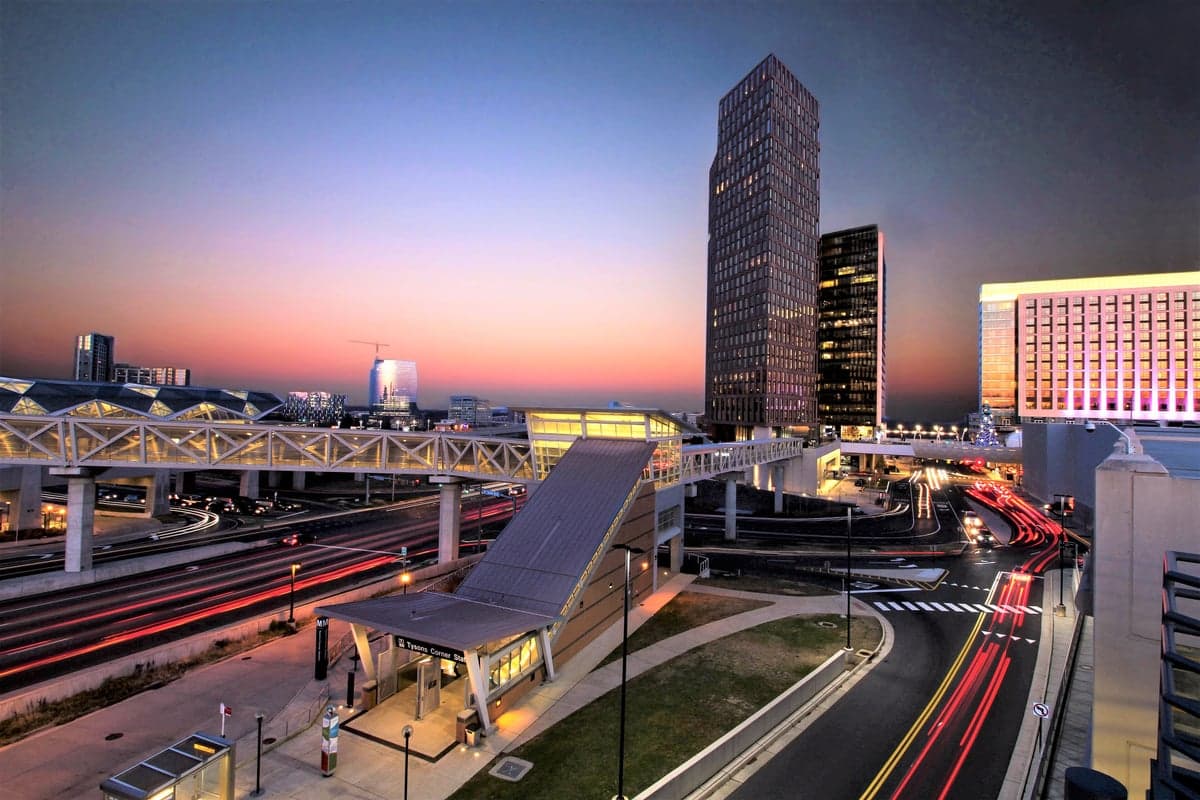
Fairfax County, Virginia, presents a wide spectrum of quality-of-life options, from dense, transit-oriented urban centers to quiet, semi-rural enclaves, all within a single jurisdiction. The county draws a diverse population: young professionals and government contractors gravitate to the walkable, high-rise hubs of Tysons and Reston, while families and long-time residents seek out the established neighborhoods of Vienna, McLean, and the more pastoral settings of Clifton and Great Falls. With a cost of living index of 214 (double the national average), a median home value of $699,700, and a median rent of $2,230, the county demands a premium for its proximity to Washington, D.C., top-ranked schools, and robust job market.
Largest town(s) & population centers
The county's largest population centers are not independent cities but unincorporated communities that function as major urban hubs. Tysons, the central business district, is a dense, high-rise landscape of corporate headquarters (including Hilton, Booz Allen Hamilton, and Capital One), luxury apartments, and the Tysons Corner Center and Tysons Galleria malls. Daily life here is defined by the Silver Line Metro, heavy traffic, and a 24/7 urban energy. Reston, a planned community, offers a more balanced mix of high-density living around its town center and Metro stations, with extensive bike paths, lakes, and village centers. Annandale and Bailey's Crossroads are highly diverse, bustling corridors known for their international restaurants (especially Korean in Annandale) and more affordable, older garden apartments. The average commute across the county is 29.5 minutes, though residents in these core areas often have shorter trips if working within the county or taking Metro into D.C.
Smaller towns & rural pockets
Despite its suburban reputation, Fairfax County retains distinct smaller towns and rural pockets that offer a markedly different pace of life. Clifton is the county's most notable rural village, a historic, unincorporated community with no streetlights, a single general store, and large horse farms along Clifton Road. Great Falls, while affluent, is characterized by large-lot estates, wooded conservation areas, and direct access to the Potomac River's Great Falls Park, offering a semi-rural, equestrian-oriented lifestyle. Vienna and Oakton function as classic suburban towns with walkable historic centers (Vienna's Church Street and Maple Avenue), single-family homes on tree-lined streets, and a strong sense of community distinct from the high-rise corridors. Burke and Springfield offer more middle-density suburban living with extensive townhouse developments and older single-family homes, anchored by the Springfield Town Center and the Franconia-Springfield Metro station.
Cost & lifestyle range
The cost and lifestyle range across Fairfax County is dramatic, even within a few miles. At the high end, McLean and Great Falls consistently rank among the wealthiest communities in the U.S., with median home values well above the county's $699,700 average, often exceeding $1.5 million for single-family homes. These areas offer large lots, top-tier public schools (Langley and McLean High Schools), and low crime rates, but require a car for nearly every errand. At the more accessible end, Annandale, Bailey's Crossroads, and parts of Lincolnia offer older, smaller homes and garden apartments with median rents closer to the county's $2,230 average, and a higher density of rental units. Reston and Herndon provide a middle ground: Reston's planned communities offer a mix of townhomes and condos near Metro, while Herndon's historic downtown and more modest single-family homes provide a slightly lower entry point than McLean or Vienna. The lifestyle spectrum ranges from car-free urban living in Tysons to car-dependent suburban and rural life in Clifton and Great Falls.
Who thrives in Fairfax County? The county best serves professionals and families who prioritize exceptional public schools, proximity to federal government and tech jobs, and diverse cultural amenities, and who have the financial means to afford the high cost of living. It is less suited for those seeking a low-cost, slow-paced rural lifestyle or a dense, walkable urban core on par with D.C. or Arlington. The county's strength lies in its variety: a young professional can live in a Tysons high-rise and walk to the Metro, while a family can raise children on a horse farm in Clifton, both within the same county lines and school system.

Crime in Fairfax County
Generally safer than 60% of comparable U.S. locations.
Violent CrimeViolent Crime Analysis
Property CrimeProperty Crime Analysis
Crime Analysis
Fairfax County, Virginia, maintains a safety profile that is notably better than the national average, though property crime remains a more common concern than violent incidents. With a violent crime rate of 209 per 100,000 residents and a property crime rate of 1,389.4 per 100,000, the county offers a generally secure environment, particularly in its western and southern communities. However, the county’s proximity to Washington, D.C., and its dense urban corridors in places like Tysons, Reston, and Annandale introduce localized crime patterns that residents should understand before relocating.
Crime in context
Fairfax County’s violent crime rate of 209 per 100,000 is roughly 40% lower than the national average of 380 per 100,000, and well below the Virginia state average of 240 per 100,000. Property crime, at 1,389.4 per 100,000, also falls below the national figure of 1,954 per 100,000, though it is slightly elevated compared to the Virginia state rate of 1,250 per 100,000. The county benefits from a well-funded police department and a relatively affluent tax base, which supports community policing and crime prevention programs. However, the broader Northern Virginia region has seen a rise in organized retail theft and vehicle-related property crimes since 2020, trends that are most pronounced in commercial hubs like Tysons Corner Center and the Springfield Town Center.
What residents experience
For most residents, daily life in Fairfax County feels safe, with the most common crimes being larceny, vehicle break-ins, and package theft. Violent crime is rare but not absent: aggravated assault accounts for roughly 60% of all violent incidents, while robberies and homicides are concentrated in specific areas. The county’s progressive judicial philosophy, particularly under Commonwealth’s Attorney Steve Descano (elected in 2019), has drawn criticism for prioritizing diversion programs and reduced sentencing for non-violent offenders. Critics argue this approach has contributed to a perception of leniency that emboldens repeat property offenders, especially in areas like Bailey’s Crossroads and Seven Corners, where police reports show higher rates of car theft and shoplifting. Residents in these neighborhoods often report feeling that the justice system’s focus on rehabilitation over incarceration fails to deter chronic offenders, leading to frustration with the county’s response to quality-of-life crimes.
Neighborhood-level variation
Safety in Fairfax County varies significantly by location. The western communities of Great Falls, Vienna, and McLean consistently rank among the safest in the region, with violent crime rates below 100 per 100,000 and property crime rates under 800 per 100,000. These areas benefit from lower population density, higher median incomes, and robust neighborhood watch programs. In contrast, the eastern and central corridors—including Annandale, Falls Church, and the Route 1 corridor near Hybla Valley and Mount Vernon—experience higher crime rates, particularly for property offenses. Annandale, for example, has a property crime rate approaching 2,200 per 100,000, driven by its dense commercial strip and proximity to major transit routes. The Route 1 area, which includes parts of the Franconia and Lorton districts, also sees elevated rates of vehicle theft and burglary, partly due to its mix of older apartment complexes and retail centers. For families and professionals considering a move, choosing a neighborhood west of I-495 or in the southern part of the county (e.g., Clifton, Burke) offers the lowest crime exposure, while areas near the county’s urbanized edges require more vigilance, especially regarding property security.
* Values derived from national, state, county, city and local statistics and may differ in a specific area. Last updated: 2026-06-15T20:50:45.000Z
Narrative content on this page is AI-generated and may contain mistakes. Verify any details that matter before acting on them.
ReloMaps may earn a commission from affiliate links at no extra cost to you.

