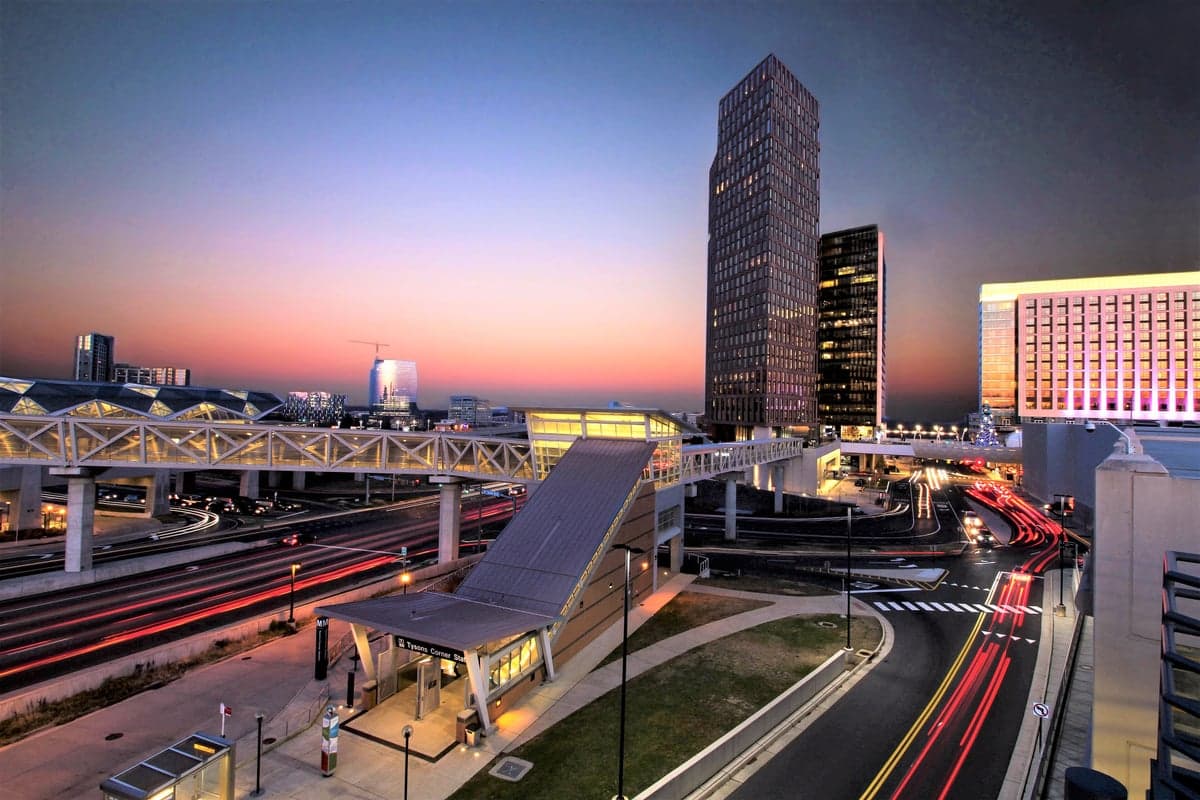
Photo: Wikipedia
Demographics of Fairfax County
Affluence Level in Fairfax County
An upper-middle-class area. Household wealth, education levels, and homeownership run ahead of national benchmarks.
People of Fairfax County
Fairfax County, Virginia, is home to over 1.14 million residents, making it the most populous jurisdiction in the state and a dense, highly educated suburban powerhouse directly west of Washington, D.C. The county’s identity is defined by its blend of historic small towns, sprawling post-war suburbs, and a rapidly diversifying population where no single racial or ethnic group holds a majority. With a foreign-born population of 12.1% and a college attainment rate of 64.3%, the people of Fairfax County are characterized by professional ambition, global connectivity, and a political culture that leans moderate to liberal, though conservative pockets remain in older communities like Vienna and Clifton.
Settlement & growth (pre-1960)
Before European colonization, the land now called Fairfax County was inhabited by Algonquian-speaking tribes, most notably the Doeg and the Tauxenent, who lived in villages along the Potomac River and its tributaries. English settlers began arriving in the mid-1600s, drawn by the Chesapeake tobacco economy and land grants from the Crown. By the 1700s, the region was a patchwork of tobacco plantations worked by enslaved Africans, with key settlements emerging at Alexandria (founded 1749) and Falls Church (established 1734). The county was formally created in 1742 from Prince William County, named after Thomas Fairfax, the proprietor of the Northern Neck land grant.
Through the 18th and 19th centuries, the population remained overwhelmingly rural and Anglo-American, with enslaved Black people making up a significant share—about 30% of the county’s residents by 1790. The Civil War devastated the area, as Fairfax County sat on the front lines between Union and Confederate forces, leading to widespread destruction and population stagnation. After Reconstruction, the economy slowly shifted from tobacco to dairy farming and small-scale commerce, but growth remained tepid. By 1900, the county’s population was just over 30,000, with most residents concentrated in villages like Vienna, Herndon, and Centreville.
The first major growth spurt came with the federal government’s expansion during the New Deal and World War II. The construction of the Pentagon in Arlington (1941) and the relocation of defense agencies to the region drew thousands of white-collar workers from across the country. Suburban development exploded after 1945, with returning GIs and their families moving into newly built subdivisions in Annandale, Bailey’s Crossroads, and McLean. This wave was overwhelmingly white, native-born, and middle-class, laying the foundation for Fairfax County’s reputation as a bedroom community for federal employees and contractors. By 1960, the population had surged to 250,000, but the county remained 95% white.
Modern era (post-1965)
The 1965 Hart-Cellar Immigration Act fundamentally reshaped Fairfax County’s demographics, as did the concurrent expansion of the federal government and the technology sector. The first major non-European wave came from East and Southeast Asia, driven by the Vietnam War’s aftermath and U.S. foreign policy ties. Vietnamese refugees began arriving in the late 1970s, settling in Falls Church and Annandale, where the Eden Center shopping plaza became a cultural anchor. By the 1990s, Korean and Chinese immigrants followed, drawn by the county’s excellent public schools and professional job market. Today, East and Southeast Asian communities make up 13.0% of the population, with significant concentrations in Chantilly and Centreville, where Asian-owned businesses and places of worship are prominent.
Indian immigration accelerated after the 1990s, fueled by the H-1B visa program and the booming tech corridor along the Dulles Toll Road. Indian Americans now account for 6.9% of the county’s residents, with large enclaves in Herndon, Reston, and Ashburn (the latter technically in Loudoun County but closely tied to Fairfax’s economy). These communities are among the most educated and affluent in the region, with many working in IT, engineering, and healthcare. The Hispanic population, now 17.4%, grew steadily from the 1980s onward, driven by immigration from Central America (especially El Salvador) and domestic migration from other U.S. states. Hispanic residents are dispersed across the county but have notable concentrations in Alexandria (the Arlandria neighborhood) and Herndon, where Spanish-language churches and bodegas are common.
The Black population, at 9.6%, includes both long-standing African American families—descendants of the county’s historic Black communities in Gum Springs and Falls Church—and newer arrivals from the Caribbean and Africa. Domestic migration from the Rust Belt and the Northeast has slowed since 2000, but Fairfax County continues to attract professionals from across the United States, drawn by its high-paying jobs in defense, cybersecurity, and consulting. Suburbanization has deepened, with once-rural areas like Lorton and Franconia now fully built out with townhouses and apartment complexes. The county’s white population, now 47.5%, has declined from 70% in 1990, as older generations age in place and younger, more diverse families move in.
The future
Fairfax County is projected to become even more diverse over the next two decades. The white population is expected to fall below 40% by 2040, while the Hispanic and Asian shares will continue to rise, driven by both immigration and higher birth rates among younger families. The Indian subcontinent population, in particular, is growing rapidly, with new arrivals settling in Reston and Herndon as the tech sector expands. East and Southeast Asian communities are dispersing from older enclaves like Annandale into newer suburbs such as Fairfax Station and Burke, reflecting upward mobility. The county’s foreign-born share, currently 12.1%, is likely to increase modestly, though domestic migration from expensive coastal cities (New York, San Francisco) may offset some of that growth.
Culturally, Fairfax County is becoming a polyglot, globally oriented suburb where English is the lingua franca but dozens of languages are spoken in homes and businesses. The county’s school system, already one of the nation’s best, is adapting to serve a student body that is 30% Hispanic and 20% Asian. Political tensions may rise as the county’s liberal tilt clashes with conservative-leaning state policies, but the overall trajectory is toward greater integration and economic stratification—newcomers tend to be highly educated and affluent, while longer-term residents in older neighborhoods face rising housing costs. The next 10-20 years will likely see continued infill development, with townhouses and apartments replacing single-family homes in transit corridors like the Silver Line metro extension.
For someone moving to Fairfax County now, the area offers a dense, diverse, and opportunity-rich environment where professional success is common but affordability is a growing challenge. The county is no longer a sleepy white suburb—it is a global hub of talent and culture, where a Vietnamese pho shop sits next to a Salvadoran pupusería and a Korean megachurch, all within a mile of a Fortune 500 defense contractor. The people of Fairfax County are its greatest asset: educated, ambitious, and increasingly representative of the world beyond America’s borders.

* Values derived from national, state, county, city and local statistics and may differ in a specific area. Last updated: 2026-06-15T20:50:45.000Z
Narrative content on this page is AI-generated and may contain mistakes. Verify any details that matter before acting on them.
ReloMaps may earn a commission from affiliate links at no extra cost to you.

